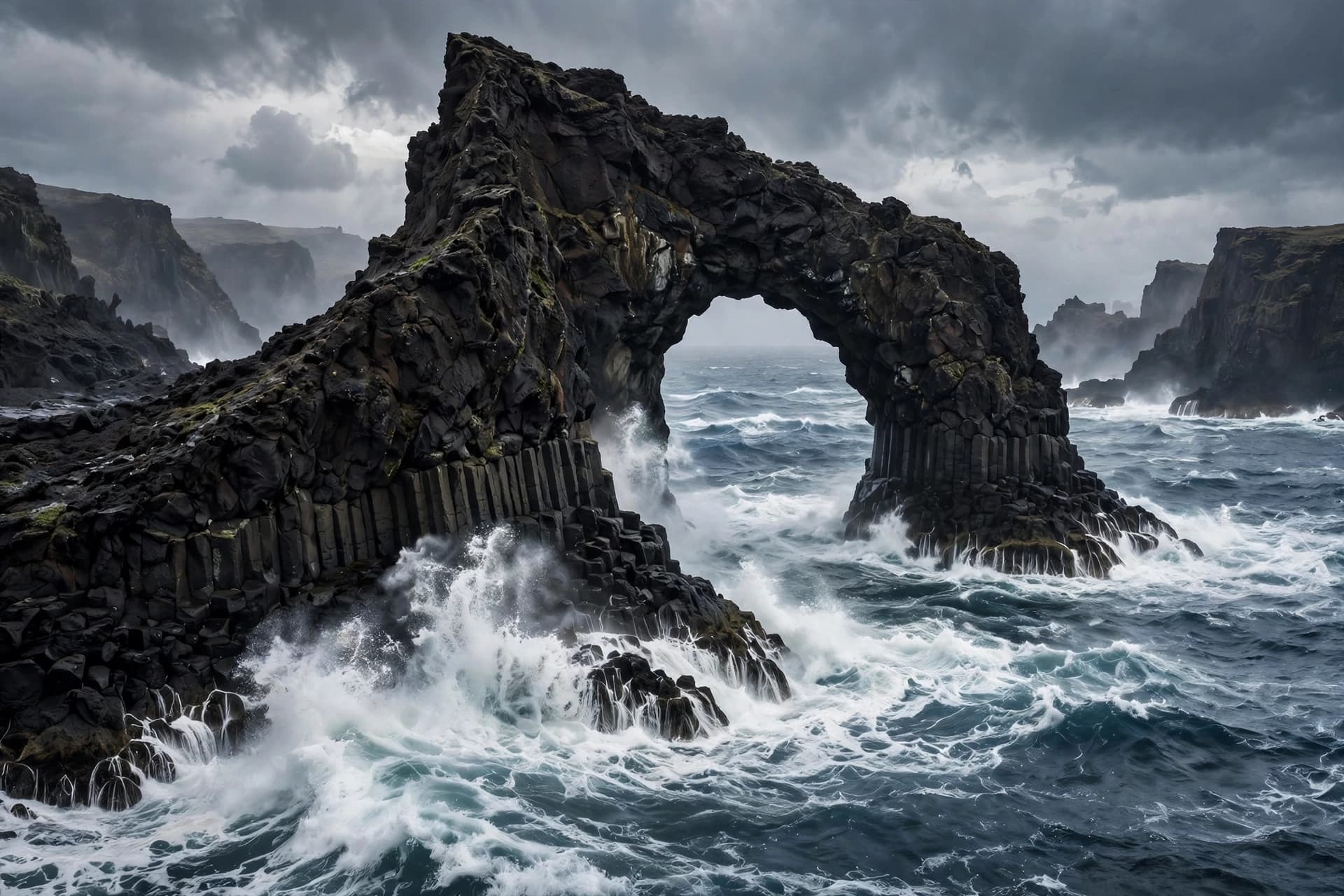
There is a quiet finality to the erosion of coastlines—a process so gradual that it escapes notice until the moment the shape of the land changes, and something familiar is simply gone. For approximately 550 years, the Holei Sea Arch stood along the southern coast of Hawaii’s Big Island, a 90-foot basalt curve carved by waves from lava that had flowed into the sea centuries earlier. It was one of the most recognizable landmarks in Hawaii Volcanoes National Park, a place where visitors stopped to photograph the arch against the Pacific and to feel the scale of geologic time made visible. Sometime between September 23 and September 27, the arch collapsed into the ocean. When the park reopened after Tropical Storm Nolo passed, the arch was no longer there .
The collapse was not unexpected. The National Park Service had warned for years that the arch was unstable. The coastline around it had been weakened by earthquakes associated with the 2018 Kilauea eruption and the collapse of the volcano’s summit, which damaged nearby cliffs and left cracks that widened over time . In July 2022, powerful swells broke a large piece of rock from the base of one of the arch’s legs, and the Park Service warned that it could collapse at any time and without warning . The original viewing area had been closed in January 2020 because of instability, and a new viewing area was established about 1,000 feet farther along Chain of Craters Road . The arch stood for four more years. Then, during a period when the park was closed for the tropical storm, it fell .
The National Park Service confirmed the collapse on October 1, noting that the exact time could not be determined. In a Facebook post, the agency described the collapse as “the latest transformation of the park’s remote and rugged coastline” . The reaction from the public, at least in the comments on that post, was largely philosophical—many described it as nature taking its course, a reminder that even the most solid-seeming features of a landscape are temporary .
What makes the Holei Sea Arch’s disappearance notable is not just the loss of a landmark but the window it offers into how coastlines change. Sea arches are formed when waves erode cliffs left behind by lava flows reaching the ocean. Different sections of rock erode at different rates; softer material wears away first, creating sea caves that eventually open into arches. But the process does not stop. The same forces that create the arch continue to act on it, weakening the rock that supports it until it can no longer hold . The Park Service has long described these formations as temporary features, and the arch’s collapse is a confirmation of that description rather than a surprise.
The immediate concern for park officials is safety. The area where the arch once stood remains unstable, with cliffs that present a serious falling hazard. The Park Service warned that social media photos show people entering the closed area near the former arch site, putting themselves and first responders at risk . The warning is a reminder that the coastline’s transformation is not only a matter of geology but of human behavior—of the temptation to get closer to something dramatic, even when the ground beneath it is no longer trustworthy.
For those who visited the arch over the decades, its absence will be felt as a gap in a familiar landscape. The lava that formed it flowed roughly 550 years ago, long before any human record of the island. The waves that carved it worked slowly, patiently, without intention. And the waves that finally brought it down did the same. The arch was never permanent, though it seemed so to the people who photographed it. Its collapse is a reminder, in a place defined by volcanic creation and destruction, that the same forces that build the land also take it apart—and that the coastline of Hawaii is not a fixed thing but a process, always underway, always changing.
AI Image Disclaimer: The visual elements in this article were created using AI generation tools and are intended for illustrative purposes only.
Sources: AP News, National Park Service, NDTV, TVMnews.mt, TvrInfo
Published by Banx Network. This article is part of the Banx decentralized media programme, powered by the BXE token on the XRP Ledger.