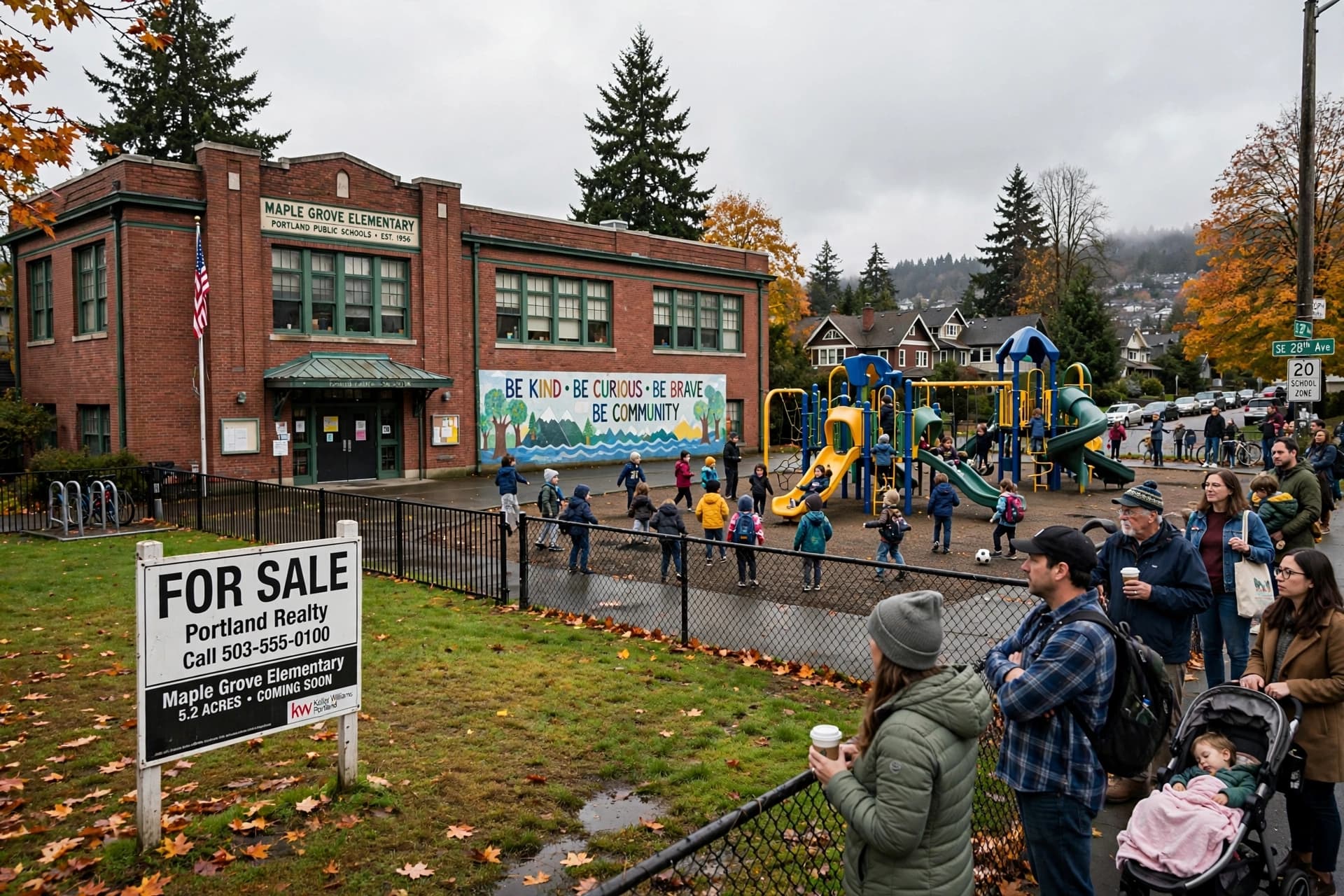
There is a particular anguish that settles over a community when the school at the center of its neighborhood is marked for closure—an anguish made heavier by the knowledge that the decision is driven not by failure but by arithmetic, by declining enrollment and rising costs, by a district that says it can no longer afford to spread its resources across buildings that are not full. In Portland, Oregon, that anguish has arrived. On Monday evening, Portland Public Schools released two scenarios for "rightsizing" the district, one proposing the closure of 14 schools, the other proposing 11. A third option would defer the decision entirely.
The schools on the list are scattered across the city, but they share a common characteristic: they are small, underenrolled, and expensive to operate. Scenario A would close thirteen elementary schools and one middle school: Maplewood, Stephenson, Irvington, Rose City Park, Buckman, Creston, Marysville, Woodmere, Lewis, Beach, James John, Peninsula, Sabin, and Sellwood Middle School. Scenario B would keep Stephenson, Rose City Park, and Lewis open, reducing the closures to 11. Both scenarios include dozens of boundary changes and the conversion of several K-8 schools to K-5 schools.
The district's rationale is straightforward. Superintendent Kimberlee Armstrong said the closures are not primarily about the district's $65 million budget deficit, but about ensuring that every school can offer a consistent standard of service. "We're closing schools because we're spreading our resources too thin," she said. "We're subsidizing … we're taking from one and adding to another with the budget that we currently have." The district points to falling enrollment, aging buildings that do not comply with accessibility standards, and mechanical systems that are out of date.
But the human cost is immediate and deeply felt. Parents and teachers have already begun organizing against the plan. A group called Save PDX Schools has launched petitions asking the district to consider alternatives—redrawing boundaries, reducing staffing at the district office, and exploring other efficiencies before closing schools. The Portland Association of Teachers said the proposed changes to more than 25 schools represent "a dramatic change" that requires far more community input. A teacher union rally is expected before the school board meeting on Tuesday.
What makes the closures particularly painful is the role that neighborhood schools play in Portland's communities. They are not just places of instruction; they are gathering places, sources of identity, and anchors for families who chose their neighborhoods because of the school. The district's own engagement sessions heard from families who loved their neighborhood schools, their dual language immersion programs, and their focus options like the arts program at Buckman and the environmental program at Sunnyside. Under the scenarios, dual language programs would be relocated or combined, and Buckman's arts focus would be discontinued.
The board is expected to vote on a final plan in December, with most changes taking effect in fall 2027. Between now and then, there will be public meetings, community input sessions, and likely protests. The district says it is listening. The families say they are not being heard. And the schools on the list—the buildings that have served generations of Portland children—wait to learn whether they will close their doors for the last time.
AI Image Disclaimer: All images in this article are AI-generated and are for illustrative purposes only.
Sources: Oregon Public Broadcasting, KOIN.com, Portland Mercury
Published by Banx Network. This article is part of the Banx decentralized media programme, powered by the BXE token on the XRP Ledger.