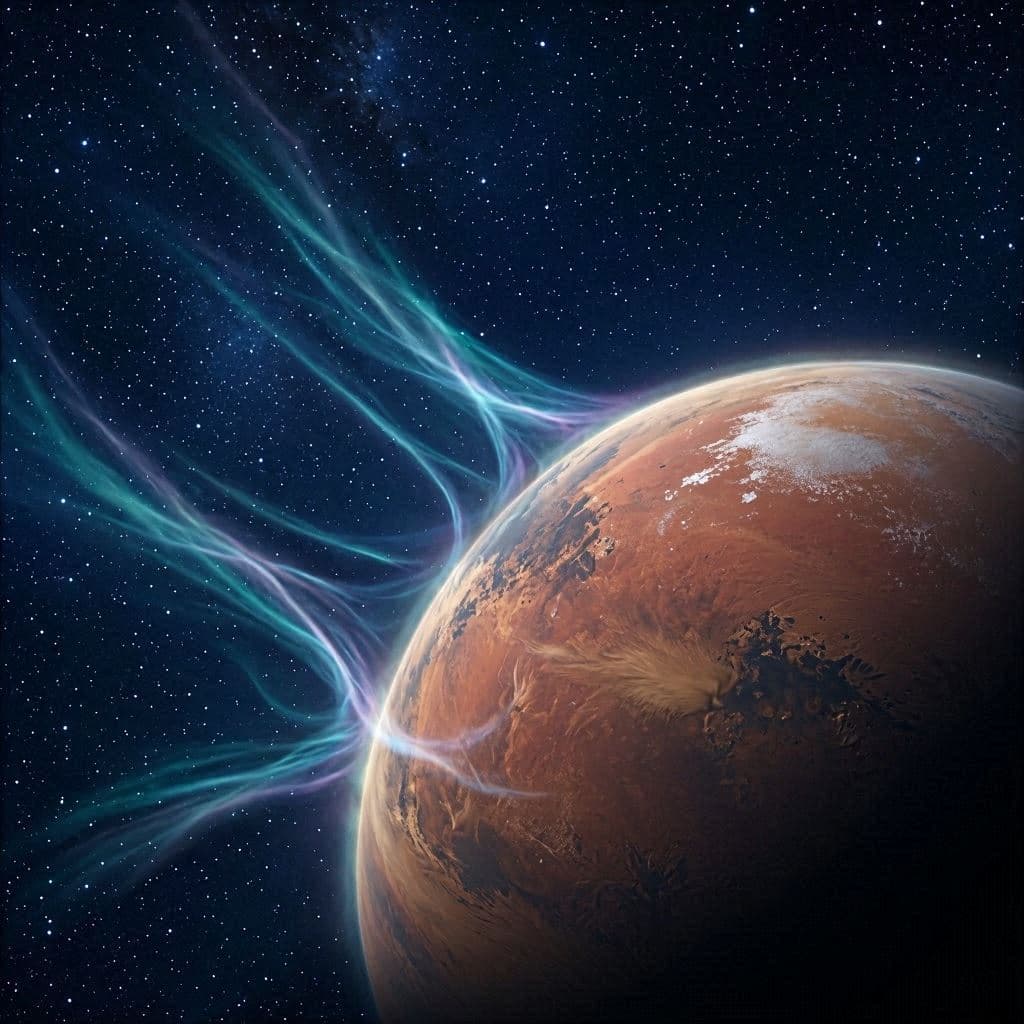
Mars, the red planet that has captivated human imagination for centuries, was not always the cold, arid world we see today. Billions of years ago, it likely possessed a thick atmosphere and flowing water, conditions that could have supported life. Today, however, its atmosphere is a mere shadow of its former self, thin and tenuous. Scientists are now uncovering the mechanisms behind this dramatic transformation, with recent findings pointing to giant plasma waves as a primary culprit in stripping away the Martian air.
These plasma waves, often referred to as "plasmoids," are massive bubbles of charged particles and magnetic fields that form in the upper atmosphere of Mars. Unlike Earth, which has a global magnetic field to shield it from solar wind, Mars lost its protective magnetosphere early in its history. This lack of defense leaves its atmosphere exposed to the relentless barrage of solar energy, creating conditions where these plasmoids can form and escape into space, carrying atmospheric gases with them.
Data from NASA’s MAVEN (Mars Atmosphere and Volatile EvolutioN) mission has provided crucial insights into this process. The spacecraft has observed these plasmoids ejecting significant amounts of oxygen and carbon dioxide into space. While individual events may seem small, over billions of years, their cumulative effect has been profound. The steady loss of these key components has thinned the atmosphere, reducing pressure and temperature, and making the surface inhospitable to liquid water.
The formation of these waves is driven by the interaction between the solar wind and the remaining localized magnetic fields in the Martian crust. When the solar wind hits the planet, it induces electrical currents that can reconnect magnetic field lines, snapping them off like rubber bands and launching them into space. These ejected structures act as carriers, dragging neutral atmospheric particles along for the ride in a process known as ion pickup.
Understanding this mechanism is vital for reconstructing the climatic history of Mars. It helps explain how a potentially habitable world transformed into a frozen desert. By quantifying the rate of atmospheric loss, scientists can better model the planet’s past environment and assess the likelihood that it once harbored life. This knowledge also informs our understanding of planetary evolution across the universe.
Moreover, these findings have implications for future human exploration. If humans are to establish a presence on Mars, understanding the dynamics of its atmosphere is essential for planning missions and potential terraforming efforts. While the current rate of loss is slow, knowing the underlying physics allows for more accurate predictions of long-term environmental changes. It underscores the delicate balance that sustains a planetary atmosphere.
The discovery of giant plasma waves as a driver of atmospheric loss on Mars adds a crucial piece to the puzzle of the planet’s history. It highlights the powerful forces at play in our solar system and the vulnerability of worlds without strong magnetic shields. As we continue to explore Mars, these insights bring us closer to understanding its past and preparing for our future among the stars.
AI Image Disclaimer: The visual elements accompanying this report are AI-generated interpretations designed to illustrate the scientific concepts discussed.
Sources: NASA Science Daily The Planetary Society
Published by Banx Network. This article is part of the Banx decentralized media programme, powered by the BXE token on the XRP Ledger.