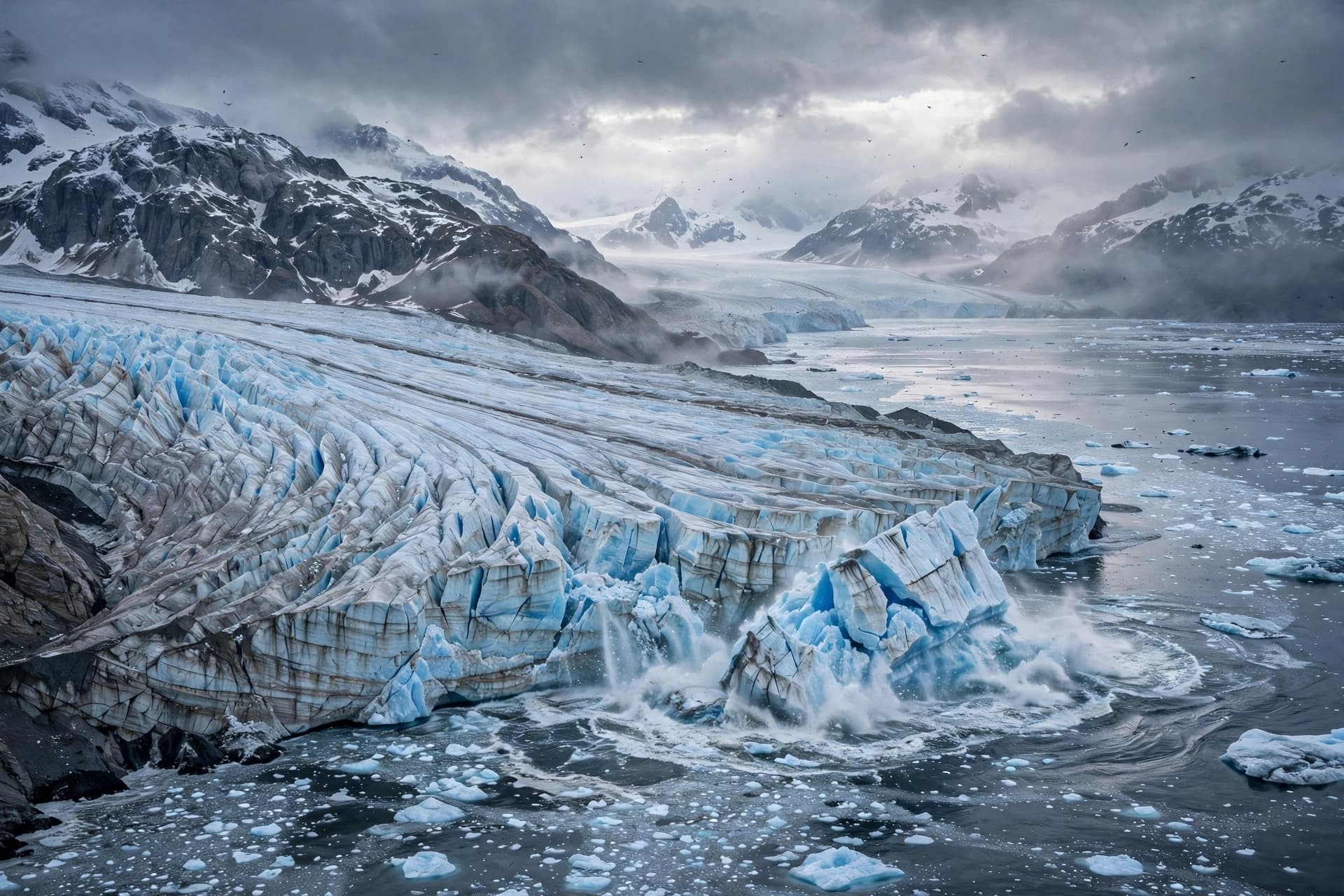
In the remote and icy expanse of northwest Greenland, the Petermann Glacier has once again reshaped the Arctic landscape. In early August 2026, a massive section of its floating ice tongue, covering approximately 76 square kilometers, broke away in a significant calving event. This detachment, captured by satellite imagery from the Copernicus Sentinel-1 mission, marks the glacier’s largest loss of floating ice since 2012. It is a stark reminder of the dynamic and often unpredictable nature of Earth’s cryosphere, where ancient ice meets a warming world. The scale of the event underscores the ongoing changes in polar regions.
The calving occurred after years of growing fractures weakened the ice shelf. Scientists from the University of Ottawa and other institutions have been monitoring these rifts, noting that the structural integrity of the floating tongue had been compromised. The resulting ice island, roughly the size of Manhattan, drifted into Nares Strait, where it collided with other ice formations. Such events are part of the natural lifecycle of glaciers, but their frequency and magnitude are increasingly scrutinized in the context of climate change. Nature follows its own rhythm, yet human influence accelerates the beat.
While the loss of floating ice does not directly contribute to sea-level rise, it can have indirect effects. The removal of the ice tongue may allow the grounded glacier behind it to flow more rapidly into the ocean, potentially increasing the discharge of land-based ice. Researchers warn that two additional large sections could detach in the near future, which would remove about 22 percent of the remaining ice tongue. This potential for further instability highlights the importance of continued observation. Vigilance is key to understanding.
The Arctic is warming at a rate faster than the global average, a phenomenon known as Arctic amplification. This warming affects ice shelves, sea ice, and permafrost, creating feedback loops that further accelerate temperature increases. The Petermann calving is one piece of a larger puzzle, illustrating how sensitive polar systems are to environmental shifts. Science seeks to connect these dots. Data informs policy.
Local communities and indigenous peoples in the region rely on stable ice conditions for hunting and travel. Changes in ice dynamics can disrupt traditional ways of life and pose safety risks. The drifting ice islands can also affect shipping routes in the Arctic, which are becoming more accessible as sea ice retreats. Adaptation is necessary for resilience. Community knowledge is valuable.
International cooperation in polar research remains crucial. Missions like Copernicus provide essential data that allows scientists worldwide to track changes in real-time. This shared knowledge helps build a comprehensive picture of global climate trends. Collaboration strengthens understanding. Transparency builds trust.
Public awareness of such events is growing, driven by media coverage and educational initiatives. People are increasingly connecting local weather patterns to broader global changes. This awareness can inspire action and support for sustainable practices. Education empowers change. Consciousness drives responsibility.
In the end, the calving at Petermann Glacier is a significant event in the story of our changing planet. It serves as a visual testament to the power of natural forces and the impact of a warming climate. As scientists continue to study the aftermath, the hope is for deeper insights and effective responses. The ice speaks, if we listen.
AI Image Disclaimer: The visual representations included here are AI-generated illustrations designed to depict glacial landscapes and ice calving events, not actual satellite images or photographs of the specific Petermann Glacier calving in August 2026.
Sources: Science Daily ESA (European Space Agency) NASA Earth Observatory
Published by Banx Network. This article is part of the Banx decentralized media programme, powered by the BXE token on the XRP Ledger.