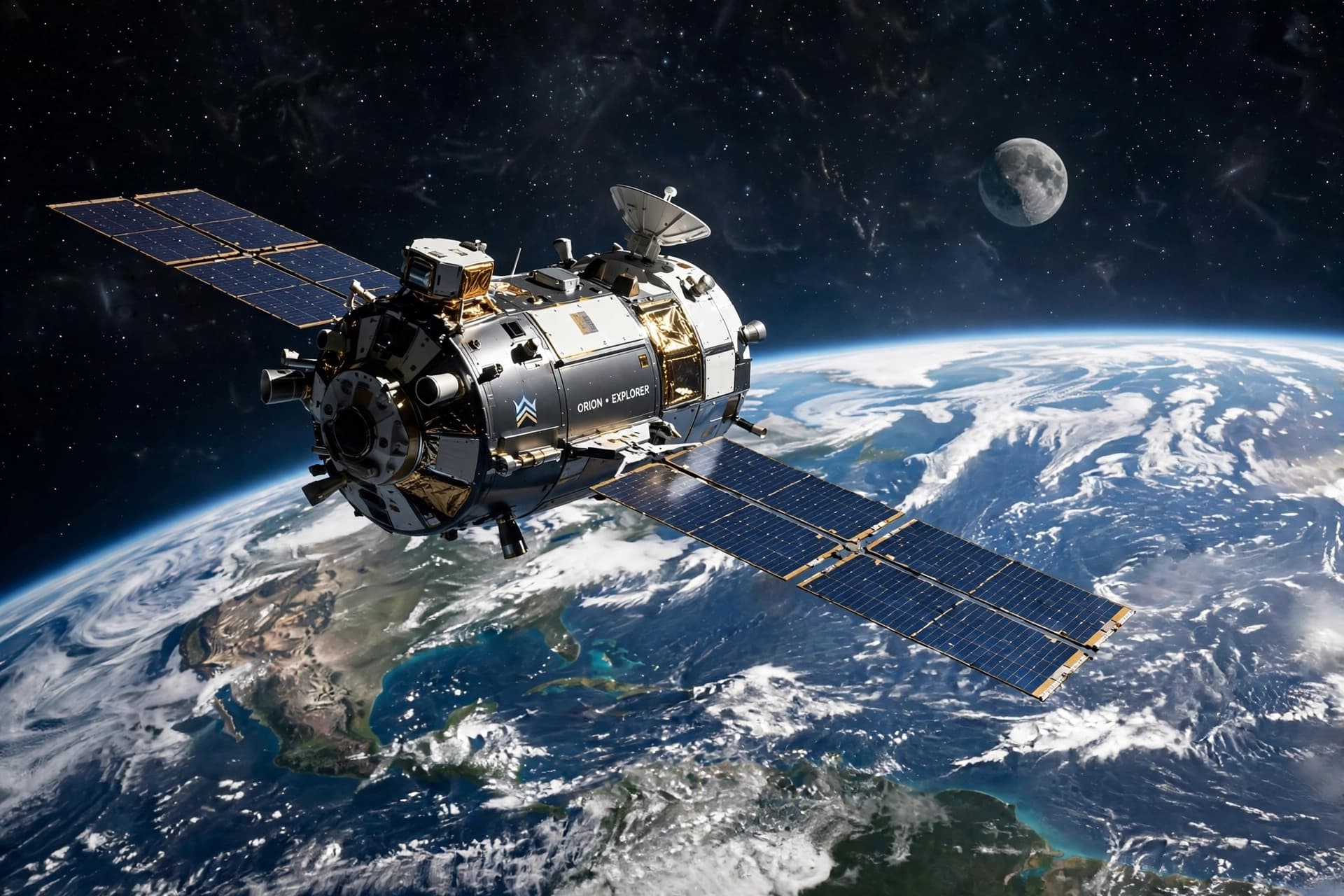
On September 28, 2026, the skies over Europe and Africa will host a rare celestial visitor: the Jupiter Icy Moons Explorer (JUICE). In a carefully choreographed maneuver, the European Space Agency’s spacecraft will perform a gravity-assist flyby of Earth, using our planet’s gravitational pull to boost its speed and adjust its trajectory toward the outer solar system. This event is a critical milestone in a long journey to explore the icy moons of Jupiter. It is a dance of physics and precision.
Launched in 2023, JUICE has been traveling through the inner solar system, visiting Venus and Earth to gain the energy needed to reach Jupiter. The upcoming flyby will bring the spacecraft within a few hundred kilometers of Earth’s surface, offering a unique opportunity for calibration and public observation. Proximity allows for verification.
For astronomers and enthusiasts, the flyby is a chance to spot the spacecraft with telescopes. It will appear as a fast-moving point of light, a tiny ambassador from humanity venturing into the deep. Observation connects us to the mission. Wonder inspires engagement.
The gravity assist is a fuel-efficient way to change velocity and direction, a technique pioneered in earlier missions like Voyager and Cassini. By leveraging planetary motion, engineers can send heavier payloads farther without massive rockets. Ingenuity saves resources. Physics enables exploration.
During the flyby, instruments on board will be tested and calibrated against known Earth targets. This ensures they are ready for the detailed study of Jupiter’s moons—Ganymede, Callisto, and Europa—when the spacecraft arrives in the 2030s. Preparation is essential for success.
These moons are believed to harbor subsurface oceans, making them prime candidates in the search for extraterrestrial life. JUICE will study their ice shells, composition, and potential habitability. Discovery awaits at the destination.
The mission represents a major achievement for European space science, showcasing technological prowess and international collaboration. It highlights the importance of long-term planning in space exploration. Vision guides action.
In the end, the Earth flyby is a brief but pivotal moment in JUICE’s decade-long journey. It reminds us of our home planet’s role as a launchpad for cosmic discovery. As the spacecraft swings away, it carries our hopes for finding life beyond Earth. The journey continues.
AI Image Disclaimer: The visual aids included here are AI-generated illustrations depicting spacecraft and planetary flybys, not actual photographs of the JUICE spacecraft or specific telemetry data.
Sources: European Space Agency (ESA) Space.com BBC Science
Published by Banx Network. This article is part of the Banx decentralized media programme, powered by the BXE token on the XRP Ledger.