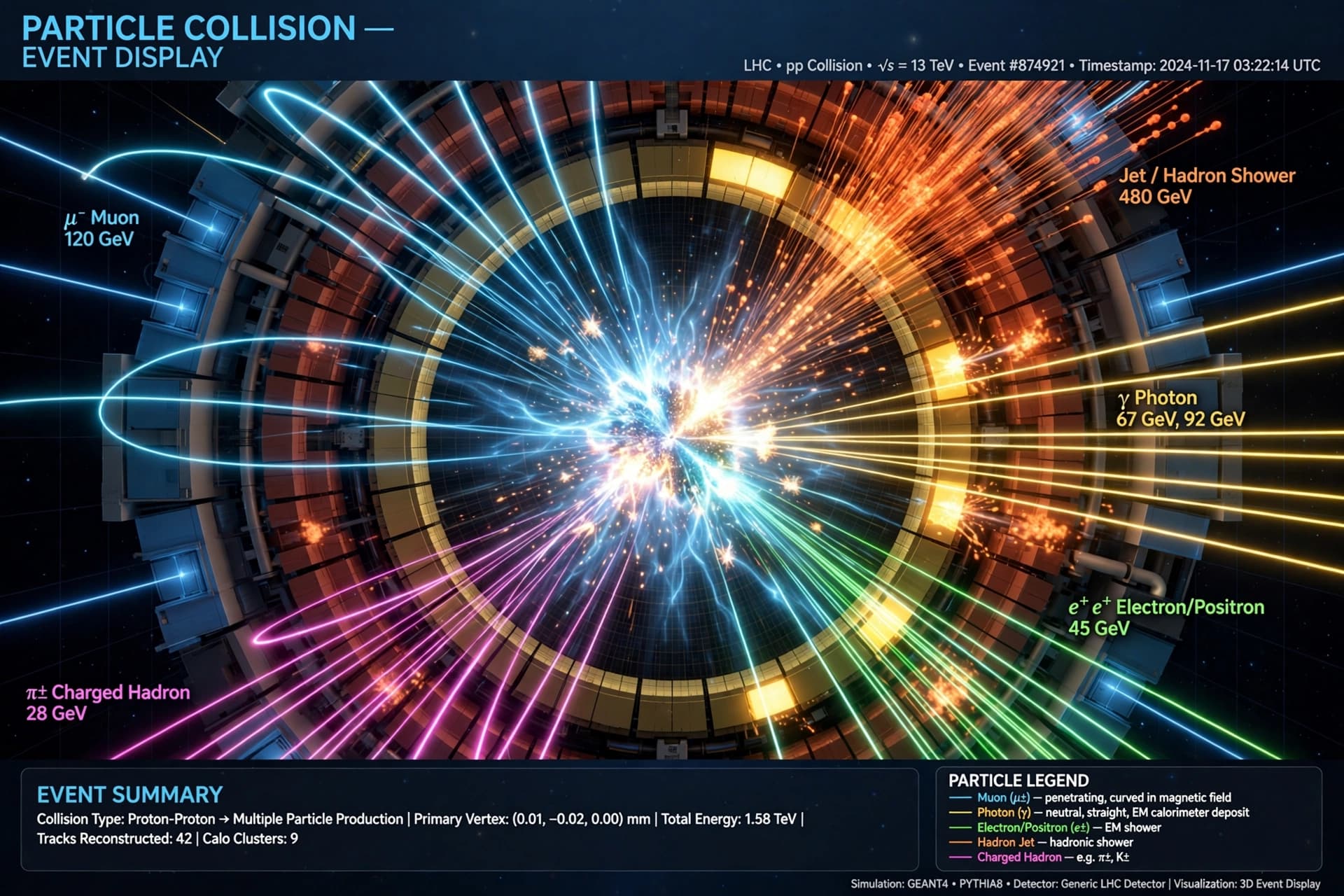
There is a particular ambition in the work of particle physicists—an ambition to recreate, in a laboratory beneath the French-Swiss border, the conditions that existed in the first microseconds after the universe began. For decades, this work has required the heaviest of tools: lead nuclei, stripped of their electrons and accelerated to nearly the speed of light, smashed together to generate temperatures more than 100,000 times hotter than the center of the Sun. Only in such extreme collisions could the quark-gluon plasma—the "primordial soup" of free quarks and gluons that filled the universe before atoms existed—be briefly recreated and studied.
Now, a new result from the ALICE collaboration at CERN's Large Hadron Collider suggests that this primordial state may not require such heavy collisions after all. In a paper published in Nature Communications, researchers report observing a key signature of quark-gluon plasma in collisions involving much smaller nuclei—oxygen and neon—and even in proton-proton collisions with unusually high numbers of produced particles. The finding challenges assumptions about how small a system can be and still produce this extreme state of matter.
The signature in question is called anisotropic flow. When quark-gluon plasma forms, the particles produced in the collision do not fly out uniformly. Instead, they exhibit preferred directions of motion, shaped by the geometry of the collision and the pressure of the expanding medium. At intermediate momenta, this flow depends on the number of quarks a particle contains: baryons, made of three quarks, show stronger flow than mesons, made of two. This difference is attributed to quark coalescence—the process by which quarks in the plasma combine to form larger particles, with baryons inheriting more of the collective motion because they have one more quark than mesons.
The ALICE team measured this flow pattern across multiple meson and baryon species in proton-proton, proton-lead, and lead-lead collisions. In proton-proton and proton-lead collisions that produced a large number of particles, they observed the same baryon-meson flow difference seen in heavy-ion collisions. "This is the first time we have observed, for a large interval in momentum and for multiple species, this flow pattern in a subset of proton collisions in which an unusually large number of particles are produced," said David Dobrigkeit Chinellato, Physics Coordinator of the ALICE experiment. "Our results support the hypothesis that an expanding system of quarks is present even when the size of the collision system is small."
The researchers compared their measurements to simulations. Models that incorporate anisotropic quark flow and coalescence successfully explain the observed pattern, while models that exclude either process fail to capture it. However, even the successful models are not exactly right—discrepancies remain, largely linked to uncertainties in modeling the proton's substructure and the initial geometry of the collisions.
The finding does not mean that a full quark-gluon plasma forms in every proton collision. Rather, it suggests that under the right conditions—when enough particles are produced—a small, expanding system of quarks can briefly develop, exhibiting the same collective behavior as its much larger counterparts. The oxygen collisions recorded in 2025, which bridge the gap between proton and lead collisions, are expected to provide further insights. "We expect that, with the oxygen collisions that were recorded in 2025, we will gain new insights into the nature and evolution of the QGP across different collision systems," said Kai Schweda, ALICE Spokesperson.
For physicists, the result sharpens a question that has lingered since the first unexpected signs of quark-gluon plasma appeared in small collision systems: where, exactly, is the threshold? How small can a system be and still produce the primordial soup? The answer, it seems, is smaller than anyone thought.
AI Image Disclaimer: All images in this article are AI-generated and are intended for illustrative purposes only.
Sources: ALICE Collaboration, CERN, Nature Communications, INFN, Gizmodo Brasil
Published by Banx Network. This article is part of the Banx decentralized media programme, powered by the BXE token on the XRP Ledger.