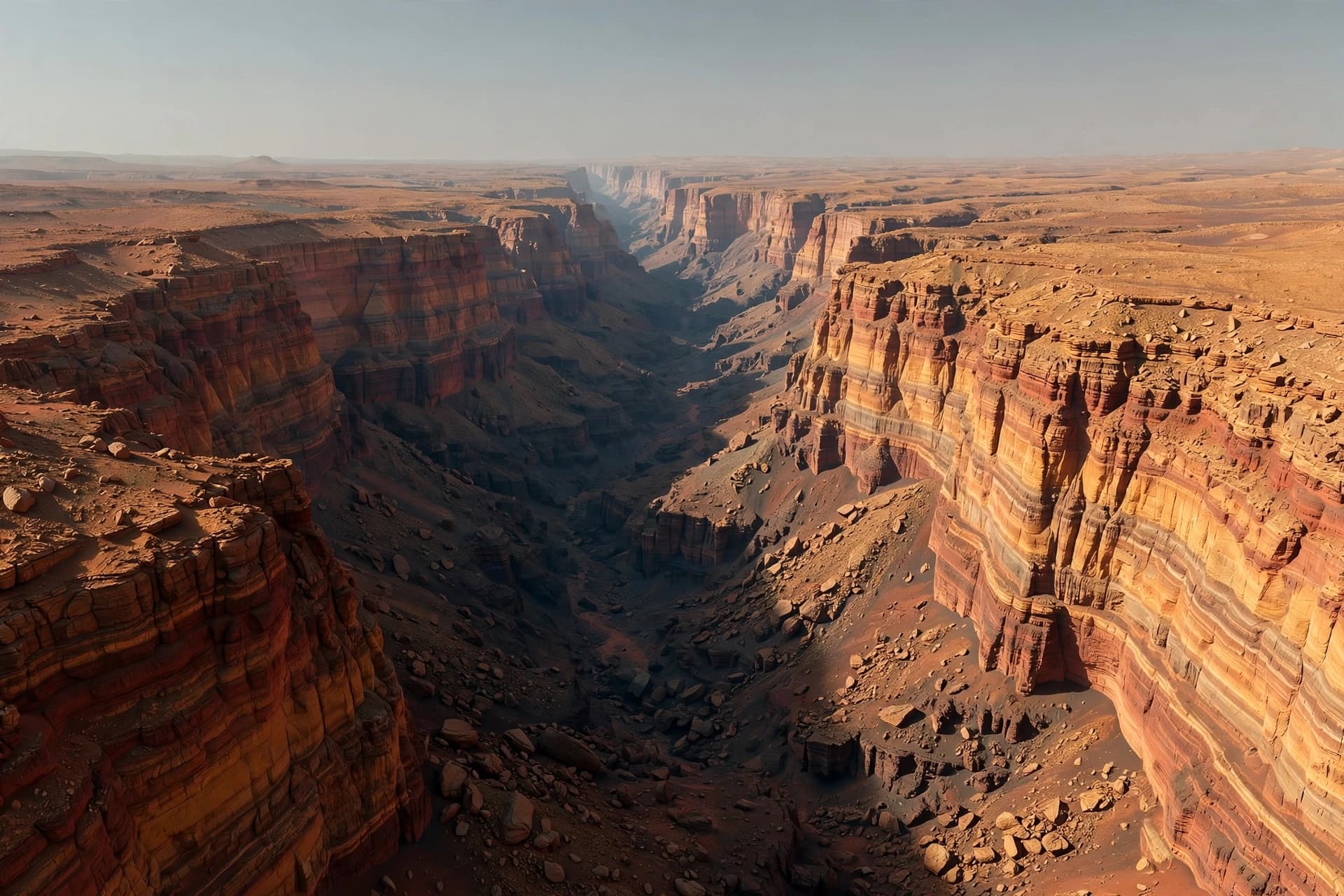
There is a particular stubbornness to a landscape that refuses to be finished, a canyon so vast that it seems it must have been carved in a single, ancient cataclysm and then left to erode in silence. Valles Marineris stretches nearly 3,900 kilometers across Mars, reaches up to 600 kilometers wide, and plunges more than nine kilometers deep—nearly nine times longer, twenty times wider, and five times deeper than the Grand Canyon . It is the largest canyon system in the solar system. And according to new research, it is not a fossil. It is still moving.
The study, published in Nature Communications and led by scientists at Imperial College London and Columbia University, examined a marsquake recorded by NASA's InSight lander on August 25, 2021. The event, designated S0976a, was unusual: it came from the opposite side of Mars from the lander and was the only marsquake detected during the mission that could be located in the planet's western hemisphere. Previous work had placed it near western Valles Marineris, but the cause was uncertain. Marsquakes can be produced by meteoroid impacts, landslides, or tectonic faulting, and distinguishing between them requires careful analysis .
The team analyzed how different seismic waves from the event traveled through Mars and arrived at InSight. From the amplitudes and directions of those waves, they reconstructed the type of motion at the source. The best explanation was a strike-slip event—blocks of crust sliding horizontally past one another along a steep, deeply rooted fault—occurring roughly 20 to 40 kilometers beneath the surface. They tested alternative explanations, including impacts and landslides, but those models could not reproduce the observed seismic waves. Satellite images of the source region showed no fresh crater or large new landslide that could account for the signal .
The implications are significant because Mars does not have plate tectonics. Its outer shell behaves more like a single, slowly cooling lid, unlike Earth's fragmented and constantly shifting crust. The finding suggests that faults established billions of years ago, during the formation and early evolution of Valles Marineris, can remain weak enough to rupture under stresses acting on Mars today. Those stresses likely come from a combination of the planet's long-term cooling, the nearby Tharsis volcanic region, and local effects associated with the canyon itself .
"What we see is that this is not just a 'dead' fossil landscape," said Jung-Hun Song, the lead author from Imperial's Department of Earth Science and Engineering. "Faults deep beneath the canyon can still slip and generate marsquakes, long after the geological processes that originally formed them have ceased" . The result adds Valles Marineris to a small but growing set of regions where InSight data have revealed active faulting on present-day Mars, alongside Cerberus Fossae and southern Elysium Planitia. The stresses within the Martian crust vary considerably from place to place, and the canyon is not exempt from them.
For a planet often described as geologically dead, Mars continues to surprise. The marsquake was small by Earth standards, and the fault slip was modest. But it was real, recorded by an instrument that was designed to listen for exactly this kind of signal. The canyon that formed billions of years ago is still shaping the planet, one slip at a time, in the quiet depths beneath its enormous walls.
---
AI Image Disclaimer: The visuals in this article are generated by artificial intelligence and are for illustrative purposes only.
Sources: Nature Communications, Imperial College London, Columbia University, Lamont-Doherty Earth Observatory
Published by Banx Network. This article is part of the Banx decentralized media programme, powered by the BXE token on the XRP Ledger.