Key Highlights
- Over 600 participants joined the 'Paddle for the Planet' protest in Newcastle.
- The event challenged local coal export policies amid climate concerns.
- A court ruling allowed the protest to proceed despite police objections.
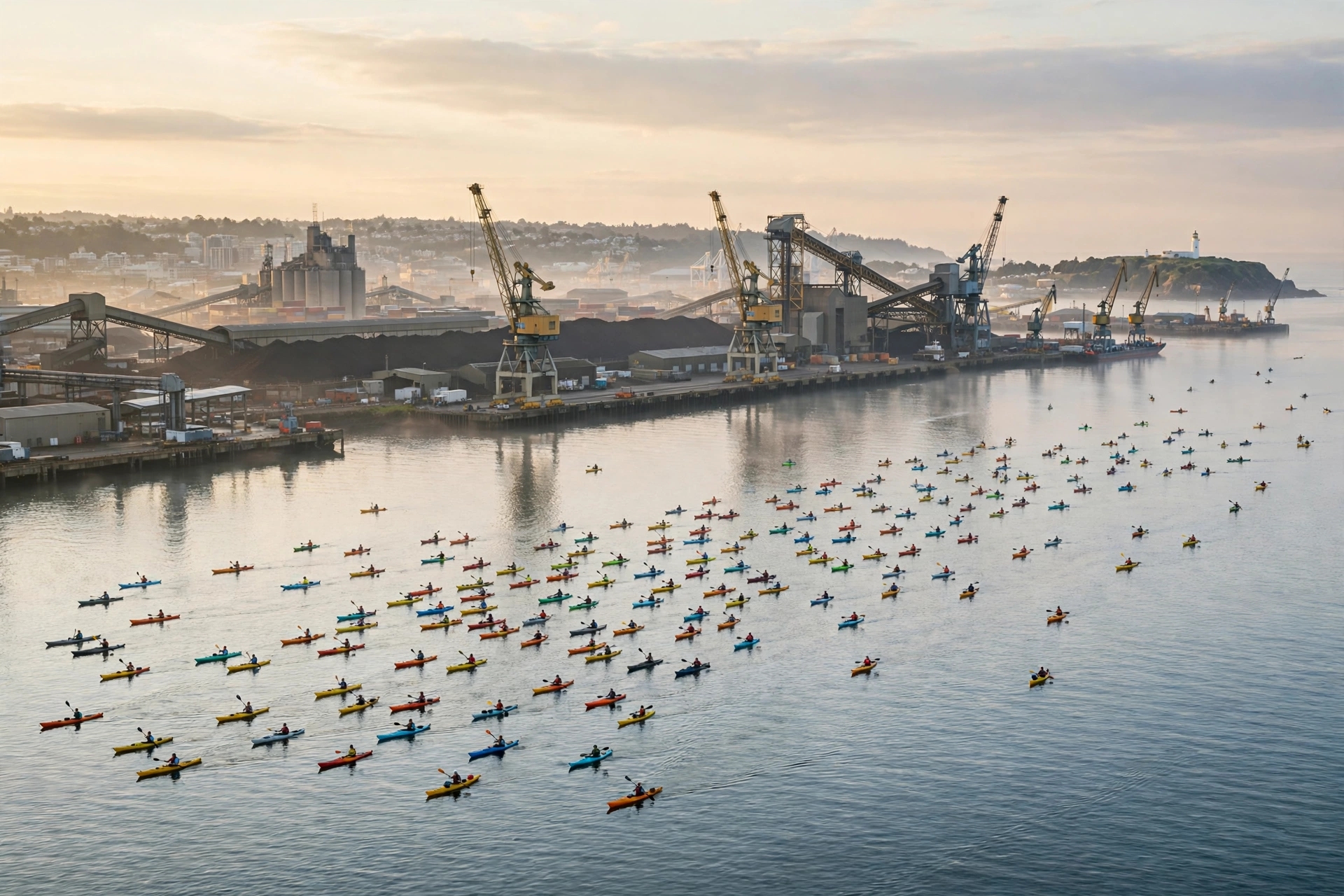
On a Saturday in November, the harbor at Newcastle transformed from a bustling hub of coal exports to a vibrant scene of activism as over 600 kayakers took to the water. Organized by Rising Tide, the event, dubbed 'Paddle for the Planet,' aimed to raise awareness about the contradictions in Australia's climate commitments while continuing to export coal. Participants paddled in unison, displaying a large banner that read, "Coal Exports Equals Climate Chaos," symbolizing their call for urgent action against climate change.
The protest faced significant hurdles leading up to the event. Newcastle City Council attempted to ban the gathering from council-owned land, and the New South Wales Police sought a Supreme Court injunction to prevent the assembly, citing safety concerns. However, the court ruled in favor of the protesters, emphasizing the importance of political expression. This decision allowed the demonstration to proceed without any arrests, marking a significant victory for climate activists.
Safety was a central theme in the court's discussions. Police expressed concerns about the potential dangers posed by hundreds of small vessels in open water, referencing a past incident where protesters were swept away by strong currents. Rising Tide countered these claims by outlining their safety measures, which included mandatory life jackets, a dedicated safety team, and strict protocols to ensure the safety of all participants. Ultimately, the court permitted a cap of 785 vessels, and shipping operations at the Port of Newcastle, the world's largest coal export terminal, were temporarily halted for four hours to accommodate the protest.
This demonstration is part of a broader narrative of escalating tensions between climate activism and governmental policies regarding fossil fuels. Rising Tide has previously faced mass arrests during protests in 2024 and 2025, although many charges were later dropped. The current state government, led by Premier Chris Minns, has supported the council's land ban, with the police minister labeling the group as "bad faith actors." This week, the government also announced plans to extend the life of the Mount Pleasant coal mine, a decision that has drawn criticism for ignoring a recent High Court ruling that mandated consideration of downstream emissions.
The implications of these debates extend beyond the courtroom and into the public consciousness, as citizens grapple with the realities of climate change and energy policy. Rising Tide has announced plans for a larger six-day festival and blockade in February, coinciding with the upcoming state election. The future of their protests remains uncertain, particularly in light of the council's land ban, but their commitment to raising awareness about climate issues is unwavering.
As the kayakers returned to shore, the harbor resumed its usual activities, with ships moving in and out, seemingly erasing the traces of the protest. However, the questions raised by the event linger, challenging the community and its leaders to confront the complexities of climate action and energy policy in Australia.
The images accompanying this article are generated by artificial intelligence and are not photographs of the actual event.
Published by Banx Network. This article is part of the Banx decentralized media programme, powered by the BXE token on the XRP Ledger.