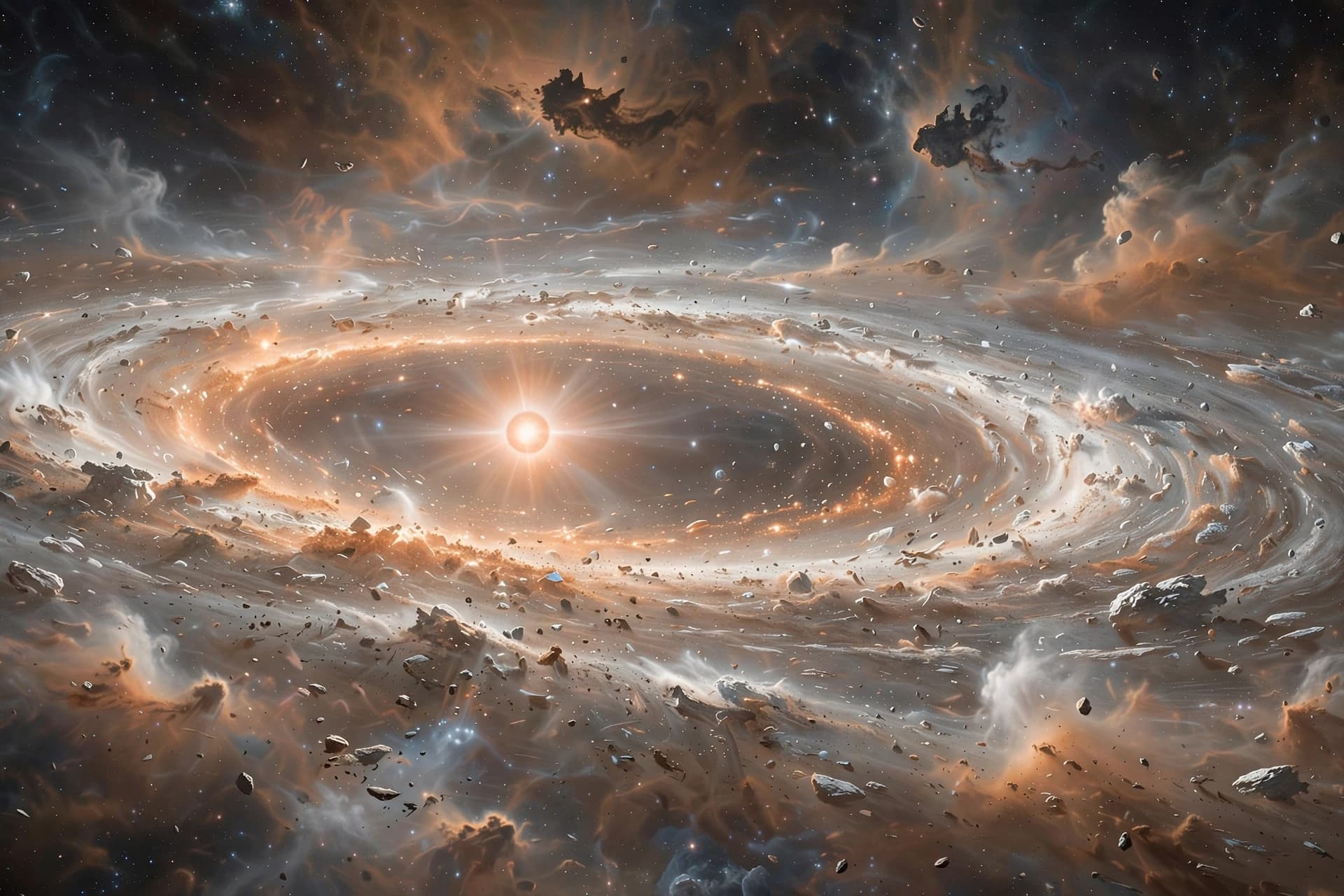
There is a violence that lives at the beginning of things—a chaos that, given enough time, settles into something recognizably ordered. Our own solar system knows this story. Billions of years ago, a Mars-sized body called Theia is believed to have struck the infant Earth, vaporizing rock and flinging debris into orbit that eventually coalesced into the Moon . That ancient catastrophe has long lived in the realm of theory. Now, the James Webb Space Telescope is offering something rare: a chance to watch similar violence unfold around other stars.
Astronomers using Webb have studied a class of young stellar systems called "extreme debris disks"—environments where rocky planets appear to have recently smashed into one another. These disks carry unusually large amounts of warm dust in the zone where rocky worlds would orbit, dust that carries the chemical fingerprints of catastrophic impacts .
The findings, published in The Astrophysical Journal, represent the first time scientists have gathered enough of these systems to study them as a group. "This is the first time we have gathered enough systems to truly understand this subclass that we call extreme debris disks," said Kate Su of the Space Science Institute, who led the research .
The team examined 21 extreme debris disks, combining new Webb observations with archival data from the retired Spitzer Space Telescope. By analyzing the mid-infrared light emitted by the dust, researchers could determine its mineral composition—and that composition told a story about the violence that created it .
About one-third of the disks were rich in silica, the main ingredient in volcanic glass. These, researchers believe, are the signatures of high-energy collisions between Mars-sized bodies, impacts so violent that rock was vaporized and then condensed into fine glassy grains. The remaining two-thirds were silica-poor, containing minerals like forsterite—better known as the green sand found on some Hawaiian beaches. These likely came from gentler, grazing collisions between smaller, moon-sized objects .
The glassy, silica-rich disks were found only around stars younger than about 300 million years. That timing aligns with computer simulations suggesting that rocky planets like Earth take shape within the first few hundred million years of a system's life .
The research offers a window into a phase of planetary formation that our own solar system likely experienced. "How rocky planets formed and giant planets evolved are part of the broader story of the solar system's formation," Su said. "Our work on extreme debris disks helps us bring together the big picture" .
Yet questions remain. Only about 1 percent of young stars show this dusty phase, far fewer than theories predicted . For now, Webb has given humanity a glimpse of the same kind of chaos that once forged our own home.
AI Image Disclaimer: The images accompanying this article are generated by artificial intelligence and are intended for illustrative purposes only.
Sources: STScI, IFLScience, Yahoo News, Mashable India, Cadena 3 Argentina, The Astrophysical Journal
Published by Banx Network. This article is part of the Banx decentralized media programme, powered by the BXE token on the XRP Ledger.