There is a particular kind of audacity in choosing to do something difficult not once, but twice, with two different vehicles, two different companies, and three rockets, all in the span of fourteen days. NASA's plan for the Artemis III mission is not a single launch but a choreography—a test of machinery and nerve that the agency's own program manager has described as "likely the most complicated launch campaign ever undertaken" . The goal is not to land on the Moon, but to prove that the vehicles meant to land there can work together, in low Earth orbit, before lives are entrusted to them farther from home.
The mission, now slated for 2027, represents a significant reshaping of the Artemis program. Under NASA Administrator Jared Isaacman, the agency added this low-Earth-orbit demonstration to its roadmap, pushing the actual crewed lunar landing to Artemis IV in 2028 . The logic is one of incremental risk: test the docking, the life support, the interfaces, and the suits in the relative safety of Earth orbit, so that the Moon landing itself carries fewer unknowns.
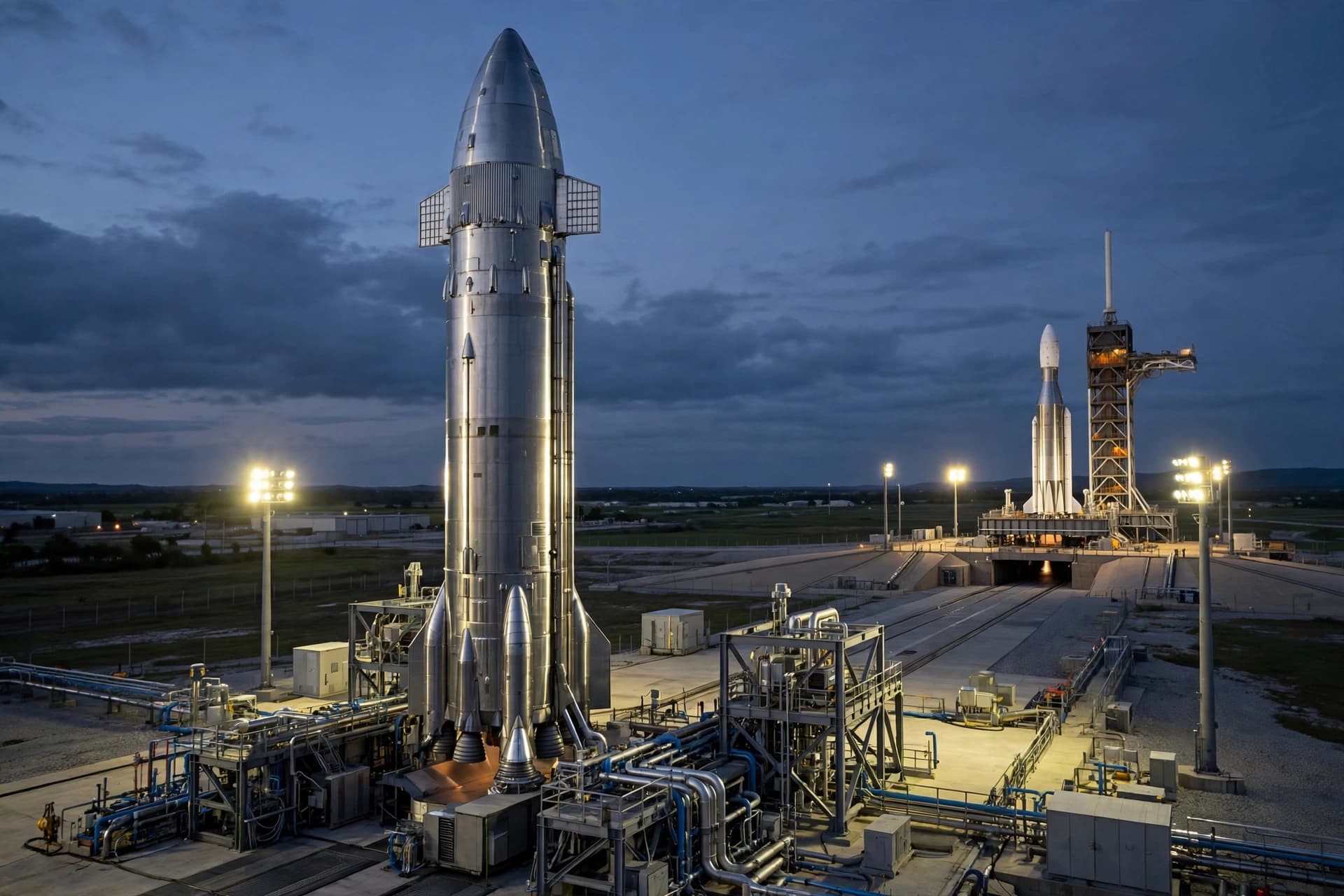
At the center of the campaign are two landers that could hardly be more different. SpaceX's Starship is a towering, stainless-steel vehicle unlike anything flown before, a two-part system that must transfer super-chilled propellants between spacecraft in orbit—a maneuver never attempted at this scale . Blue Origin's Blue Moon Mark 2, by contrast, is a more conventional design, reminiscent of a scaled-up Apollo lander, though it has yet to fly a test flight after a New Glenn rocket explosion in May damaged the company's Florida launch site . Both companies hold multibillion-dollar contracts, and both will have one docking sequence each to demonstrate their worth.
The schedule is unforgiving. SpaceX must complete several Starship demonstrations, including landing-leg and airlock tests, and conduct its first orbital propellant transfer in early 2027 . Blue Origin must bring its lander to flight readiness after a year of setbacks. NASA, meanwhile, has simplified other elements of the program—lighter spacesuits from Axiom, design changes to the Space Launch System and Orion—but the landers, according to program manager Jeremy Parsons, are what "drive the schedule" .
What is being tested, ultimately, is not just hardware but a model of partnership. NASA has outsourced the landers to commercial companies, each with its own engineering culture and its own approach to risk. The Artemis III mission will place both vehicles in the same orbital theater, docking with the same Orion spacecraft, and the results will be compared. The agency has structured the test to keep two options alive, a deliberate hedge against the possibility that one vehicle falters.
The stakes are difficult to overstate. The Artemis program is NASA's return to the Moon, the first crewed landing since Apollo 17 in 1972. A successful Artemis III does not guarantee that landing, but a failure would delay it, perhaps significantly. The "mad dash" of which NASA speaks is not merely a logistical sprint but a test of whether the commercial model can deliver on the most demanding human spaceflight mission in half a century.
For now, the work continues: the welding, the testing, the fueling demonstrations, the simulations. The rockets are being built. The landers are being assembled. And in 2027, if the schedule holds, three rockets will rise, two spacecraft will dock with Orion, and NASA will learn whether its most complicated campaign can produce the clarity it needs.
AI Image Disclaimer: The visuals accompanying this article were generated by artificial intelligence and are for illustrative purposes only.
Sources: CNN, ScienceAlert, Space.com, EurekAlert
Published by Banx Network. This article is part of the Banx decentralized media programme, powered by the BXE token on the XRP Ledger.