Key Highlights
- Voyager 1 resumes operations after a communications glitch.
- The spacecraft is approaching a historic light-day milestone.
- Engineers at NASA's Jet Propulsion Laboratory successfully restored contact.
NASA's Voyager 1, the most distant human-made object in space, has successfully resumed normal operations following a communications glitch that interrupted its signal in late October. The spacecraft, which is currently over fifteen billion miles from Earth, is once again transmitting engineering data. This recovery comes at a pivotal moment as Voyager 1 is on the verge of achieving a milestone that no other human-made object has reached: crossing a light-day.
The communications issue began around October 18, when Voyager 1 ceased to transmit usable data. Engineers at NASA's Jet Propulsion Laboratory (JPL) identified the problem as a fault in one of the spacecraft's computers, which had switched to a backup mode and was unable to communicate effectively with the rest of the system. To resolve the issue, the team sent a series of commands across the vast distance, where signals take nearly a full day to reach the spacecraft. By October 24, the team confirmed that Voyager 1 was back online, and by the end of that week, it was transmitting data from its scientific instruments once again.
The light-day milestone, which Voyager 1 is expected to cross in the coming weeks, refers to the distance light travels in a single day—approximately 16 billion miles. This achievement is symbolic, as it signifies that the signals from Voyager 1 will take more than a day to reach Earth, a testament to the probe's extraordinary journey through interstellar space. Voyager 1 crossed the heliopause in 2012, marking its entry into interstellar space, and is currently traveling at a speed of about 38,000 miles per hour.
The significance of this recovery is underscored by the age of the Voyager hardware. Launched in 1977, the spacecraft's systems were designed by engineers who could not have foreseen the challenges it would face over the decades. Voyager 1 has endured extreme radiation, temperature fluctuations, and the gradual depletion of its power supply. To conserve energy, various instruments have been powered down, and the engineering team has become adept at finding innovative solutions to problems that the original designers never anticipated.
This recent glitch is not the first for Voyager 1, nor will it be the last. In 2022, the probe began sending back garbled telemetry due to a faulty memory chip, an issue that took months to resolve. In 2024, a similar problem caused the spacecraft to transmit nonsensical data for weeks before engineers implemented a workaround. Each time, the team at JPL has managed to restore the probe to operational status, demonstrating their patience, ingenuity, and deep understanding of a machine that has outlived many of its creators.
For the engineers at JPL, the glitch was a moment of concern, but the successful recovery has brought a sense of relief. For the broader public, Voyager 1 serves as a powerful symbol of human curiosity and exploration. The upcoming light-day milestone is not just a numerical achievement; it represents a story of human endeavor and the relentless pursuit of knowledge that will continue as long as the spacecraft remains operational and we continue to listen.
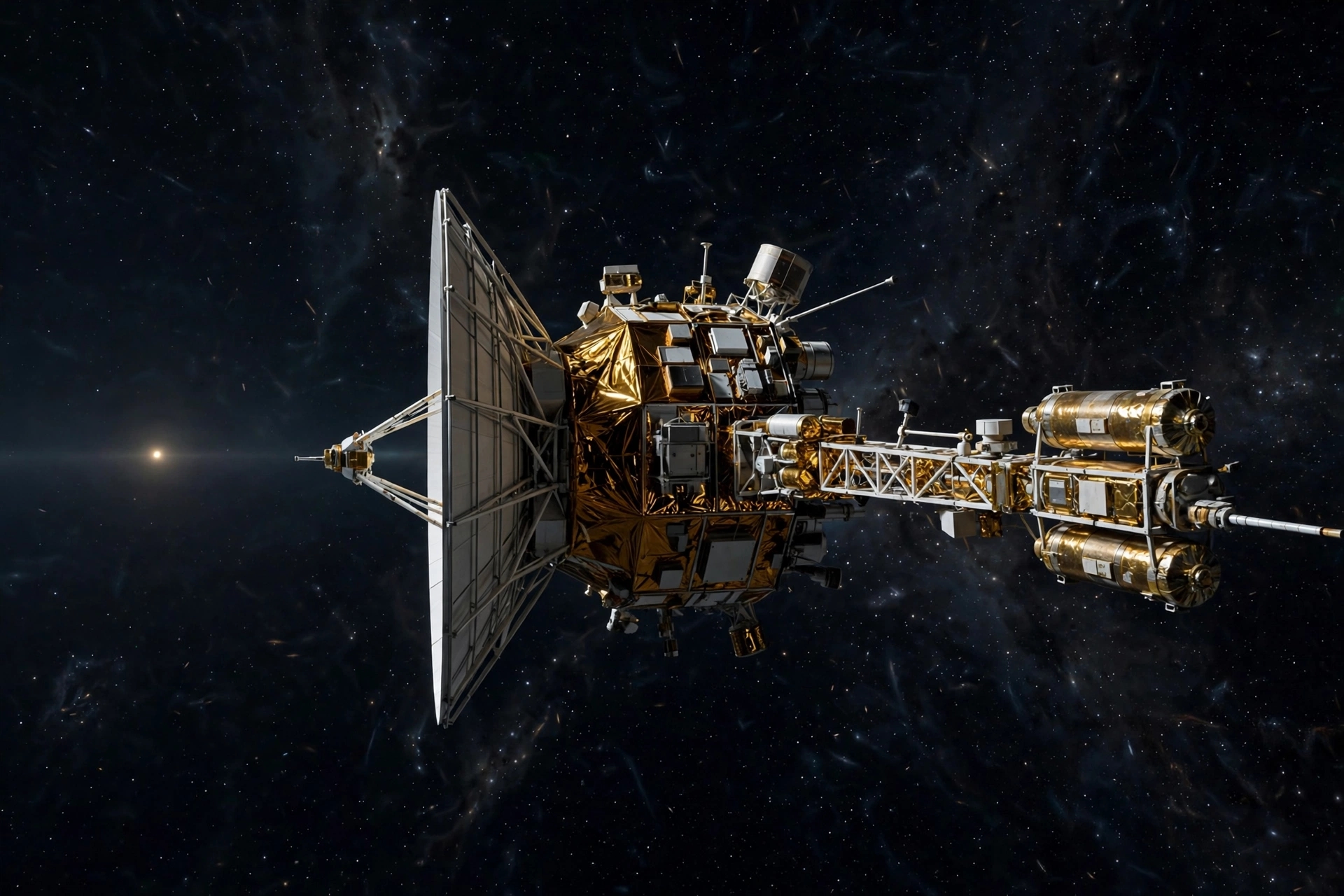
AI Image Disclaimer: The visuals accompanying this article are generated by artificial intelligence and are for illustrative purposes only; they do not depict the actual Voyager 1 spacecraft, its instruments, or the JPL control room.
Published by Banx Network. This article is part of the Banx decentralized media programme, powered by the BXE token on the XRP Ledger.