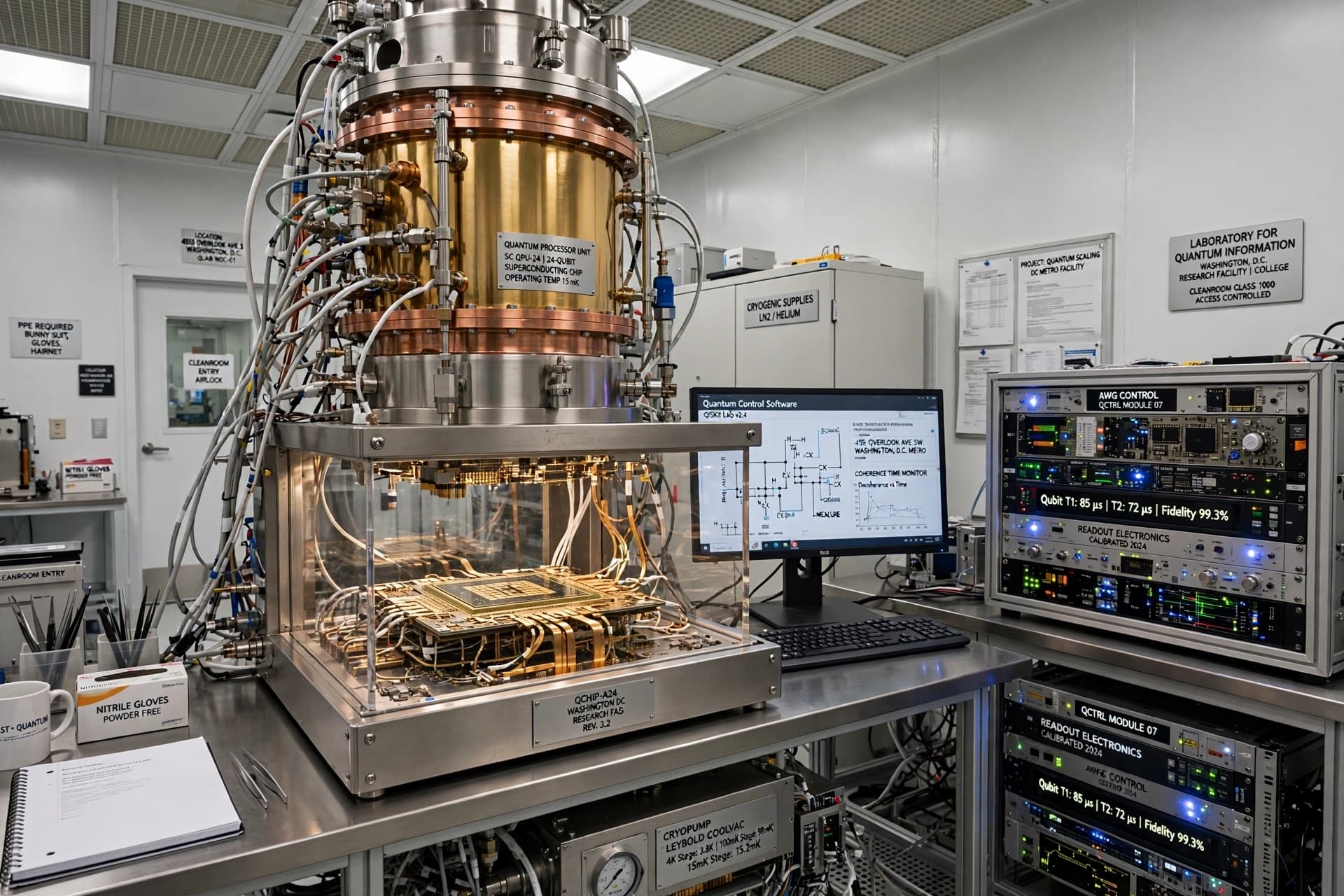
The center is located in the University of Maryland’s Discovery District and was established alongside the university and other industry partners. At its center is a quantum system built around Microsoft’s Majorana 2 chip, technology that the company has been developing as part of its broader effort to create commercially useful quantum machines. DARPA will use the system for independent testing and evaluation.
Quantum computing remains different from conventional computing in ways that are difficult to reduce to a simple comparison. Instead of relying solely on the familiar binary language of conventional machines, quantum systems seek to use properties of quantum mechanics to process certain classes of problems differently. The promise is significant, but so are the engineering challenges that remain between laboratory demonstrations and reliable large-scale systems.
For DARPA, the Maryland facility provides an opportunity to examine the technology through direct access rather than relying entirely on remote demonstrations. Reuters reported that DARPA is evaluating several quantum approaches as part of an effort to determine whether any of them can eventually produce economically feasible systems by 2033. That timeline places today's experiments within a much longer technological horizon.
The questions surrounding quantum computing extend well beyond speed. One area of particular interest is encryption. Powerful quantum machines could eventually have implications for some forms of existing cryptography, while quantum technologies could also contribute to new approaches for protecting communications. For researchers and security organizations, understanding both sides of that equation has become an important part of the field.
Microsoft has previously worked with DARPA through remote evaluation, making the new Maryland arrangement notable because researchers will have physical access to the equipment. The change may allow more detailed observation of how the system performs under real testing conditions, including the practical engineering issues that can be difficult to evaluate from a distance.
The company has said it aims to commercialize its quantum systems by 2029. That objective sits ahead of DARPA’s 2033 evaluation horizon, illustrating the different clocks moving through the same field: companies looking toward products and markets, while government researchers examine whether the underlying technology can meet demanding technical and economic requirements.
The Maryland site also reflects a broader transformation in the geography of advanced computing. Research that once existed primarily within highly specialized laboratories is increasingly being connected to universities, technology companies and government research organizations. The result is an ecosystem in which hardware, academic research and independent evaluation can happen closer together.
There is still a long distance between a functioning quantum system and a mature commercial quantum computer capable of delivering dependable value at scale. The new facility does not remove that distance, nor does DARPA’s evaluation establish that a particular approach will ultimately succeed. What it does provide is a place where the questions can be examined more closely.
And perhaps that is the quieter meaning of the Maryland development. Technological progress is rarely a single dramatic leap. More often, it is a sequence of rooms, laboratories, measurements and experiments where ambitious ideas are slowly asked to prove themselves. In Maryland, one such room has just opened its doors.
IMAGE DISCLAIMER: Images or visualizations accompanying this article are illustrative and may not represent the exact equipment, facility, or testing conditions described.
SOURCES: Reuters CNA Microsoft University of Maryland DARPA
Published by Banx Network. This article is part of the Banx decentralized media programme, powered by the BXE token on the XRP Ledger.

.jpg&w=3840&q=75 "Helion Energy: Can Fusion Power Move From Prototype to the Grid?")