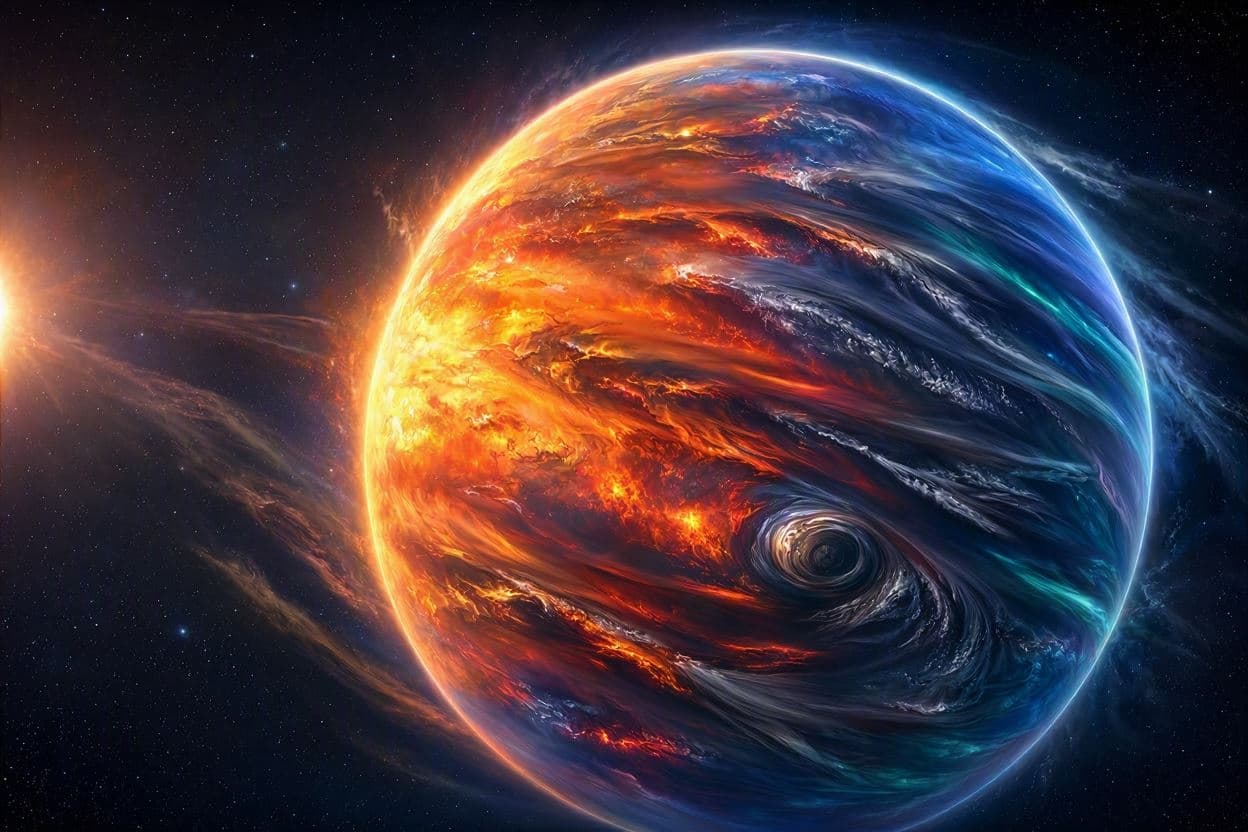
In the vast, silent theater of the cosmos, where planets dance around distant stars, a new level of detail has come into focus. The James Webb Space Telescope, with its keen infrared eye, has peeled back the layers of an alien atmosphere, revealing a world where the weather is not just a backdrop, but a violent, churning force that defies our earthly expectations.
The target of this latest observation is WASP-18b, an "ultra-hot Jupiter" located some 400 light-years from Earth. Unlike the gas giants in our own solar system, this massive world orbits its star in less than a day, subjecting it to searing temperatures that can reach 2,500 degrees Celsius. Such extreme heat does more than just warm the planet; it fundamentally alters the chemistry of its atmosphere, tearing apart water molecules and creating a complex soup of atoms and ions.
For years, astronomers could only guess at the dynamics of such worlds, relying on indirect measurements and theoretical models. But Webb’s ability to capture three-dimensional data has changed the game. By mapping the temperature and composition of the atmosphere across the planet’s surface, scientists have created the first-ever 3D weather map of an exoplanet. This detailed view shows how heat is distributed from the blistering dayside to the slightly cooler nightside, driving winds that scream at thousands of miles per hour.
The findings reveal a chaotic system where energy is transported not just by wind, but by the very breakdown and reformation of molecules. On the dayside, intense radiation from the host star splits water vapor into hydrogen and oxygen. As these gases are swept toward the nightside by supersonic winds, they begin to recombine, releasing heat in the process. This chemical recycling acts as a powerful engine, fueling the turbulent weather patterns that define the planet’s climate.
This discovery challenges previous assumptions about how hot Jupiters behave. Earlier models suggested that such planets might have more uniform temperatures due to efficient heat redistribution. However, Webb’s data shows significant variations, indicating that the atmosphere is far more dynamic and less predictable than previously thought. These insights help refine our understanding of planetary formation and evolution in extreme environments.
The implications extend beyond WASP-18b. By understanding the forces at play on this distant world, scientists can better interpret observations of other exoplanets. Each new map adds a piece to the puzzle of how diverse planetary systems can be, highlighting the unique conditions that arise when a planet lives in such close proximity to its star.
As technology continues to advance, the hope is that future telescopes will provide even greater resolution, allowing us to see smaller-scale features like storms or cloud formations. For now, the 3D map of WASP-18b stands as a testament to human ingenuity, offering a glimpse into a world that is both alien and strangely familiar in its atmospheric complexity.
The James Webb Space Telescope continues to redefine our view of the universe, turning distant points of light into detailed worlds with their own weather, chemistry, and stories. As we learn more about these chaotic atmospheres, we gain a deeper appreciation for the delicate balance that makes our own planet so hospitable.
AI Image Disclaimer: The visual elements accompanying this article are AI-generated interpretations designed to reflect the themes of astronomical discovery and exoplanetary science.
Sources: Science Daily, University of Maryland, NASA, Nature Astronomy
Published by Banx Network. This article is part of the Banx decentralized media programme, powered by the BXE token on the XRP Ledger.