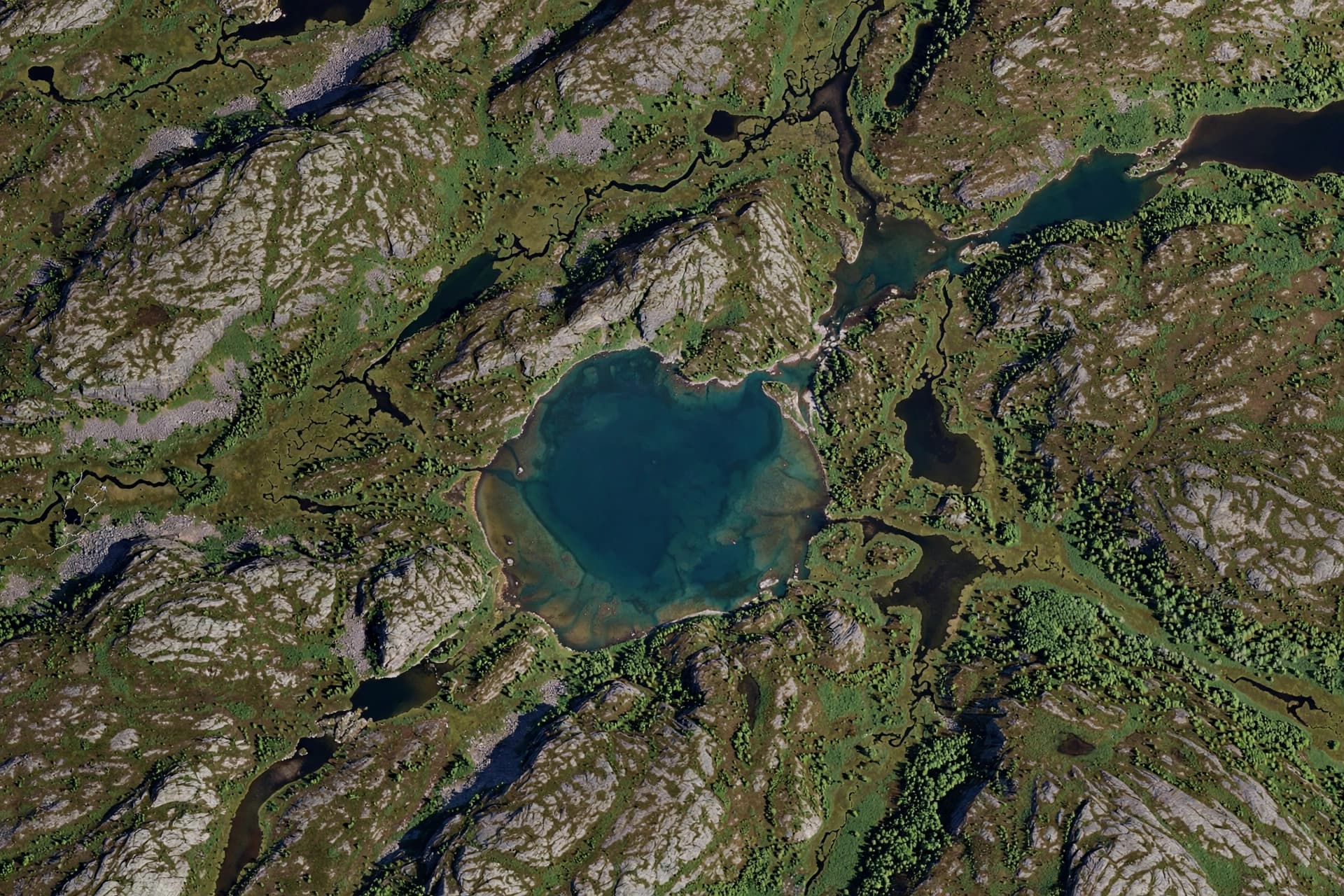
There is a quiet kind of discovery that happens when someone is looking for something else entirely—a moment when the eye catches a shape that does not belong, a pattern that whispers of a different story. In 2024, Joël Lapointe was planning a camping trip in Quebec’s Côte-Nord region, scanning satellite maps for a suitable spot by the water. What he found instead was a circular depression near Lake Marsal, a formation so distinctly round that it seemed to demand explanation . He was not a geologist. He was simply a curious person with a computer and a question.
Lapointe, an amateur astronomer, did what any thoughtful observer might do: he checked whether the structure appeared in databases of known impact craters. It did not. He then contacted researchers, and his inquiry eventually reached Gordon Osinski, a planetary geologist at Western University and director of the Impact Earth database . Osinski was skeptical at first. He receives frequent emails from members of the public claiming to have found craters, and the vast majority prove unfounded. But the satellite imagery and the character of the terrain were compelling enough to warrant a closer look .
In October 2025, a team traveled to the remote site. The journey itself was an ordeal. They arrived by floatplane, but the aircraft could not reach the shore; the researchers waded fifty meters through water, carrying their equipment . The terrain was rugged, marshy, and densely vegetated. Osinski, who has conducted fieldwork on all six continents, described it as one of the most difficult expeditions of his career . For days, the team gathered samples and photographs, uncertain whether they were documenting a meteorite impact or a volcanic formation previously misclassified.
Then they found the evidence that changed everything. Scattered across rock outcrops were shatter cones—conical structures that form only under the extreme shock waves of a cosmic impact or a nuclear explosion . They also discovered cliffs of impact melt rock, formed when the heat and pressure of an asteroid strike liquefied vast volumes of the Earth’s crust . Dating of zircon crystals in the samples indicated the impact occurred approximately 390 million years ago, when the first vertebrates were just beginning to emerge on land .
The crater, now named Uhackatik in consultation with the Innu Council of Ekuanitshit, measures roughly 25 kilometers in diameter . Osinski noted that an impact of this magnitude today would devastate an entire region, potentially leveling major cities and causing global climatic effects . At 25 kilometers, it ranks among the largest craters discovered in recent years, and its relative youth—geologically speaking—and preservation make it particularly valuable for study. Researchers believe it could offer insights into crater formation on the Moon, Mars, and other rocky bodies in the solar system .
Lapointe, for his part, has been gracious about his role in the discovery. “It’s not every day that an ordinary citizen finds a 390-million-year-old crater,” he told Radio-Canada . He encouraged others not to ignore their intuition or observations, even when they fall outside their field of expertise. The researchers will present their findings at the annual congress of the Meteoritical Society, and further laboratory analyses are planned to confirm the preliminary results .
What began as a search for a campsite became a contribution to geological knowledge—a reminder that discovery does not always require a laboratory or a grant. Sometimes it requires only a person willing to ask what a strange shape on a map might mean, and researchers willing to follow that question into the wilderness.
AI Image Disclaimer: The images accompanying this article were generated by artificial intelligence and are intended for illustrative purposes only.
Sources:
· CBC News · Futura Sciences · Radio-Canada
Published by Banx Network. This article is part of the Banx decentralized media programme, powered by the BXE token on the XRP Ledger.