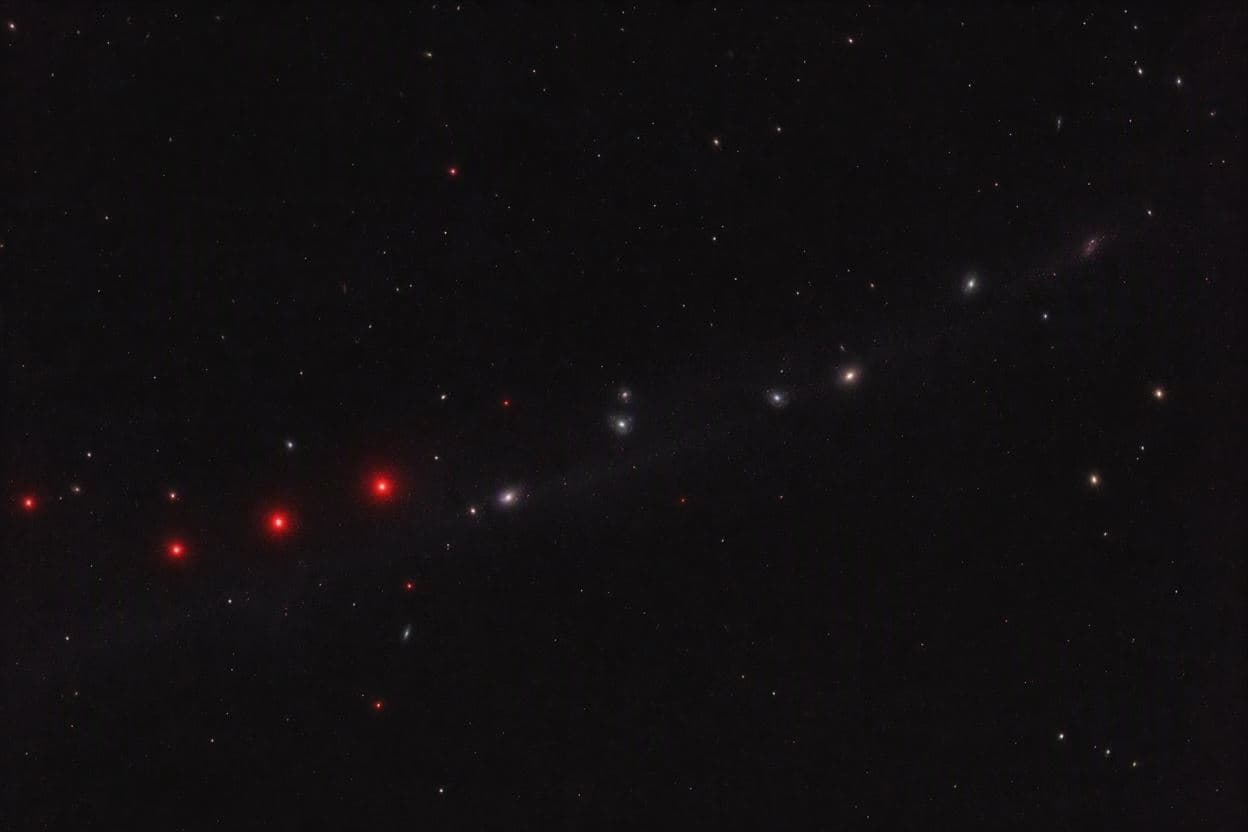
In the deepest reaches of the early universe, where time itself seems to stretch and warp, astronomers have discovered enigmatic objects known as "Little Red Dots." These compact, bright sources, detected by the James Webb Space Telescope, have puzzled scientists since their discovery. Now, new research suggests that these dots may be the seeds of the supermassive black holes that reside at the centers of galaxies today, offering a glimpse into the mysterious origins of these cosmic giants.
The Little Red Dots are characterized by their small size and intense red color, indicating that they are extremely distant and existed when the universe was less than a billion years old. What makes them particularly intriguing is their brightness, which exceeds what normal stars can produce. This excess energy suggests the presence of accretion disks, where matter spirals into a central object, heating up and emitting light. In this case, the central object is likely a black hole in its infancy.
Traditional theories of black hole formation struggle to explain how supermassive black holes could grow so large so quickly after the Big Bang. If they started as stellar-mass black holes, formed from the collapse of massive stars, they would not have had enough time to accumulate the billions of solar masses we see today. The Little Red Dots offer a potential solution: they may represent a new class of "black hole stars" or direct-collapse black holes, which formed from massive clouds of gas without going through the stellar phase.
Recent studies published in Nature and other journals propose that these objects are surrounded by dense cocoons of gas and dust, which obscure their visible light but allow infrared radiation to escape. This explains their red appearance and their unusual spectral features. By analyzing the light from these dots, astronomers can infer the properties of the black holes within, such as their mass and accretion rate, providing critical data for refining formation models.
The discovery of these objects challenges our understanding of galaxy evolution. If supermassive black holes formed early and grew rapidly, they may have played a key role in shaping the first galaxies, influencing star formation and chemical enrichment. The interplay between black holes and their host galaxies is a complex dance, and the Little Red Dots provide a front-row seat to the opening act of this cosmic drama.
Observational evidence continues to mount, with more Little Red Dots being identified in JWST data. Each new discovery adds to the statistical sample, allowing scientists to test different hypotheses about their nature. Some researchers argue that they could be intense starburst galaxies, but the lack of certain spectral signatures makes the black hole hypothesis more compelling. The debate is healthy and drives further investigation.
Understanding the origins of supermassive black holes is not just an academic exercise; it helps us comprehend the structure of the universe we live in today. Every large galaxy, including our own Milky Way, hosts a supermassive black hole at its center. Tracing their lineage back to the Little Red Dots connects the present to the primordial past, revealing the continuity of cosmic evolution.
As JWST continues to peer deeper into space and time, it is likely that more surprises await. The Little Red Dots are just the beginning of a new chapter in astronomy, one that promises to rewrite the history of the early universe. In their faint red glow, we see the seeds of the giants that rule the cosmos.
AI Image Disclaimer: The images accompanying this article are AI-generated artistic interpretations of early universe phenomena and are not actual photographs from the James Webb Space Telescope.
Sources: Nature MIT News Universe Today
Published by Banx Network. This article is part of the Banx decentralized media programme, powered by the BXE token on the XRP Ledger.