There is a question that has occupied biologists for as long as they have studied life: what is the minimum required for something to be alive? Not merely to exist, but to reproduce, to maintain itself, to carry forward the instructions of its own existence. The answer, according to a newly discovered microorganism from the ocean, is far less than anyone might have guessed—and yet, in its own way, more precise and complete than expected.
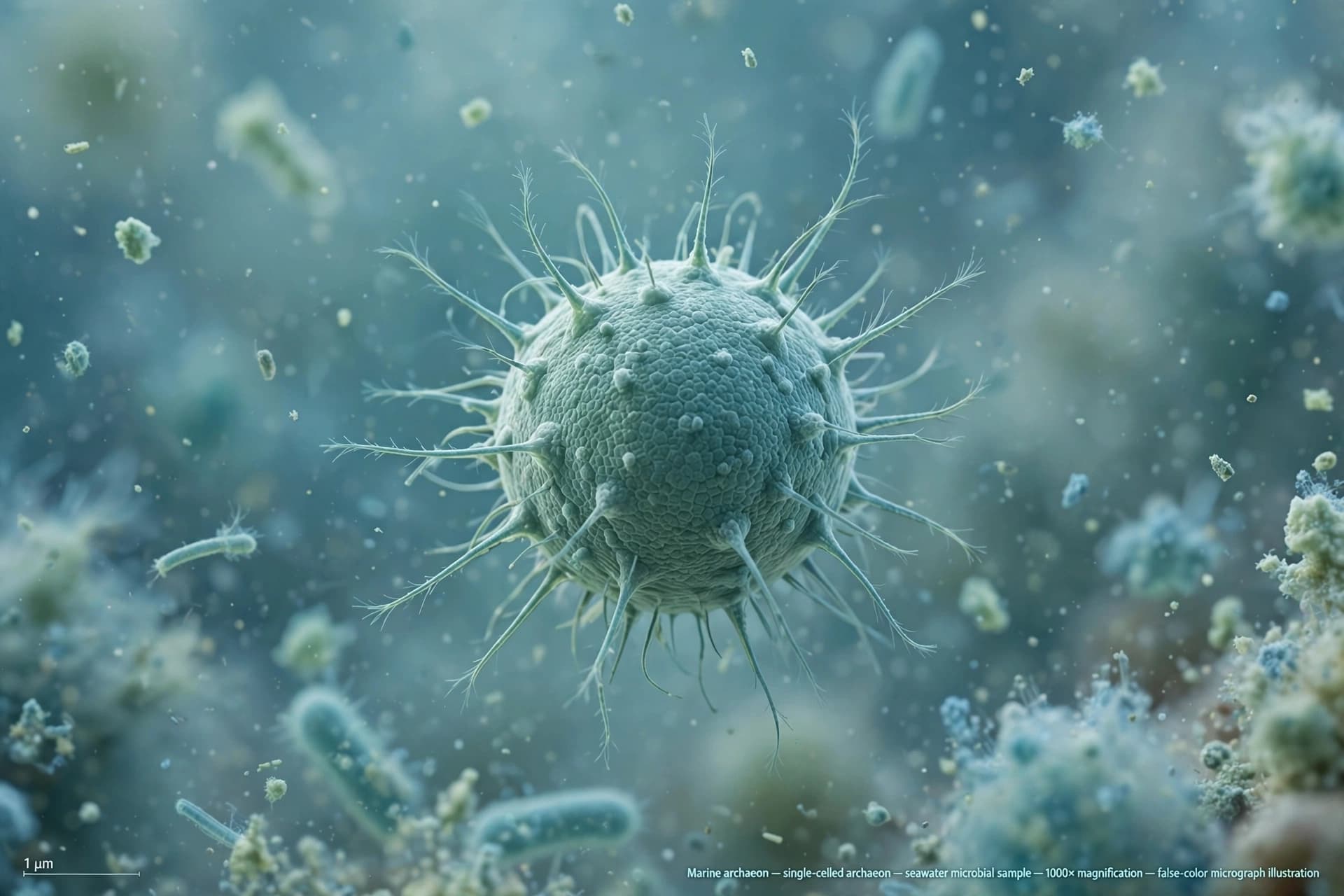
The organism is an archaeon, a type of single-celled life fundamentally distinct from bacteria. It has been named Candidatus Sukunaarchaeum mirabile, or Sukunaarchaeum for short, after a small Japanese deity . It was discovered by an international team from the University of Nottingham and the University of Tsukuba while analyzing the genetic material of individual marine plankton. What they found was a genome of extraordinary economy: just 189 protein-coding genes, less than half the size of the smallest archaeal genome previously known .
But the size of the genome is only part of the story. Most organisms with very small genomes have abandoned some of the machinery required for independent life. Mitochondria, for instance, were once free-living bacteria but now depend on their host cells for much of what they need. Sukunaarchaeum, however, has taken a different path. It has lost almost all the genes needed to produce its own nutrients and energy—yet it has retained the full complement of genes required to copy its DNA and manufacture proteins . It can replicate itself. It can express its genetic information. It may, in other words, be close to the minimum level of genetic information needed for an organism to remain an independent cell.
Professor Thorsten Allers, a co-author of the study from the University of Nottingham, explained the significance: “The key to defining life is whether something can replicate itself, and whether it can do this autonomously. This exciting discovery provides new clues about how simple a living cell can become while remaining capable of reproducing and maintaining its own genetic information” .
The organism’s strategy appears to be one of extreme dependence combined with remarkable self-sufficiency. It cannot make its own nutrients; it must obtain them from other organisms. Around a quarter of its genome consists of genes for unusually large membrane proteins whose functions remain unknown, but which are also found in some parasitic archaea . This raises the possibility that Sukunaarchaeum lives as a parasite inside or alongside another organism. The researchers have not yet directly observed the microbe or identified its host.
The discovery adds to a growing body of research into minimal genomes. Previous work on organisms like Mycoplasma genitalium suggested that a few hundred genes might be sufficient for independent life, but Sukunaarchaeum pushes that boundary further . The organism belongs to a lineage that is genetically very different from all previously known archaea, and related sequences found in marine samples suggest it is part of a much larger group that has gone largely unnoticed .
The team plans to investigate where Sukunaarchaeum lives, what it depends on, and how it interacts with other organisms. The findings, published in Current Biology, could help scientists better understand the limits of life—how much genetic information an organism truly needs to survive and reproduce, and what can be discarded along the way.
There is something almost philosophical about a creature so reduced and yet so complete. It has shed nearly everything it can afford to lose and kept only what it cannot do without. In its tiny genome, the essentials of life are written in their most minimal form—a reminder that complexity is not the only path to persistence.
AI Image Disclaimer: The visual content in this article was generated by artificial intelligence and serves an illustrative purpose only.
Published by Banx Network. This article is part of the Banx decentralized media programme, powered by the BXE token on the XRP Ledger.