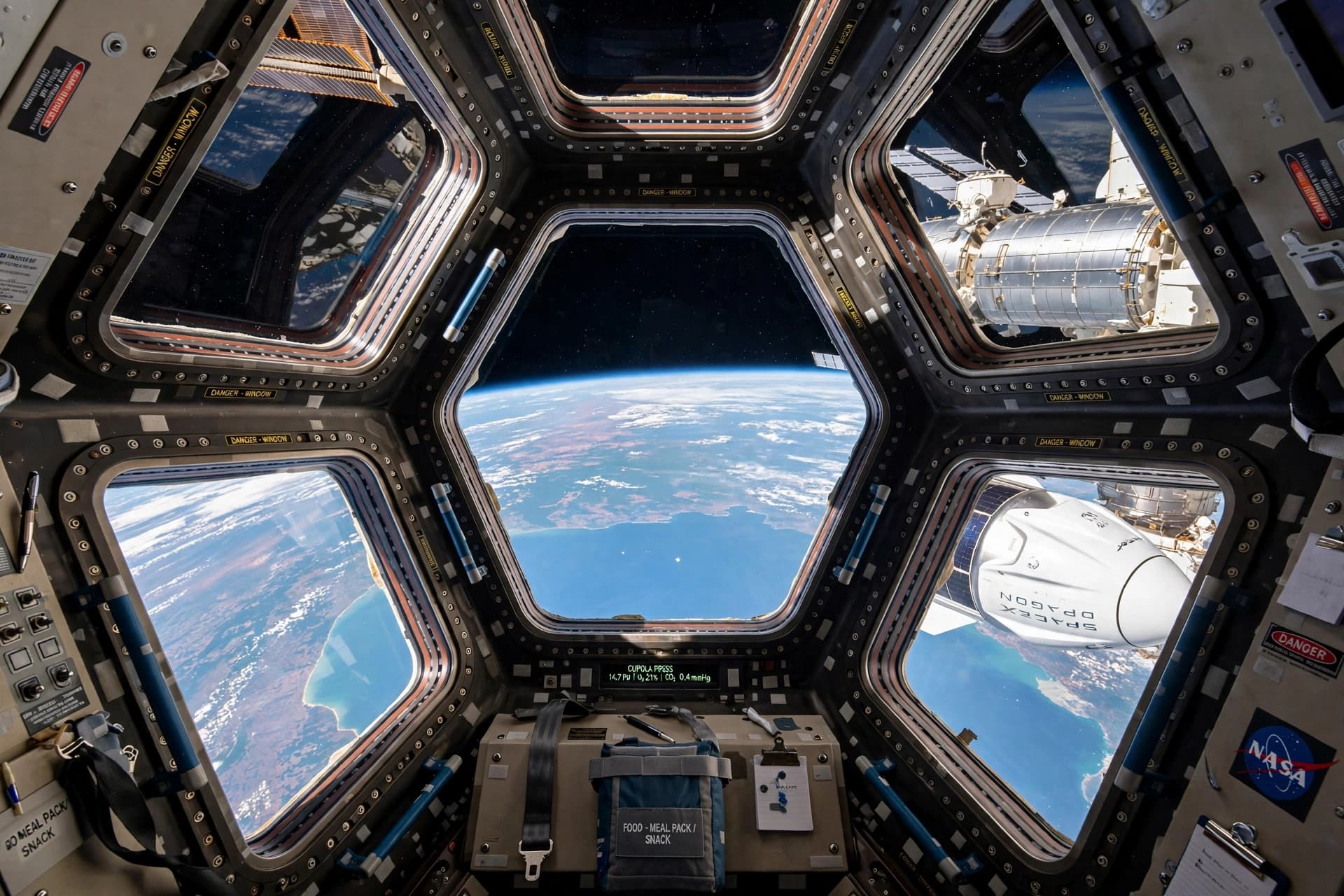
There is a particular wonder in watching a human being leave the planet and arrive somewhere else—a journey that once took days, then hours, and now, with a kind of quiet efficiency, less than eight hours from launch to hatch. On Thursday, October 1, Canadian Space Agency astronaut Joshua Kutryk and his Crew-13 colleagues boarded the International Space Station after a flight from Cape Canaveral that set a new record for a Commercial Crew mission. The Dragon spacecraft docked at 7:06 p.m. ET, just 7 hours and 55 minutes after liftoff, and the hatch was opened a little over two hours later .
Kutryk, a 44-year-old colonel and former fighter pilot, is the first Canadian astronaut to fly as part of NASA's Commercial Crew Program. He joins NASA astronauts Jessica Watkins and Luke Delaney and Roscosmos cosmonaut Sergey Teteryatnikov for a six-month mission aboard the station . The crew launched from Florida at 11:10 a.m. ET aboard a SpaceX Falcon 9 rocket, beginning a journey that Kutryk described as the fulfillment of a lifelong dream .
Upon boarding the station, Kutryk expressed both disbelief and gratitude. "It's been a while since a Canadian has been here. I cannot believe I'm here," he said, drawing laughter from his fellow crew members. "I just cannot believe it, but it just feels really good to have the CSA back, the Canadian flag back, and I'm just looking forward to a good mission—after some sleep" . Earlier, during the approach, he thanked those who had made the mission possible and spoke of the responsibility that comes with operating "humanity's one and only outpost in space" .
The mission is notable not only for its speed but for its scientific focus. During his six months aboard, Kutryk will contribute to Canadian and international experiments centered on health research. These include testing a new physical training protocol for astronauts, studying mental health, bone density, cardiorespiratory health, perception of orientation, anemia, and ocular rigidity . He will also participate in technology demonstrations designed to advance space exploration and improve life on Earth, as well as regular maintenance and robotics tasks, including potential spacewalks .
For the Canadian Space Agency, this mission represents a significant milestone. It is the CSA's fourth long-duration mission to the ISS and its first as part of the Commercial Crew Program . Mathieu Caron, director of the CSA's astronaut office, noted that the studies conducted during these missions are critical as humans prepare to return to the Moon and eventually journey to Mars . The mission follows Canada's participation in the Artemis II lunar flyby, which carried CSA astronaut Jeremy Hansen around the Moon earlier this year .
There is also a personal dimension to Kutryk's mission that adds a layer of poignancy. His wife, Heather, is expecting the couple's third child while he is in orbit. Caron acknowledged the unique circumstances, noting that the CSA and NASA are working together to provide support and arrange video calls with his growing family . Kutryk, who grew up on a cattle farm in eastern Alberta, will experience the birth of his child from 250 miles above the Earth—a reminder that even in an era of routine spaceflight, the human stories at the center of these missions remain extraordinary.
AI Image Disclaimer: The visual elements in this article were created using AI generation tools and are intended for illustrative purposes only.
Sources: Canadian Space Agency, CBC News, The Canadian Press, SRF
Published by Banx Network. This article is part of the Banx decentralized media programme, powered by the BXE token on the XRP Ledger.