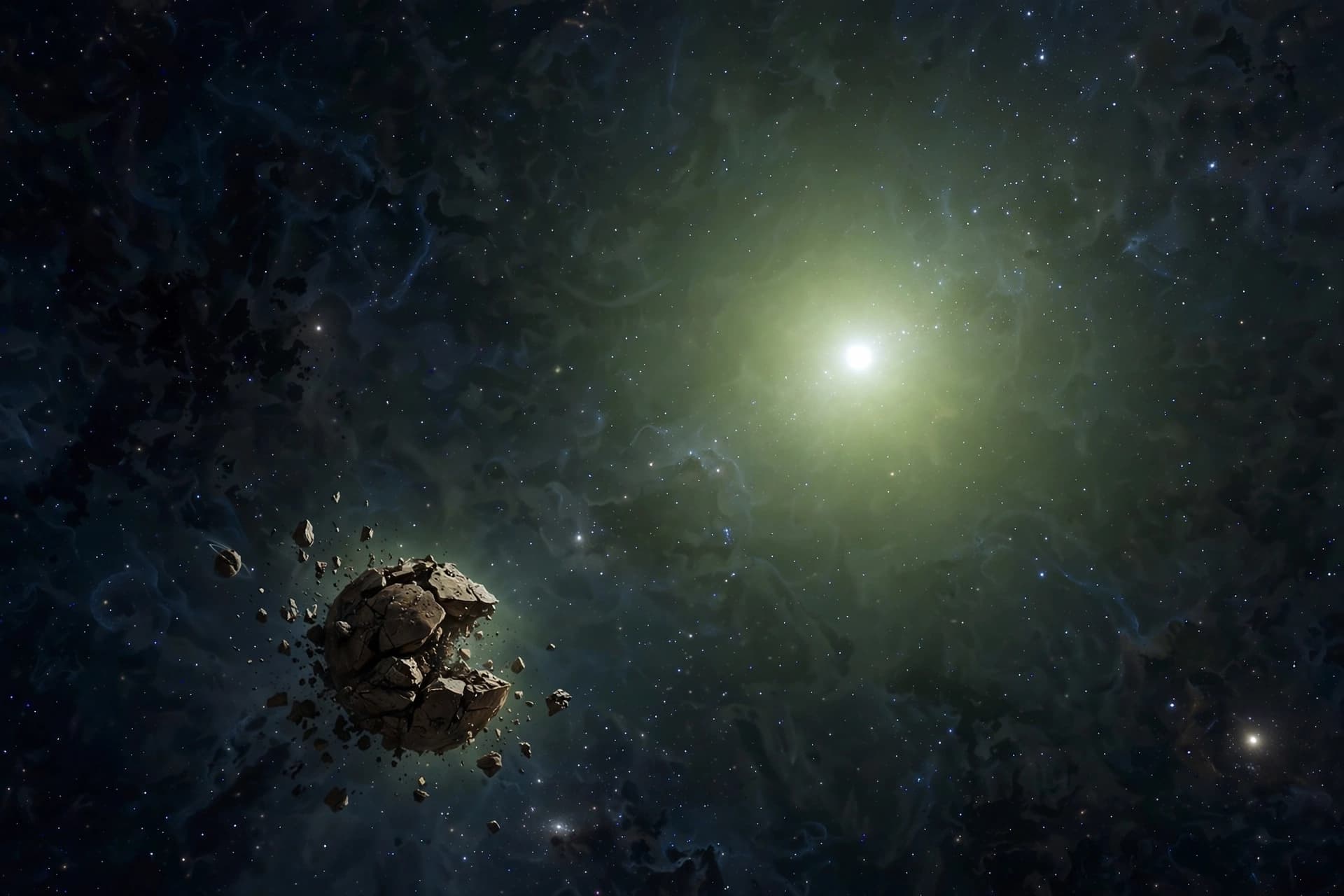
In the palette of the cosmos, stars have always obeyed a simple rule: temperature dictates color. Cool stars glow orange, the Sun shines white, the hottest burn blue. But somewhere in the constellation Draco, a dead star has broken that rule in a way that feels almost like a ghost story—a cosmic zombie that swallowed its own planets and now glows a pale, spectral green.
Astronomers at the University of Warwick have identified WD J1330+6435 as the first green star ever credibly documented. The white dwarf, located about 280 light-years from Earth, is a dense stellar remnant roughly the size of our planet but containing half the mass of the Sun. Its unusual chartreuse hue comes from an atmosphere enriched with sodium, calcium, and lithium—elements it ingested from the rocky debris of planets that once orbited it .
The science behind the color is elegant. In normal stars, sodium absorbs a narrow wavelength of orange light. But white dwarfs are extraordinarily dense—millions of times denser than the Sun's outer layers, roughly the density of water. Under such conditions, sodium atoms are constantly bombarded by surrounding helium atoms, altering their energy levels. The sodium no longer absorbs just orange; it absorbs yellows, oranges, and some reds. What remains is a ghostly green glow .
"The traces of sodium in the atmosphere of this white dwarf absorb the orange part of the spectrum, leaving behind a ghostly green glow," said Mark Hollands, lead author of the study published in RAS Techniques and Instruments. "Imagine standing on a planet and looking up at a green star. It feels like something out of science fiction" .
The discovery emerged from a broader project assessing how white dwarfs would appear to human eyes. Researchers found that despite their name, white dwarfs can display a wide range of colors—pink, purple, yellow, cyan, and in one remarkable case, green. The color depends on the chemical composition of the star's atmosphere, which in turn reflects what it has consumed. Stars rich in carbon appear pink or purple. Cooler ones with hydrogen and helium look blue. And those that have feasted on planetary debris take on warmer, stranger hues .
Co-author Boris Gänsicke compared the phenomenon to painting. "They start with a few basic colors, then mix them together to form any color they need for their painting," he said. "Take away some of the color going into the mix, and the output will change" .
While green stars have long existed in science fiction, WD J1330+6435 is the first confirmed example in the real universe. For astronomers, it is a reminder that even in the quiet aftermath of stellar death, the cosmos can produce colors no one expected to find.
AI Image Disclaimer: This article's image is AI-generated and does not depict an actual astronomical observation.
Sources: The Globe and Mail, The Independent, Space.com, VRT, Emirates24|7, Ukrinform
Published by Banx Network. This article is part of the Banx decentralized media programme, powered by the BXE token on the XRP Ledger.