There is a particular kind of training that does not happen in simulators or classrooms, but in environments where the consequences of inattention are immediate and the isolation is not an exercise. For astronauts preparing for the long voyages ahead—to the moon, to Mars, perhaps beyond—one of the most instructive places on Earth may lie beneath the surface of the sea.
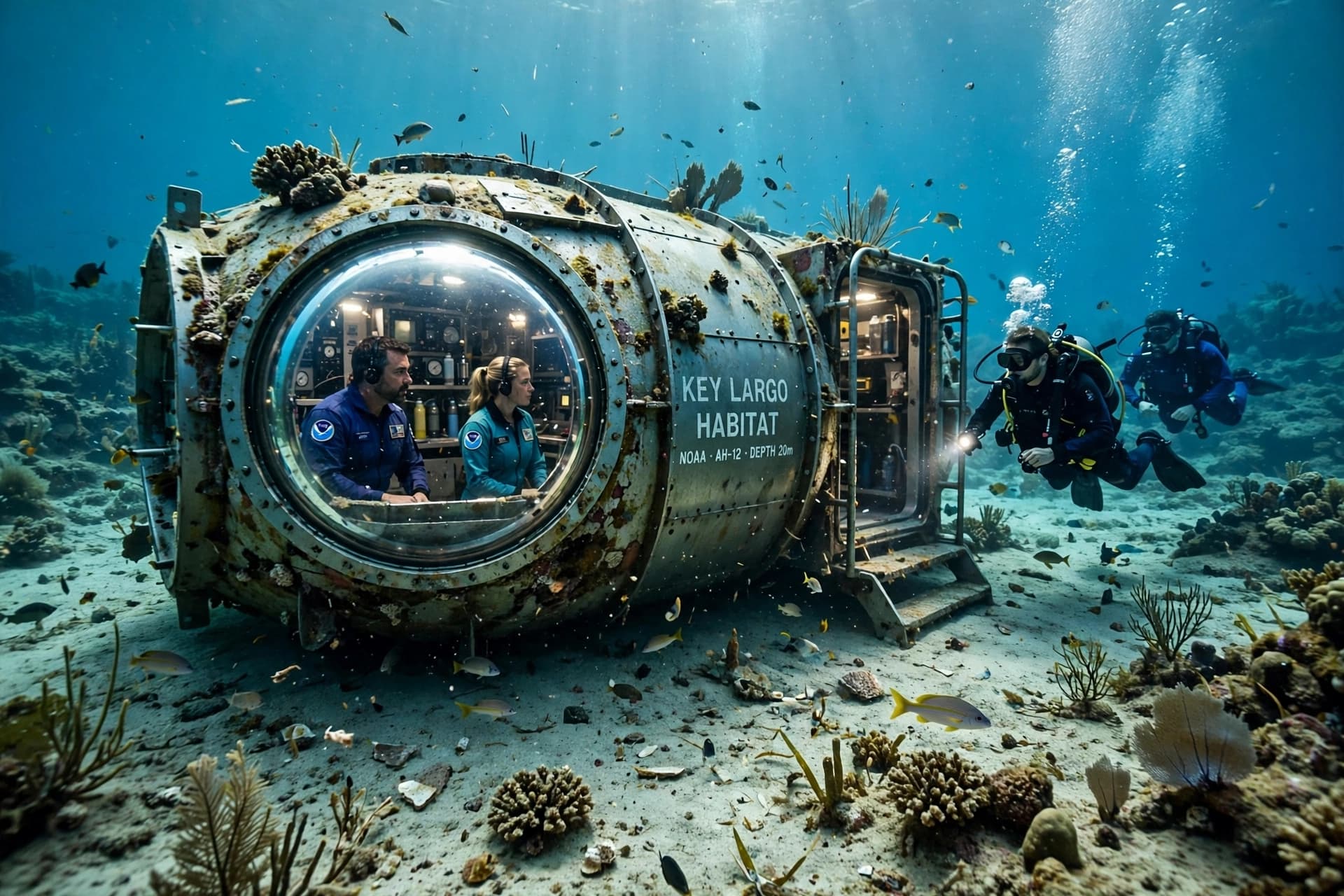
Underwater habitats like the Jules’ Undersea Lodge in Key Largo, Florida, serve as analog environments for space missions, places where the physical and psychological conditions of spaceflight can be approximated with a fidelity that land-based simulations cannot match . The concept is not new. NASA’s NEEMO missions, which began in the 2000s, used the Aquarius undersea laboratory to train astronauts for the International Space Station and future deep-space missions . The rationale was straightforward: an undersea habitat is isolated, extreme, and unforgiving, much like space itself.
To become an aquanaut, a participant must stay underwater for at least 24 hours, entering a state of saturation. The body absorbs all the nitrogen it can at a given depth, and surfacing requires hours of decompression. This constraint, inconvenient as it may seem, mirrors the operational realities of spaceflight: once you are there, you cannot simply leave . The habitat becomes home, and the surrounding water becomes the void.
The risks are real, and that is part of the point. In an underwater habitat, equipment malfunctions or sudden storms can threaten the crew in ways that land-based analogs cannot replicate. The strict procedures required for safety—checking gear, monitoring weather, managing air supplies—cultivate a discipline that translates directly to space operations . As one analog astronaut observed, the higher risk of an underwater mission makes it feel more similar to an actual space mission than a simulated one on land.
The scientific objectives of these missions are equally grounded. Crews test spaceflight countermeasures, validate equipment for tracking tools in a habitat, and study how the body and mind respond to confinement and high atmospheric pressure . NEEMO missions also include simulated spacewalks, with aquanauts weighted to approximate lunar or Martian gravity, practicing the careful choreography of working outside a spacecraft while communicating with mission control .
What the underwater environment offers that a simulator cannot is a kind of embodied knowledge. The weight of the water, the need to monitor air, the constant awareness of a boundary between safety and danger—these become second nature. For astronauts who will one day travel far from Earth, that second nature may be as valuable as any technical skill.
The analog astronaut experience also carries a quieter lesson. Living in an underwater habitat, with a small crew and limited space, requires patience, communication, and a willingness to set aside irritation for the sake of the mission. These are not qualities that can be taught in a lecture. They are learned in the doing, in the small hours of a shared confinement, in the moments when the outside world feels impossibly distant.
The work continues, with missions like SEA STAR and the ongoing NEEMO program refining the methods by which the sea prepares humans for the stars. There is a fitting symmetry in this: the ocean, the most familiar of Earth’s frontiers, serving as the training ground for the least familiar. To go to space, it seems, one might first learn to live beneath the waves.
Image note: The image accompanying this piece is AI-generated and intended for illustrative purposes only.
Sources: NASA, Space.com, NASA Analog Missions Case Study, NASA Technical Reports Server
Published by Banx Network. This article is part of the Banx decentralized media programme, powered by the BXE token on the XRP Ledger.