The sun does not give up its secrets easily. From a distance, it appears as a steady furnace, but up close—close enough for a spacecraft to graze its corona—it becomes a place of tangled forces and restless energy, where the rules of ordinary fluids and the behavior of charged particles meet in an uneasy truce. Understanding that boundary is one of the quiet obsessions of heliophysics.
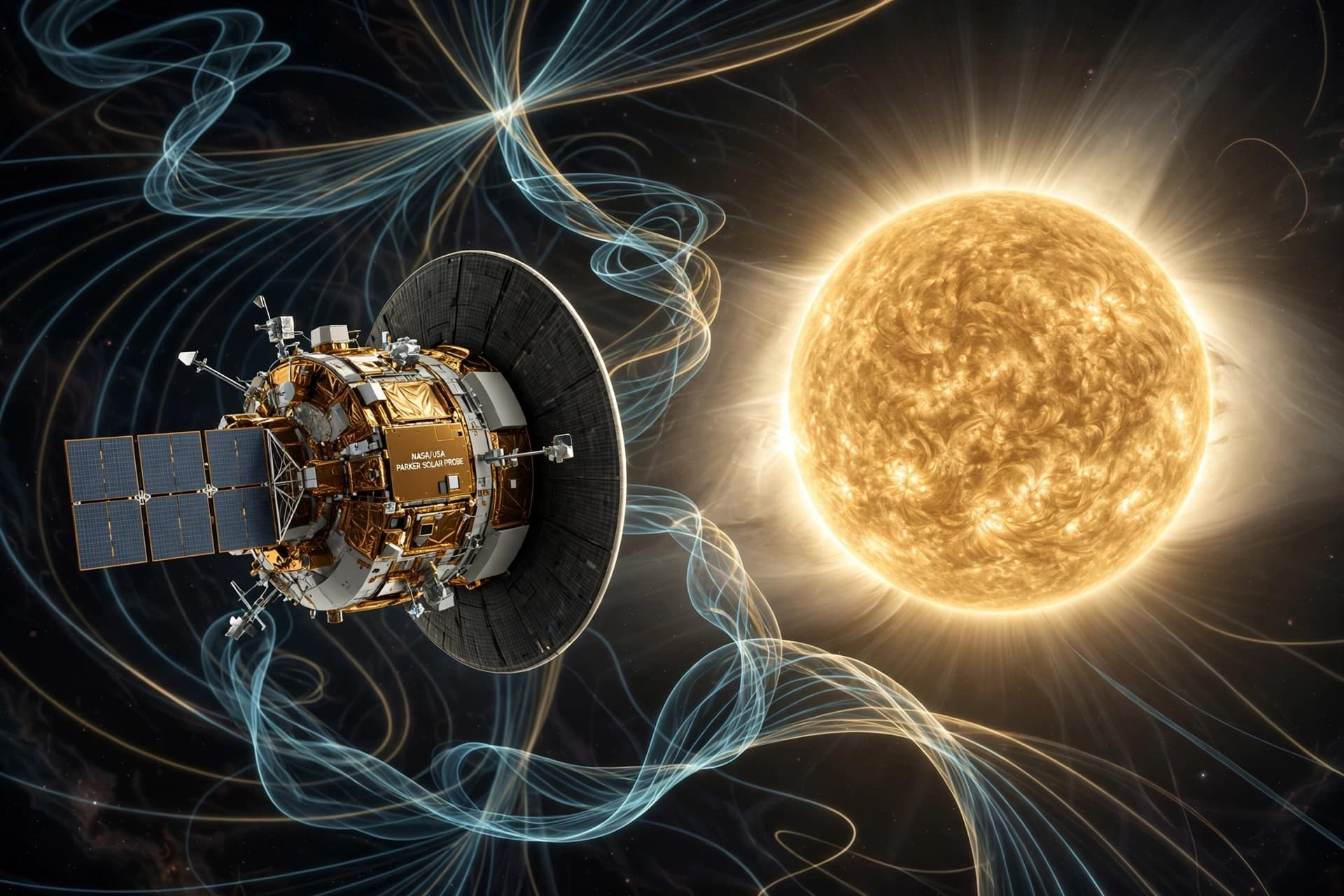
A recent analysis of data from NASA’s Parker Solar Probe has brought a sharper focus to that boundary. Researchers examining high-resolution magnetic field readings from the spacecraft identified a distinct pattern: paired, counter-rotating helical structures emerging near the interface where the solar wind transitions from a fluid-like plasma to a collection of individual particles . These twisted magnetic braids, as they might be imagined, are not merely curiosities. They appear to grow and couple across scales, linking small particle-level ripples to larger plasma motions in a way that complicates the standard picture of how energy moves through the solar wind .
The finding, published in The Astrophysical Journal Letters, centers on a property called magnetic helicity—essentially the amount of twisting and linking in magnetic field lines. In the sun’s chaotic environment, such handedness usually washes out. But near the ion kinetic interface, the Parker data showed something unusual: a clear helical signal, with two peaks of opposite rotation sitting side by side . The structure seemed to resist the local plasma conditions, its frequencies biased toward lower values in a pattern researchers describe as nonlocal evolution.
This matters because the solar wind carries energy outward from the corona, and how that energy dissipates—or fails to dissipate—shapes the environment that spacecraft and astronauts must navigate. A related concept, the helicity barrier, suggests that in certain turbulent plasmas, energy flowing from large swirls down to tiny ripples can be blocked at the ion boundary, forcing magnetic structures to grow larger instead of breaking apart . The Parker observations appear consistent with that accumulation, at least until the solar wind crosses the heliospheric current sheet, where the helical signature fades.
The work does not claim to solve the broader puzzle of coronal heating or solar wind acceleration. The authors are careful, and the data remain open to interpretation. What the study offers is a more textured view of the interface itself—a region where the language of fluids and the language of particles must somehow be spoken together, and where the sun’s magnetic field leaves fingerprints that are only now becoming legible.
Parker Solar Probe continues its mission, diving closer to the sun with each orbit. The twisted braids it has revealed are not the final word, but they are a reminder that the solar wind is not a simple breeze. It is a braided, structured, and still-unfinished story, written in fields and particles, waiting for the next pass to turn another page.
Image note: This article includes an AI-generated illustration for atmospheric context; it is not an actual photograph from the mission.
Sources: Universe Today, The Astrophysical Journal Letters, NASA Parker Solar Probe mission materials
Published by Banx Network. This article is part of the Banx decentralized media programme, powered by the BXE token on the XRP Ledger.