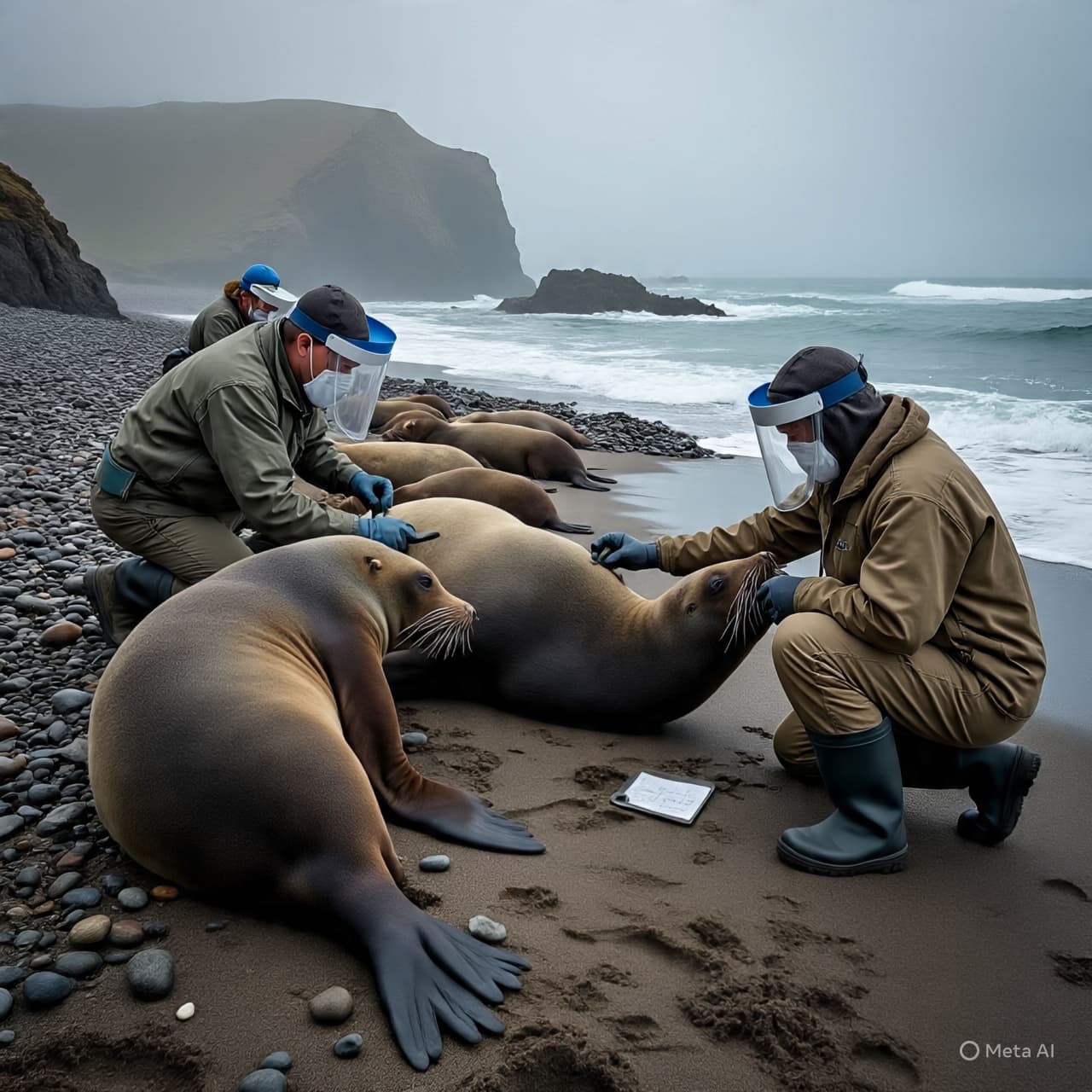
In the golden hush of a winter morning wind at California’s Año Nuevo beaches, great silvered forms once only whispered about in seasonal migration stories now lie still against the surf. It is here, where ocean and sand meet, that an unseen guest has arrived — not with the herald of wings or song, but as a microscopic visitor carried perhaps on a distant wing or ocean breeze. The seals, ancient dwellers of these shores, have become the first of their kind in California to be touched by a virus known more for its journeys through birds than mammals. In the soft light of dawn, scientists and rangers alike watch, not with clamor or alarm, but with the solemn attentiveness born of deep care for lives both wild and vulnerable.
Along the sweeping arc of coastline at Año Nuevo State Park, researchers started to notice something unusual halfway through February — eightlungs that trembled once with breath, the slackened gaze of pups less than a year old, and the quiet stillness where restless motion once reigned. Samples taken from seven northern elephant seal pups, long the spirited protagonists in winter beach life, tested positive for the highly pathogenic avian influenza strain H5N1, a first for marine mammals in California and a moment that has brought focused scientific attention to this rugged stretch of shore.
The implications are both immediate and introspective. On one hand, park officials have paused routine public viewing and guided tours — a precautionary gesture toward both human visitors and the seals themselves. On the other, wildlife biologists from the University of California system and collaborating agencies now expand their observations, scanning both sea and sand for further clues. These are not harbingers of hysteria but rather reminders that the web of life — woven from feathers and flukes, waves and wind — holds threads that sometimes carry surprises.
For communities near and far, there is care in guidance: do not touch live or dead seals, keep pets at a respectful distance, and cherish the quiet majesty of these animals from afar. Researchers remind that risk to people remains very low, and yet they listen closely to the rhythms of the colony, where adult females have largely departed on migration, leaving researchers hopeful that many remain untouched by illness.
Like footprints in shifting sand, this first detection marks both a moment and a movement toward understanding how viruses travel beyond their ordinary realms. The ocean has stories to tell, and it falls upon the careful observers — the park rangers, the scientists, the quiet visitors — to reflect these tales with both precision and compassion.
At the edge of wave and world, the seals continue their ancient cycle, and those who watch them continue theirs: to learn, to protect, and to honor the fragile dance between life and change.
AI Image Disclaimer (Rotated Wording) “Visuals are created with AI tools and are not real photographs.”
Sources — Media/Niche
Associated Press (AP News) reporting on the bird flu outbreak in California elephant seals. CBS San Francisco covering the virus found in elephant seal pups. UC Davis News/UC Santa Cruz release on the first HPAI detection in marine mammals in California. KQED reporting on park closures and wildlife monitoring. San Francisco Chronicle / SFGate detailed local reporting on infected seals and research response.
Published by Banx Network. This article is part of the Banx decentralized media programme, powered by the BXE token on the XRP Ledger.