Life, in its most resilient forms, often thrives where we least expect it. In the scalding waters of hot springs, where temperatures soar well above what most complex organisms can endure, a tiny amoeba has been found flourishing. Dubbed the "fire amoeba," this microscopic creature has shattered previous scientific assumptions about the heat limits of eukaryotic life. Its discovery not only expands our understanding of biological boundaries but also invites us to reconsider the potential for life in extreme environments across the universe.
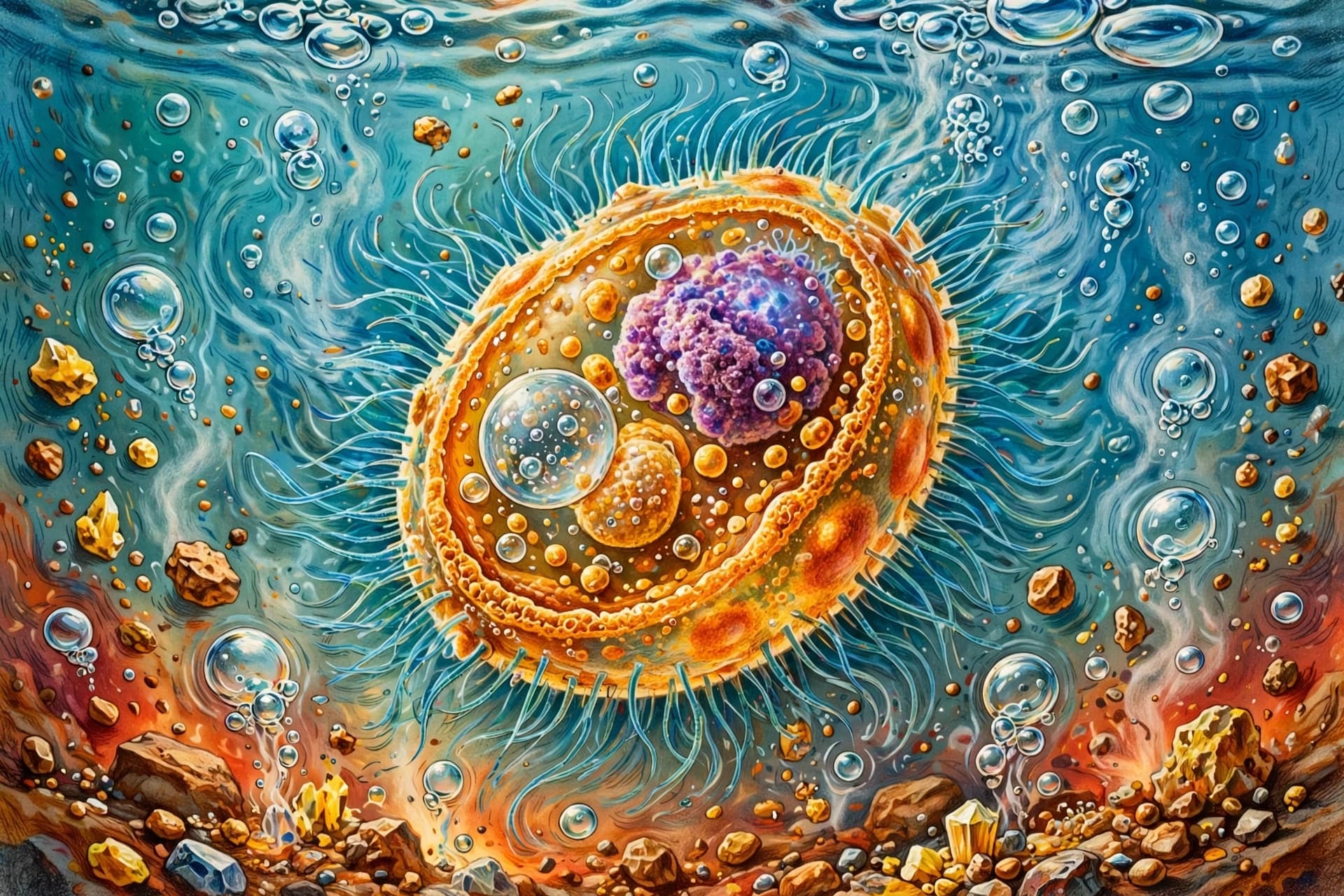
The amoeba, scientifically named Incendiamoeba cascadensis, was discovered in the geothermal pools of Lassen Volcanic National Park in California. Researchers found that it can reproduce at temperatures up to 63°C (145°F), a record for any complex cell with a nucleus. Previously, it was believed that eukaryotes—organisms whose cells contain a nucleus—could not survive above 60°C. This new finding pushes that boundary, demonstrating that complex life is more adaptable than previously thought.
The significance of this discovery lies in the distinction between simple and complex life. Bacteria and archaea, known as extremophiles, have long been known to thrive in extreme heat. However, eukaryotes, which include plants, animals, and fungi, were thought to be more fragile. The fire amoeba’s ability to maintain cellular integrity and divide at such high temperatures suggests that evolutionary mechanisms exist to protect complex cellular structures from heat damage.
Scientists are now studying the genetic and molecular adaptations that allow Incendidoeba to survive. Preliminary research indicates that the amoeba may possess unique proteins or metabolic pathways that stabilize its cellular components. Understanding these mechanisms could have applications in biotechnology, such as developing heat-resistant enzymes for industrial processes. It is a glimpse into the innovative solutions nature has engineered over millions of years.
This discovery also has implications for astrobiology. If complex life can exist in Earth’s hottest springs, it raises the possibility that similar organisms could thrive in extreme environments on other planets or moons. Places like Europa or Enceladus, with their subsurface oceans and hydrothermal activity, become even more compelling targets in the search for extraterrestrial life. The fire amoeba serves as a model for what might be possible beyond Earth.
For the scientific community, the find is a reminder of how much remains unknown about the diversity of life on our own planet. Despite centuries of study, new species continue to be discovered in unexpected places. The fire amoeba highlights the importance of exploring niche environments, where unique evolutionary pressures have shaped distinct forms of life. It encourages a sense of humility and curiosity in the face of nature’s complexity.
Public interest in the "fire amoeba" reflects a fascination with the extremes of life. It captures the imagination, offering a story of resilience and adaptation. By sharing this discovery, scientists hope to inspire greater appreciation for microbial life and its role in ecosystems. It is a small creature with a big message about the tenacity of life. The discovery of the fire amoeba breaks a longstanding barrier in biology, showing that complex life can withstand higher temperatures than previously believed. It expands our understanding of life’s limits and opens new avenues for research in evolution and astrobiology. As we continue to explore the natural world, such findings remind us that life is full of surprises.
AI Image Disclaimer: The visuals in this article are AI-generated artistic representations of microscopic organisms and geothermal environments, not actual microscopic images of Incendiamoeba cascadensis.
Sources: NPR Gizmodo New Scientist
Published by Banx Network. This article is part of the Banx decentralized media programme, powered by the BXE token on the XRP Ledger.