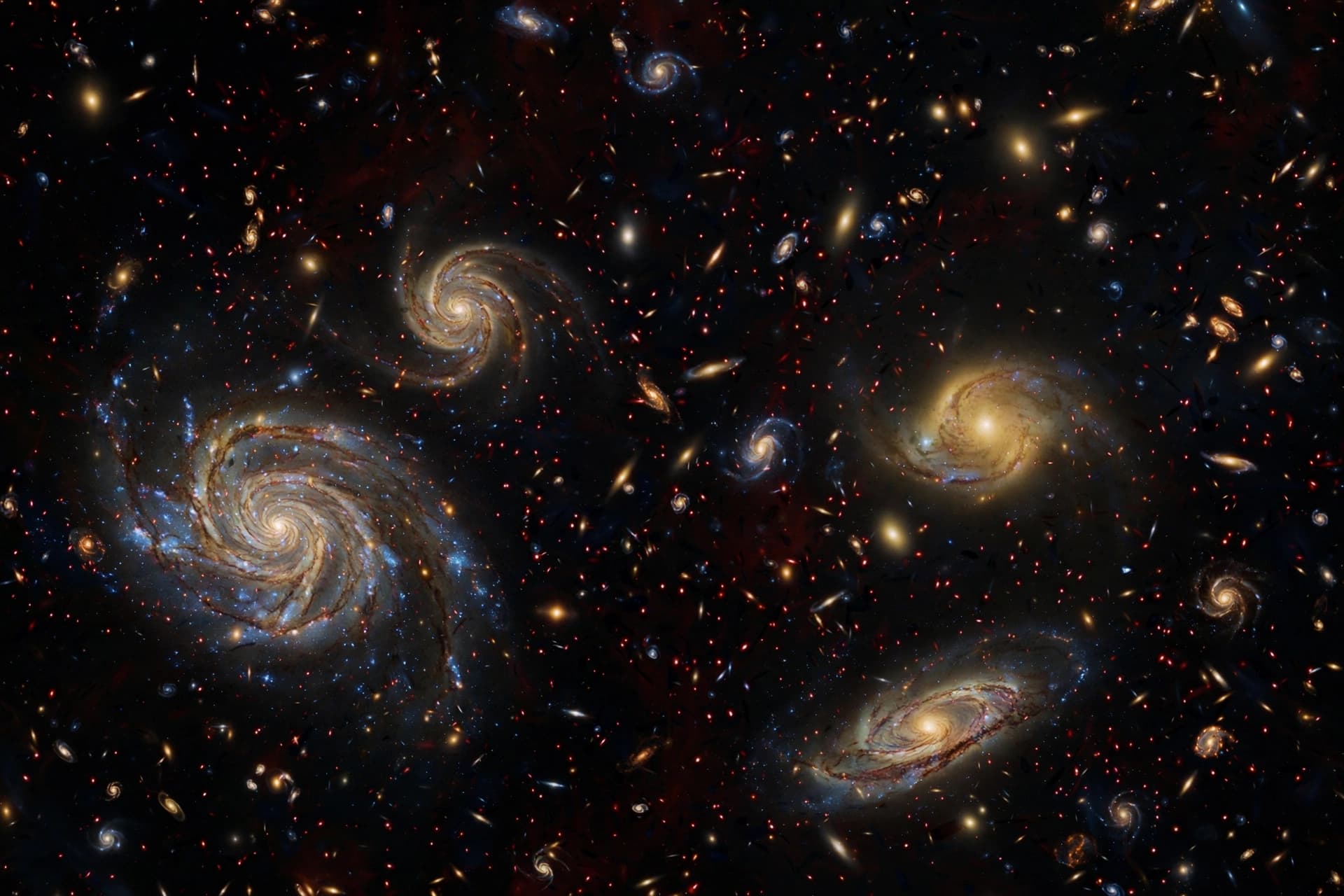
The universe is filled with enigmas, points of light that defy easy explanation. Among these are the mysterious "red dots" observed in deep space, faint sources that have puzzled astronomers for years. Recently, a breakthrough study has offered a compelling explanation for these elusive objects, suggesting they may be young, dusty galaxies in the early universe. This revelation not only solves a long-standing mystery but also opens a new window into the cosmic dawn, when the first stars and galaxies were just beginning to shine.
The red dots were initially detected by the James Webb Space Telescope (JWST), which revealed numerous compact, red sources in the early universe. Their color indicated high redshift, meaning they are extremely distant and old. However, their small size and brightness did not fit neatly into existing models of galaxy formation. Scientists were left wondering if they were something entirely new, perhaps exotic objects like primordial black holes or unusual star clusters.
The new explanation proposes that these red dots are indeed galaxies, but ones shrouded in thick dust and dominated by intense star formation. The dust absorbs ultraviolet light from young, hot stars and re-emits it as infrared radiation, which appears red to our instruments. This process, known as reddening, can make galaxies appear smaller and redder than they actually are. The JWST’s sensitivity to infrared light allows it to peer through this dust, revealing the true nature of these objects.
This finding aligns with theoretical predictions about early galaxy evolution. In the first billion years after the Big Bang, galaxies were likely smaller, denser, and dustier than their modern counterparts. The red dots represent a population of these infant galaxies, undergoing rapid growth and star birth. Their discovery helps fill a gap in our understanding of how large structures like the Milky Way formed over time.
For cosmologists, this is a significant step forward. It validates the capabilities of the JWST and confirms that our models of the early universe are on the right track. The ability to identify and characterize these faint sources enhances our confidence in interpreting other deep-field observations. It turns confusion into clarity, allowing for more accurate maps of the cosmic web.
The implications for star formation history are profound. If these red dots are common, it suggests that the early universe was a bustling factory of stars, producing massive amounts of light and heavy elements. This activity would have influenced the reionization of the universe, a key phase when neutral hydrogen was transformed into ionized plasma. Understanding this process is crucial for piecing together the timeline of cosmic evolution.
Public interest in these "red dots" reflects a broader fascination with the unknown. The idea that there are still mysteries to be solved in the depths of space captivates the imagination. Each explanation brings us closer to a complete picture of the cosmos, yet also reveals new questions to ask. It is a cycle of discovery that keeps science vibrant and engaging.
As research continues, astronomers will look for more examples of these red dots, studying their properties in greater detail. Spectroscopic analysis will confirm their distances and chemical compositions, providing even deeper insights. The journey from mystery to understanding is ongoing, driven by curiosity and advanced technology.
The likely explanation of the mysterious red dots as dusty, young galaxies marks a triumph of modern astronomy. It demonstrates the power of the James Webb Space Telescope to unravel the secrets of the early universe. As we look further back in time, the cosmos reveals its history, one red dot at a time.
AI Image Disclaimer: The visuals in this article are AI-generated artistic interpretations of deep space fields and early galaxies, not actual raw images from the James Webb Space Telescope.
Sources: Space.com NASA JWST Mission Page Nature Astronomy
Published by Banx Network. This article is part of the Banx decentralized media programme, powered by the BXE token on the XRP Ledger.