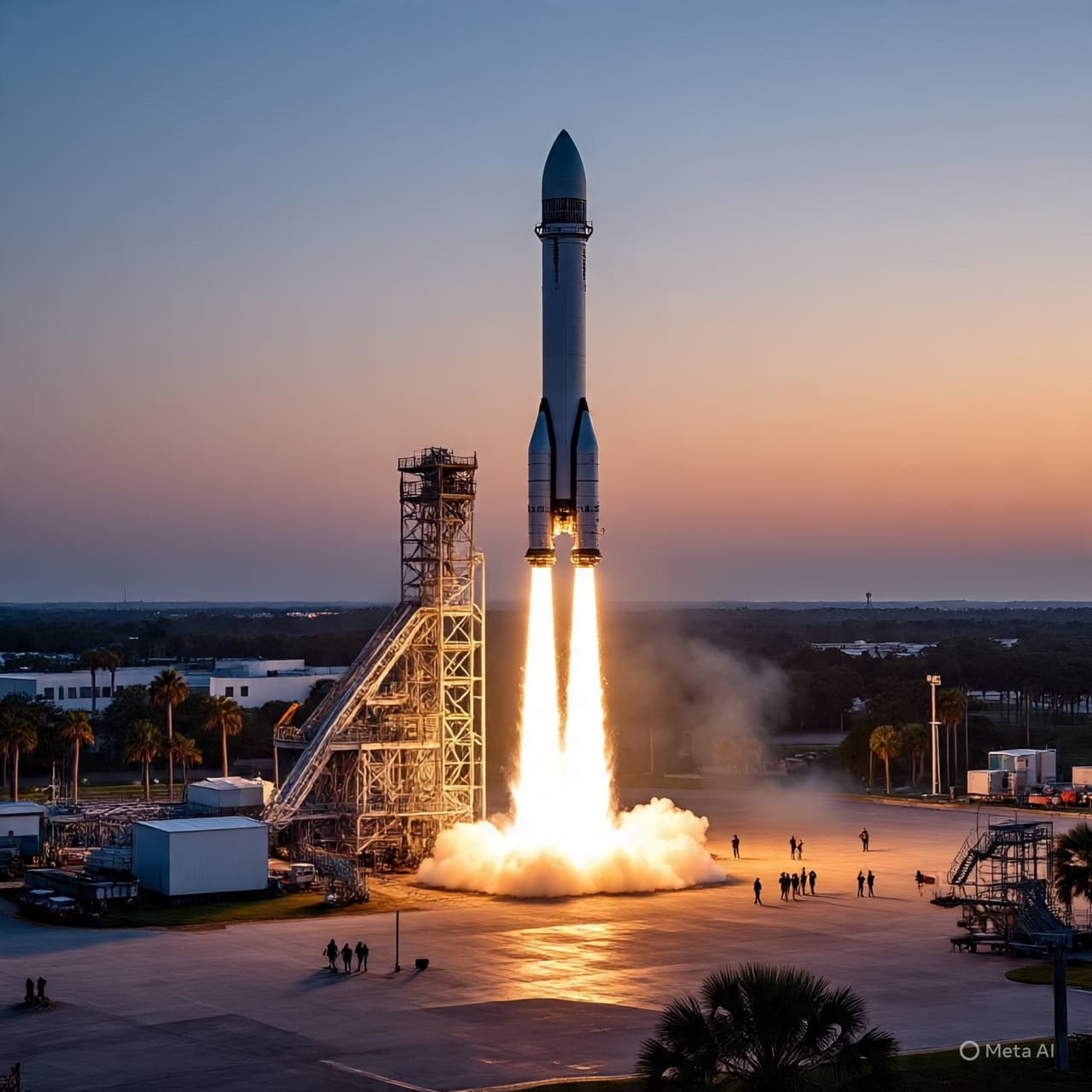
There are mornings in life when the horizon seems to breathe differently, when the first light of day stretches gently across the Earth and reaches into the skies above, inviting things unseen and untried to rise. On one such dawn this week, from the quiet fringes of California’s coast, SpaceX lifted a Falcon 9 rocket into that soft glow, beginning a new chapter not just in launch cadence but in how humanity imagines making things beyond our planet. (NASASpaceFlight.com)
The mission was called Twilight, a name that feels lyrical and apt — a moment caught between night and day, between what has already been and what might soon be. In the early hours of Sunday, Jan. 11, from Space Launch Complex-4E at Vandenberg Space Force Base, the Falcon 9 rose at about 5:44 a.m. PST, carrying 40 small payloads destined for a dawn-dusk sun-synchronous orbit — a place where satellites travel perpetually along the line where Earth’s night kisses its day. (3dprint.com)
Tucked among those dozens of spacecraft was a quiet experiment with a big question: can a structure be born in the vacuum of space using additive manufacturing? A German company called Dcubed has sent up a prototype designed to 3D print a sixty-centimeter boom in orbit, a small yet symbolically rich attempt to stretch the possibility of “making” beyond Earth’s gravity. (All3DP)
In that arrangement — where NASA science missions, communications satellites, Internet-of-Things nodes, observation CubeSats, and this humble manufacturing test share a ride — one sees a reflection of a broader human impulse. We send tools not merely to observe, but to build; we send machines not only to listen, but to interact; we invest in experiments that whisper promises of future systems that can assemble themselves in the half-light of space where the sun never sets, and the stars never sleep. (spaceflightnow.com)
The Falcon 9’s first stage, ever faithful, touched back down at Landing Zone 4 shortly after placing its diverse cargo into orbit, a reminder that in our rush toward distant ambitions, there remains a rhythm, a measured pulse to each achievement. (spaceflightnow.com)
From this rendezvous of dawn and mechanical ingenuity, we can feel the gentle unfolding of a narrative in spaceflight: one where shared missions grow, not just in number but in meaning, where a rideshare flight can carry both scientific insight and the seeds of future industrial possibilities. (NASASpaceFlight.com)
SpaceX’s Twilight rideshare flight, the inaugural launch in this new series, marked one of the earliest orbital missions of 2026 and highlights how commercial and institutional players are making orbit more accessible and more varied in purpose. (spaceflightnow.com)
AI Image Disclaimer (Rotated Wording) “Graphics are AI-generated and intended for representation, not reality.”
Sources 3DPrint.com – SpaceX Twilight rideshare mission coverage. (3dprint.com) UPI / AccuWeather news – SpaceX launches Twilight rideshare with NASA and 3D printing experiments. (AccuWeather) Spaceflight Now – report on deployments and mission details. (spaceflightnow.com) NASAspaceflight.com – SpaceX Twilight rideshare mission launch account. (NASASpaceFlight.com) All3DP – in-space 3D printing experiment information. (All3DP)
Published by Banx Network. This article is part of the Banx decentralized media programme, powered by the BXE token on the XRP Ledger.