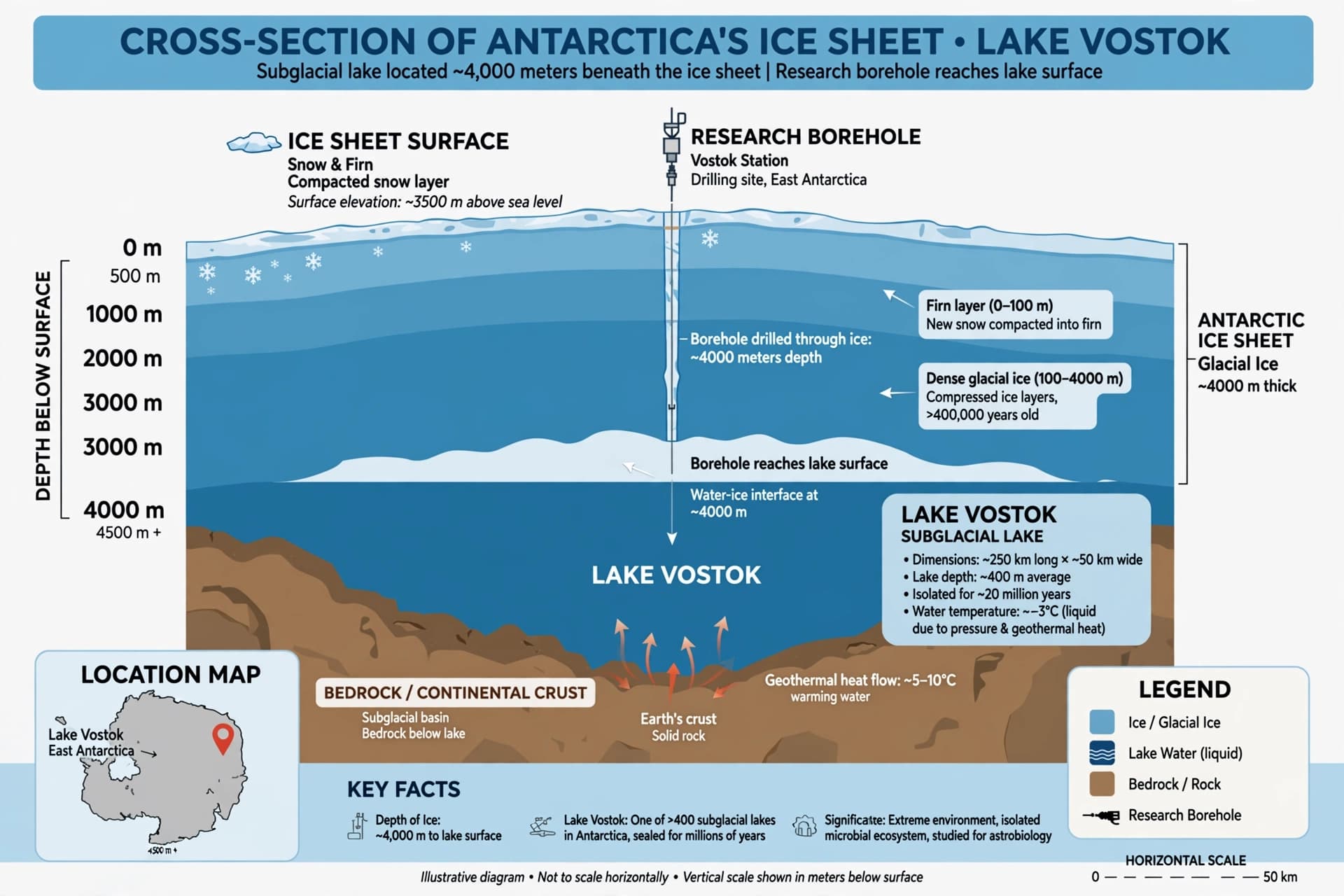
There is a particular kind of mystery that resides not in the stars but beneath our feet—a secret held so deeply and for so long that the very idea of it strains the imagination. Beneath the frozen surface of Antarctica, buried under nearly four kilometers of ice, lies a body of water that has not felt the touch of sunlight or the breath of wind for at least fifteen million years. It is called Lake Vostok, and no human has ever seen it.
Lake Vostok is one of the largest lakes on Earth by volume, roughly the size of Belgium, yet it exists in a state of isolation so complete that its water has been sealed off from the atmosphere since before the ancestors of modern humans walked the African savanna . The lake was first suspected in the 1960s, when Soviet seismic surveys hinted at something unusual beneath the ice. In 1996, British and Russian researchers confirmed its existence using radar imagery .
The challenge of studying such a place is immense. Drilling through four kilometers of ice without contaminating the lake has proven extraordinarily difficult. In 2012, Russian researchers finally reached the surface of the lake using a drill filled with kerosene and freon—a method that concerned many scientists because of the risk of introducing modern microbes into an ecosystem that had evolved in complete isolation . The samples that were retrieved contained traces of bacterial DNA, but skepticism remains about whether these organisms are truly native to the lake or the result of contamination .
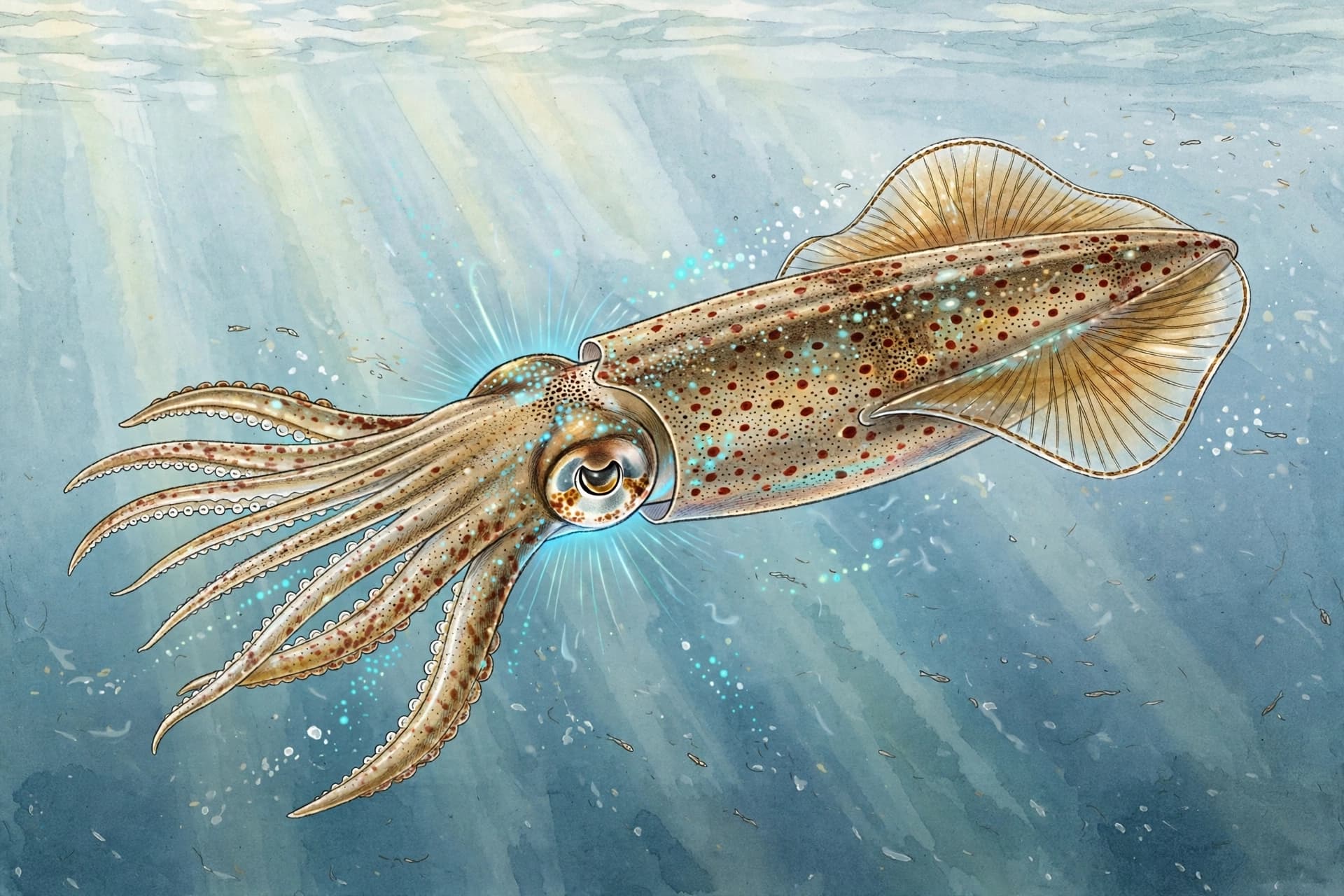
In the years since, Russian cryoastrobiologists have continued to analyze ice cores pulled from the depths. In 2025, researchers at the Petersburg Nuclear Physics Institute announced the discovery of a fourth new bacterial species in the ice, one that, like its predecessors, appears unrelated to any known genus or family . The closest known relatives of this organism share only about 87 percent of its DNA—a vast genetic distance in microbiological terms . The lake, it seems, may host a microbial world entirely its own.
Lake Vostok’s significance extends far beyond Antarctica. It is considered the best Earth-based analog for the subsurface oceans believed to exist beneath the icy crusts of Jupiter’s moon Europa and Saturn’s moon Enceladus . If life can persist in the darkness and isolation of Vostok, then the same might be true for these distant moons. The study of the lake’s microbes could inform the search for life beyond Earth.
Yet the question of whether to continue exploring Vostok—and how—remains unresolved. Concerns about contamination cut both ways: the risk of introducing surface organisms into the lake, and the risk of releasing unknown microbes into the surface world . No new drilling projects that would reach the lake are currently underway. The last borehole that made contact with the lake was in 2015 . Russia has announced plans to develop a cleaner drilling system, but the project remains incomplete.
What lies in the dark water of Lake Vostok, whether it is a thriving ecosystem of novel life or a sterile relic of a distant age, remains unknown. The lake keeps its secrets well—and perhaps, for now, that is as it should be.
AI Image Disclaimer: The imagery accompanying this article was created using artificial intelligence for illustrative purposes only and does not depict the actual lake or research described
Published by Banx Network. This article is part of the Banx decentralized media programme, powered by the BXE token on the XRP Ledger.