There is a certain poetry in watching an empty cup under soft light, its surface unmarked yet brimming with possibility. We often think of imagination as a private gift unique to humans — a space where pictures, stories, and unspoken thoughts rise, flicker, and drift like motes of dust in afternoon rays. But what if that silent world of inner vision is not only ours to inhabit? What if another species, one whose roots weave close to our own on the tree of life, can step into a playground of the unseen?
For decades, scholars have placed imagination — the ability to hold in mind objects, actions, and scenarios that are not presently real — on the highest shelf of human cognitive achievement. It seemed to distinguish us, a subtle yet profound signpost of our mental lives. Recently, researchers testing a bonobo named Kanzi gently nudged that assumption open, revealing a soft yet resonant truth: imagination may not be an exclusively human realm after all.
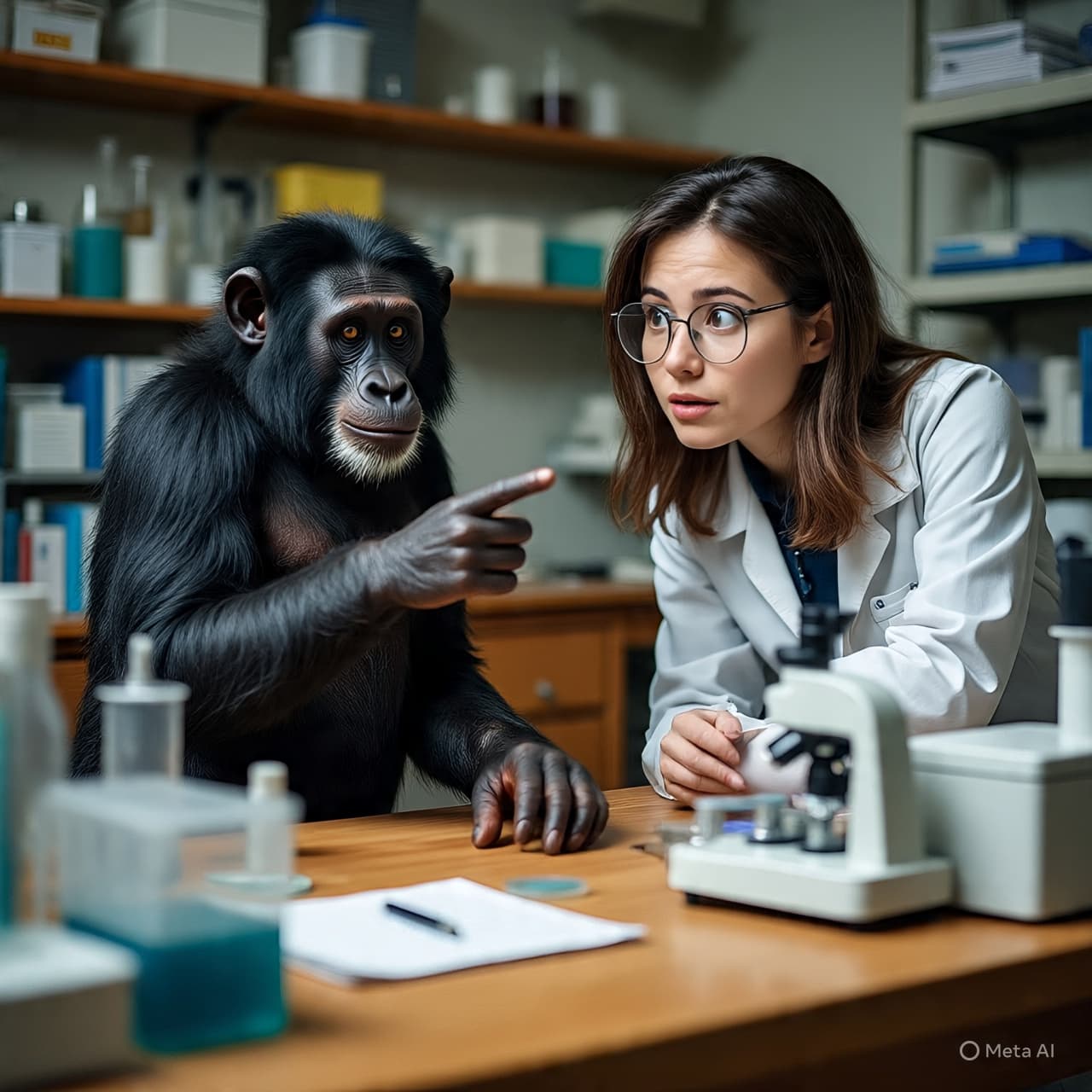
Kanzi, a 43‑year‑old bonobo who spent much of his life participating in cognitive research, became the centerpiece of a series of playful experiments at Johns Hopkins University. In settings designed like a child’s tea party, scientists asked Kanzi to interact with unfilled cups, imaginary juice, and pretend grapes — objects that existed only in demonstration and suggestion. With remarkable consistency, he pointed to the correct locations of these imaginary items in ways that suggested he tracked them as if they were real.
At first glance, the experiment may seem whimsical, even akin to watching a child pour phantom tea into an invisible cup. Yet the implications carry a thoughtful gravity. To imagine an object that is not physically present requires a mind not only to see what is, but to hold lightly what is not — a cognitive dance between reality and representation. In Kanzi’s performance, this dance was not fumbled but followed with clarity that surprised many in the research community.
Critically, Kanzi also showed he could distinguish pretend objects from real ones. When presented with actual juice alongside pretend versions, he reliably chose the real beverage — a subtle but important reminder that his choices were informed by understanding, not confusion.
Some scientists have long noted anecdotal signs of play and imagination in apes — from wild chimpanzees draping leaves over their heads to improvise games to captive primates leafing through photos as though they held hidden treasures. Yet these observations could be dismissed as simple mimicry or misinterpretation. The recent controlled tests with Kanzi move beyond anecdote into evidence that great apes can represent the unseen, blurring the boundary once thought to mark human cognition alone.
Though only one individual was tested and further research is needed, Kanzi’s achievements invite reflection on the evolutionary roots of the mind. If imagination evolved not strictly in humans but in shared ancestors or alongside parallel cognitive pathways, then the silent play of minds beyond our own becomes part of a broader, more inclusive story of intelligence.
In factual terms, the experiments suggest that bonobos may be capable of tracking and representing imaginary objects — an ability previously assumed unique to humans — potentially reshaping understanding of animal cognition. Researchers caution that more studies are required to determine whether this capacity is widespread among bonobos and other primates.
AI Image Disclaimer Illustrations were produced with AI and serve as conceptual depictions.
Sources: BBC Sky at Night Magazine ScienceDaily Live Science National Geographic
Published by Banx Network. This article is part of the Banx decentralized media programme, powered by the BXE token on the XRP Ledger.