There is a particular wonder in the idea that the Moon, silent and still for billions of years, might still be speaking—not with sound, but with the faint magnetic signatures trapped in its dust. For decades, scientists have puzzled over the patchwork of magnetic anomalies scattered across the lunar surface, especially on the farside, where orbital surveys have detected localized regions of magnetized crust whose origins remain debated. The Moon today has no global magnetic field. Yet its rocks and soils hold memories of a time when it might have. And now, in soil returned by China's Chang'e-6 mission—the first ever retrieved from the lunar farside—researchers have found a mineral that acts as a kind of magnetic time capsule, preserving a record of ancient conditions that has survived billions of years .
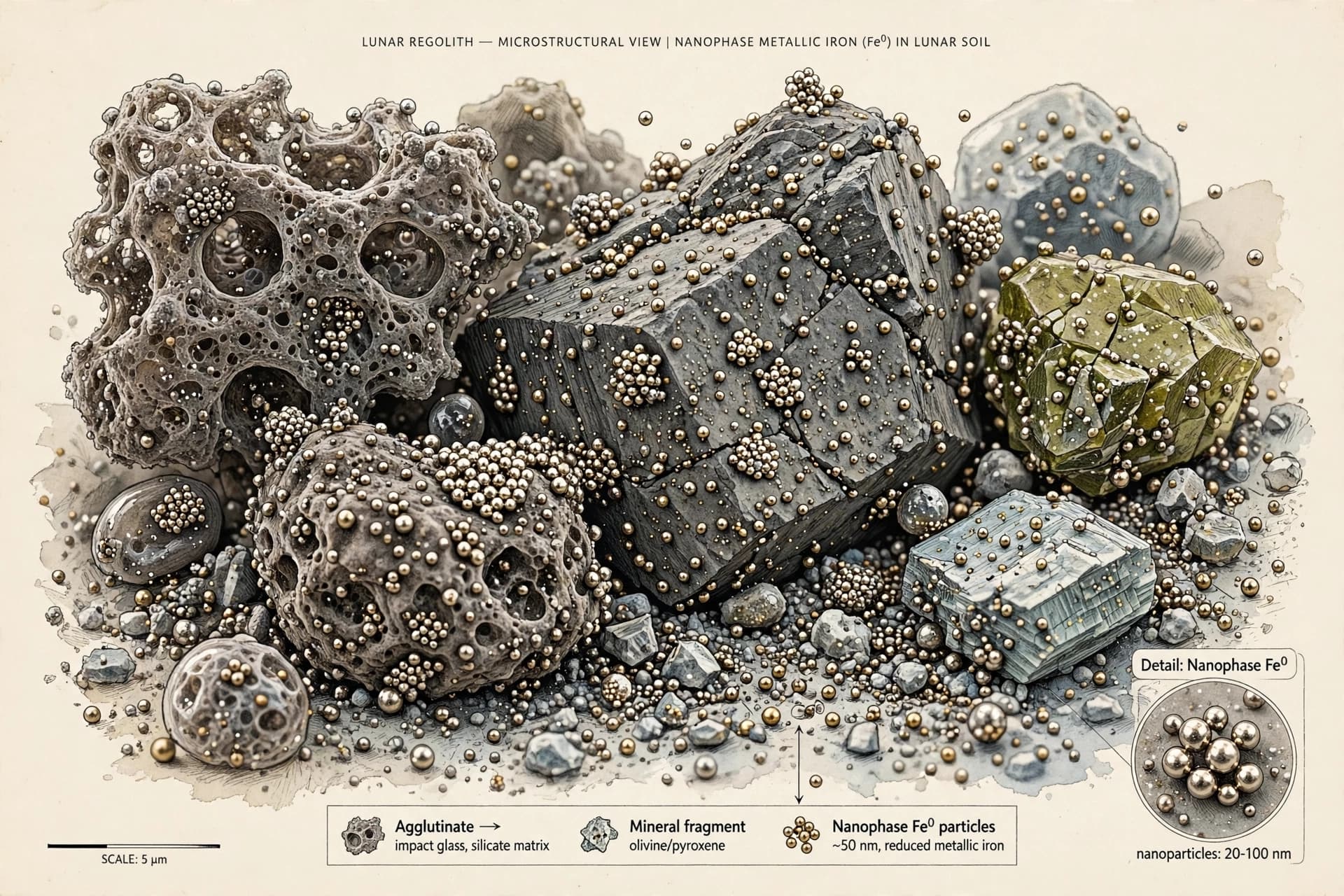
The discovery centers on a rare iron phase called face-centered cubic γ-Fe (gamma iron). Normally, this form of iron is stable only at high temperatures and transforms into the more familiar α-Fe (alpha iron) as it cools. Finding it preserved in lunar soil at surface temperatures is, in itself, remarkable. A research team led by Prof. Du Haifeng from the Hefei Institutes of Physical Science, Chinese Academy of Sciences, identified nanoscale γ-Fe particles inside impact-glass particles from the Chang'e-6 samples . The team suggests that the extreme conditions of lunar impacts—rapid cooling of molten material, trace amounts of carbon, and the surrounding glassy matrix—acted as a kind of natural preservative, freezing the high-temperature iron phase in place and preventing it from transforming .
What makes this more than a mineralogical curiosity is what the researchers found when they examined the magnetic structure of these particles. Using off-axis electron holography, they observed that relatively large γ-Fe nanoparticles form a stable single-vortex magnetic state. Under an external magnetic field, this vortex structure evolves but maintains a stable magnetic response—meaning the particles are capable of retaining remanent magnetism over long periods . In other words, they can record magnetic information. Since γ-Fe and α-Fe form under different conditions and have different magnetic properties, they may preserve records from different stages of lunar history, including the transient magnetic fields generated by impacts themselves .
This matters because the Moon's ancient magnetic history is still poorly understood. Did the Moon once have a global magnetic field generated by a core dynamo, similar to Earth's? Or are the magnetic anomalies we see today the result of external processes, like large impacts that briefly magnetized the crust? The identification of γ-Fe as a potential magnetic recorder expands the range of minerals that could carry answers to these questions . It offers a new material basis for understanding how the lunar surface records magnetic information, and by extension, how magnetic fields evolve on other airless bodies in the solar system.
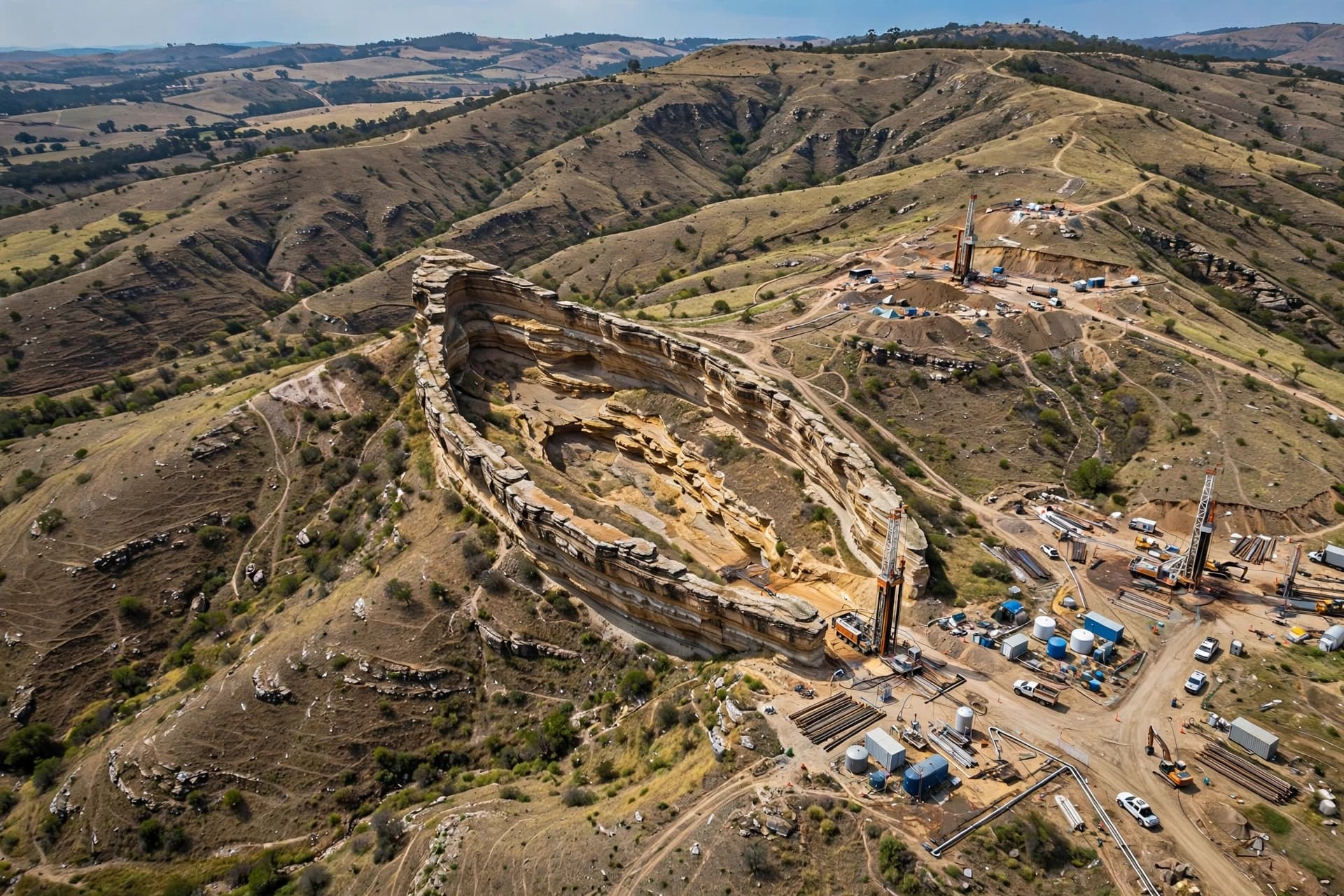
The Chang'e-6 mission returned 1,935.3 grams of regolith from the Apollo basin, within the vast South Pole-Aitken basin—the oldest and largest impact basin on the Moon . This region is characterized by strong magnetic anomalies, making it a natural laboratory for studying lunar magnetism. The team's discovery of γ-Fe in impact glass from this region suggests that space weathering itself—the relentless bombardment of meteorites—can "manufacture" minerals with strong magnetic memory. The coexistence of γ-Fe with other magnetic phases like tetrataenite and nanophase iron particles points to a complex assemblage of magnetic minerals on the lunar surface, whose collective behavior may be a significant source of the anomalies mapped by orbiting spacecraft .
For now, the findings open more questions than they answer. The researchers note that future studies combining magnetic experiments and micromagnetic simulations will be needed to assess how well γ-Fe can record transient impact fields versus a lunar dynamo field . But the discovery itself is a reminder that the Moon, for all its apparent stillness, is not a dead world. It is an archive, written in minerals and magnetism, and we have only just begun to learn how to read it.
AI Image Disclaimer: The images accompanying this article were generated by artificial intelligence and are for illustrative purposes only.
Sources: Hefei Institutes of Physical Science (Chinese Academy of Sciences), EurekAlert!, PNAS
Published by Banx Network. This article is part of the Banx decentralized media programme, powered by the BXE token on the XRP Ledger.