There is a kind of light the universe has kept mostly to itself—a faint, cool glow that slips past the edges of what our finest instruments can see. For more than a decade, since Europe's Herschel telescope went silent, astronomers have been without a dedicated eye for this far-infrared realm. Now, like a long-awaited lighthouse being lit on a distant shore, a new mission is preparing to cast its gaze into that darkness.
NASA has selected PRIMA, the PRobe far-Infrared Mission for Astrophysics, as the first mission in a new class called Probe Explorers . It is a designation that matters. Probe Explorers sit between the smaller, researcher-led Explorer missions and the multibillion-dollar flagships like the James Webb Space Telescope—a middle path meant to deliver major science on a steadier cadence . PRIMA's cost is capped at $1.2 billion, with launch targeted for 2033 .
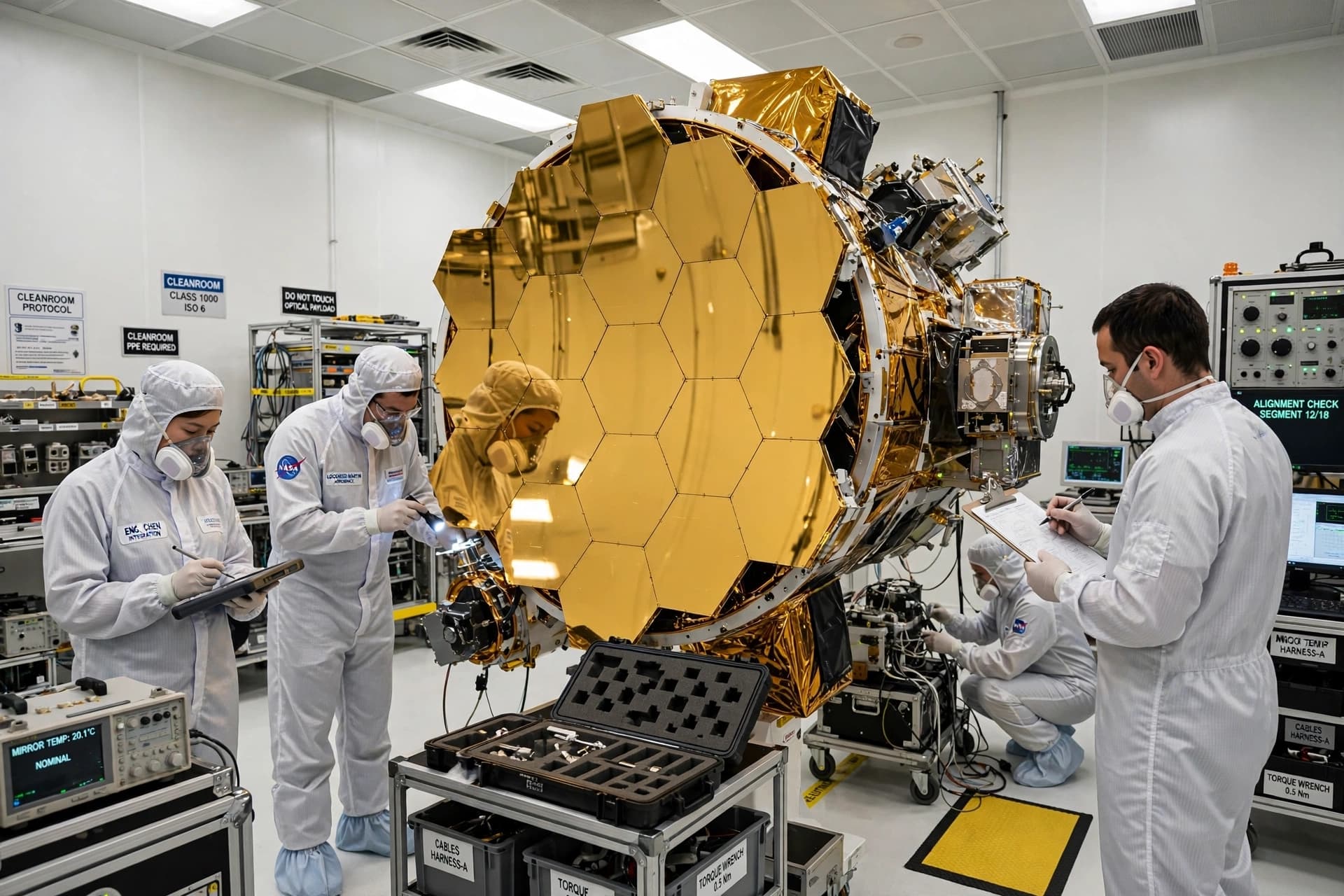
The telescope carries a 5.9-foot mirror and a set of detectors that represent a leap in sensitivity. At the heart of its instrument suite is a technology called kinetic inductance detectors, superconducting sensors that can register the energy and arrival time of individual photons—roughly a hundred times more sensitive than the detectors aboard Herschel . The mirror will be cooled to just 4.5 degrees above absolute zero by a mechanical cryocooler, a design that avoids the consumable helium that limited Herschel's lifespan to under four years .
What will PRIMA actually do? Three questions guide its mission. First, how do planets form their atmospheres, and where does water come from? By observing the disks of gas and dust around newborn stars, PRIMA will trace cool water—a prerequisite for life—as it moves through the planet-forming process . Second, how have galaxies and their supermassive black holes grown together over cosmic history? The far-infrared can see through the dust that hides the most active chapters of galactic evolution . Third, how did the universe build up the complex elements beyond hydrogen and helium? PRIMA will survey cosmic dust across different epochs to understand that slow enrichment .
The mission is managed by NASA's Jet Propulsion Laboratory, with contributions from Goddard, Marshall, and an international consortium including CNES, ASI, DLR, CSA, KASI, JAXA, and the UK Space Agency . Researchers at institutions from UMass Amherst to Imperial College London will work on the data tools and hardware that make the science possible .
PRIMA's five-year mission will not answer every question alone. But by filling the observational gap between Webb and radio telescopes, it completes a kind of spectrum—a more continuous view of the cosmos than humanity has ever assembled . Sometimes the most important instruments are not the ones that shout the loudest, but the ones that quietly close a gap we did not know we could fill.
AI-generated images are used for illustrative purposes in this article.
Sources: NASA, Science, EurekAlert, UK Research and Innovation, Imperial College London, Max-Planck-Gesellschaft
Published by Banx Network. This article is part of the Banx decentralized media programme, powered by the BXE token on the XRP Ledger.