In the frozen depths of our solar system, where sunlight is a faint whisper and temperatures hover near absolute zero, Pluto has long been viewed as a distant, inert relic. Yet, recent analysis of data from NASA’s New Horizons mission reveals a world far more dynamic than previously imagined. Scientists have identified massive landslides on the dwarf planet’s surface, geological features so vast they could blanket a small city. This discovery challenges our understanding of icy bodies, suggesting that even in the coldest corners of space, the forces of gravity and time continue to shape the landscape with surprising vigor.
Body: The landslides were detected in high-resolution images captured during the historic 2015 flyby. Located in regions such as Sputnik Planitia, these deposits consist of water ice blocks that have tumbled down steep slopes, creating debris fields that stretch for kilometers. Unlike landslides on Earth, which are often driven by liquid water or seismic activity, Pluto’s slides appear to be the result of sublimation—the process by which solid ice turns directly into gas. This subtle but persistent erosion weakens the structural integrity of cliffs, leading to catastrophic collapses.
The scale of these events is staggering. Some of the debris flows cover areas exceeding several square kilometers, indicating that the initial collapse involved enormous volumes of material. The sheer size suggests that the mechanical properties of water ice at Pluto’s temperatures allow it to behave in ways that are distinct from rock or soil. It flows, fractures, and settles with a fluidity that defies our terrestrial intuitions about solid matter.
These findings provide crucial insights into the geological history of the Kuiper Belt object. The presence of such fresh-looking landslides implies that geological activity on Pluto may have occurred relatively recently, perhaps within the last few million years. This recency challenges the notion that small, distant worlds are geologically dead, pointing instead to a complex interplay of internal heat, volatile ices, and surface processes that keep the planet evolving.
For planetary scientists, Pluto serves as a natural laboratory for studying extreme conditions. Understanding how water ice behaves under low gravity and extreme cold helps refine models of other icy moons in the outer solar system, such as those orbiting Jupiter and Saturn. The mechanisms driving these landslides may be universal, offering a key to unlocking the secrets of similar features elsewhere in the cosmos.
The discovery also highlights the enduring value of archival data. Years after the New Horizons probe returned its treasure trove of images, researchers continue to find new details through advanced analysis techniques. Each re-examination peels back another layer of mystery, proving that exploration does not end when the spacecraft leaves the vicinity of its target. The data remains a living resource, yielding answers to questions we have only just begun to ask.
As we look to future missions to the outer solar system, the lessons from Pluto will be invaluable. They remind us that dynamism is not exclusive to warm, rocky planets. Even in the deep freeze, change is constant, driven by forces that are subtle yet powerful enough to reshape worlds over eons.
Closing: The giant landslides of Pluto stand as a testament to the quiet power of geological processes. They transform our view of the dwarf planet from a static ice ball to a world of active change. As science continues to probe the edges of our solar system, Pluto reminds us that there is always more to discover in the dark.
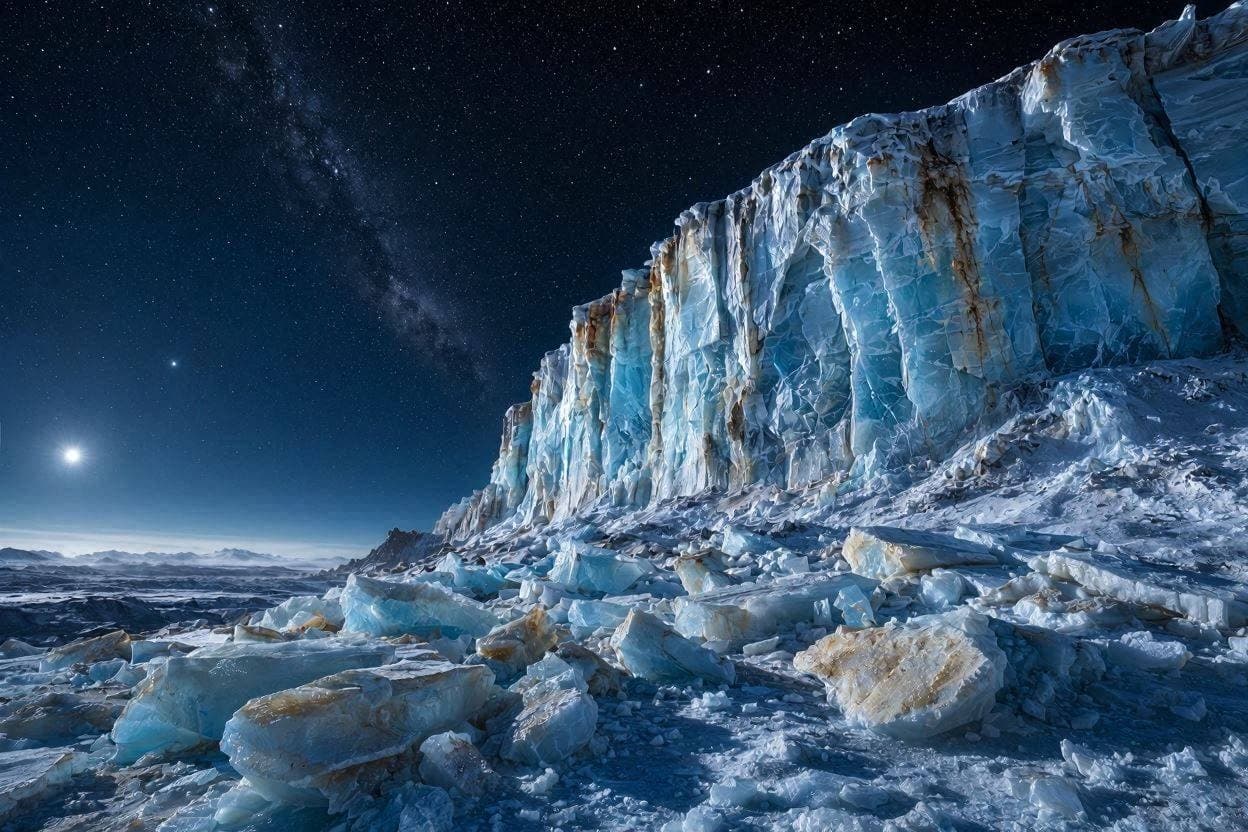
AI Image Disclaimer: The images accompanying this article are AI-generated conceptual illustrations of icy landscapes and planetary surfaces, designed to visualize the geological features described without depicting specific real-time data.
Sources: NASA Jet Propulsion Laboratory Nature Communications Space.com Brown University News
Published by Banx Network. This article is part of the Banx decentralized media programme, powered by the BXE token on the XRP Ledger.