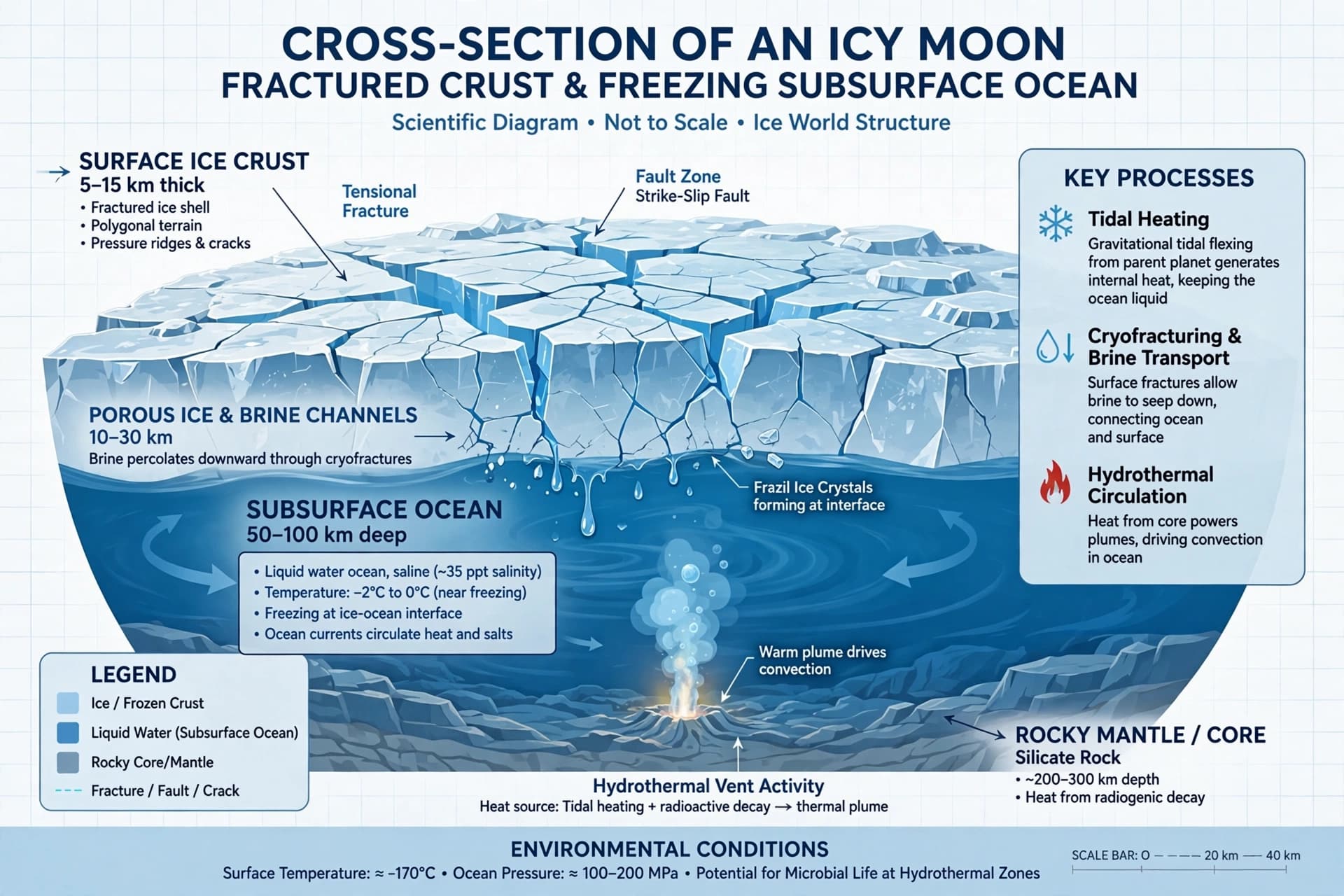
In the search for life beyond Earth, icy moons have emerged as some of the most promising candidates. Worlds like Europa and Enceladus hide vast subsurface oceans beneath thick shells of ice, kept liquid by the gravitational tug of their parent planets. However, not all icy moons are created equal. Recent research suggests that moons which have suffered significant collisions in their past may cool too rapidly to maintain these hidden waters. This finding adds a layer of complexity to our understanding of habitability, reminding us that violence in the early solar system may have extinguished potential oases of life.
The study focuses on the thermal evolution of icy moons that have experienced large impacts. When a massive object strikes an icy body, it can fracture the crust and disrupt the internal heat distribution. While one might assume that such energy input would warm the interior, the resulting damage often creates pathways for heat to escape more efficiently. The structural integrity of the moon is compromised, allowing internal warmth to radiate into space at an accelerated rate.
This rapid cooling poses a significant challenge for the retention of subsurface oceans. Liquid water requires a consistent heat source, typically provided by tidal heating or radioactive decay. If the moon loses heat too quickly, the ocean freezes, turning a potentially habitable environment into a solid block of ice. For moons that were once warm and wet, a major collision could have been a catastrophic event, sealing their fate as frozen worlds.
The implications for astrobiology are profound. It suggests that the history of impacts plays a crucial role in determining which moons remain habitable today. Scientists must now consider not just the current state of a moon, but its violent past. A moon that looks promising from the outside may harbor a frozen core due to ancient trauma, invisible to current remote sensing techniques.
Researchers used computer models to simulate the thermal behavior of impacted icy bodies. These simulations revealed that the size and frequency of collisions significantly affect cooling rates. Moons in crowded orbital environments, where impacts are more common, are less likely to retain liquid water over billions of years. This helps explain why some moons have oceans while others, seemingly similar in size and composition, do not.
For future missions, this insight guides the selection of targets. Missions like Europa Clipper and JUICE will look for signs of recent geological activity and heat flow. Understanding the thermal history of these moons will help interpret the data they collect. It allows scientists to distinguish between moons that are currently active and those that are merely relics of a warmer past.
The study also highlights the fragility of habitable conditions. Life, as we know it, requires stability. A single catastrophic event can undo millions of years of thermal equilibrium, freezing the very medium that might have supported biological processes. It is a sobering reminder of the precarious balance that sustains life in the cosmos.
The realization that smashed icy moons cool too rapidly to retain oceans refines our search for extraterrestrial life. It underscores the importance of geological history in assessing habitability. As we explore the outer solar system, we must look beyond the present, considering the scars of the past that shape the potential for life today.
AI Image Disclaimer: The visuals in this article are AI-generated artistic interpretations of icy moons and subsurface structures, not actual photographs from space missions.
Sources: Nature Astronomy Planetary Science Institute Earth.com
Published by Banx Network. This article is part of the Banx decentralized media programme, powered by the BXE token on the XRP Ledger.