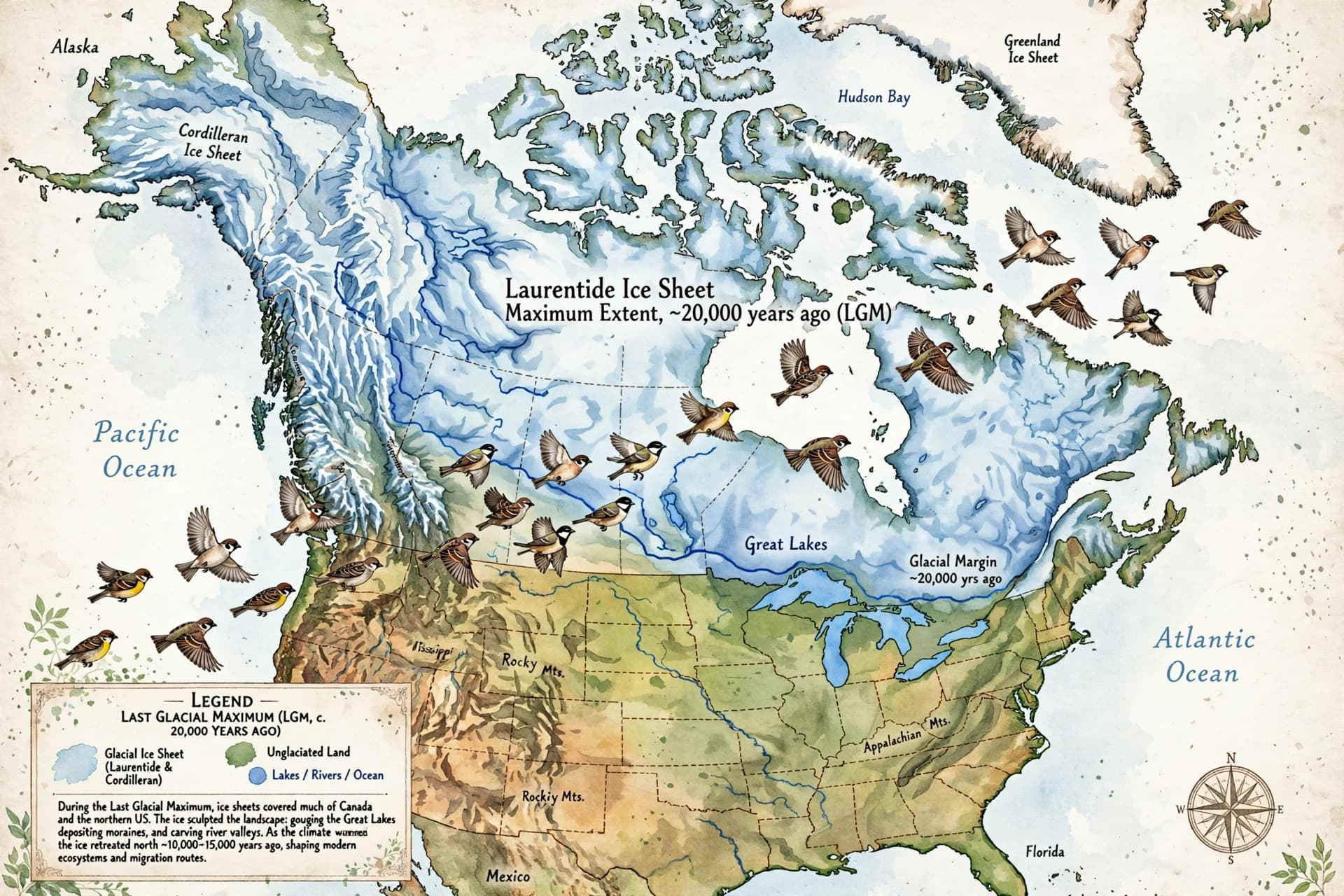
Migration is often viewed as a precise, innate clockwork mechanism, a rhythmic pulse that guides millions of birds across continents with unwavering accuracy. Yet, nature is rarely so rigid, and occasionally, flocks appear to lose their way, venturing far off their established routes into territories that seem illogical for their survival. These deviations, long puzzling ornithologists, are now being reinterpreted not as errors, but as echoes of a distant past. A compelling new hypothesis suggests that these seemingly misplaced journeys are genetic memories from the Last Ice Age, when the map of North America looked vastly different.
During the height of the glacial period, massive ice sheets covered much of the northern hemisphere, rendering traditional breeding grounds inaccessible. Birds that once nested in the Arctic tundra were forced to adapt, finding refuge in southern latitudes or isolated pockets of habitable land. Over thousands of years, these populations evolved distinct migratory patterns suited to a frozen world. When the ice eventually retreated, the landscapes changed, but the genetic instructions for migration remained, preserved in the DNA of species like the Canada warbler and other songbirds.
The study highlights how evolutionary lag can influence modern behavior. Just as humans carry traits from ancestors who lived in entirely different environments, birds may be following routes that were optimal ten thousand years ago but are less efficient today. The "wrong" direction is, in fact, a right turn in historical context. It represents a survival strategy that worked when the continent was locked in ice, leading birds to areas that were once safe havens but are now merely detours.
Researchers used complex modeling to reconstruct ancient climate conditions and compare them with current migratory data. The correlation was striking. Many of the so-called vagrants—birds found far outside their normal range—were tracing paths that led to ice-free corridors that no longer exist. This discovery shifts the narrative from one of confusion to one of resilience, showing how deeply history is embedded in biological instinct.
Understanding this phenomenon helps scientists better predict how birds might respond to current climate change. If past migrations were shaped by dramatic environmental shifts, present-day warming could similarly alter future routes. However, the speed of modern change poses a new challenge, as genetic adaptation may not keep pace with rapid habitat loss. The lessons from the Ice Age offer both insight and caution for conservation efforts.
For birdwatchers and citizens scientists, this adds a layer of depth to every sighting. A bird appearing in an unexpected location is not just a rarity but a living link to a prehistoric era. It invites us to look at the sky with a sense of historical perspective, recognizing that the creatures above us are carrying stories written in ice and time. Their flights are narratives of survival that span millennia.
The research also underscores the importance of preserving diverse habitats. As birds navigate these ancient, ingrained pathways, they rely on specific stopover sites that may have been critical for thousands of years. Protecting these corridors ensures that even if the routes seem inefficient by modern standards, the birds have the resources they need to complete their journeys. It is a reminder that conservation must account for deep time.
In the end, the mystery of the misdirected birds is resolved with a gentle understanding of nature’s complexity. They are not lost; they are remembering. By studying their paths, we gain a deeper appreciation for the enduring legacy of the Ice Age and the remarkable adaptability of life on Earth.
AI Image Disclaimer: The visual representations included here are AI-generated illustrations designed to depict migratory patterns and ancient landscapes, not actual photographs of specific bird species or fossil records.
Sources: University of Nebraska-Lincoln Phys.org Science Advances
Published by Banx Network. This article is part of the Banx decentralized media programme, powered by the BXE token on the XRP Ledger.

.jpg&w=3840&q=75 "New Wild Cat Species Identified for First Time in 100 Years, Researchers Say")