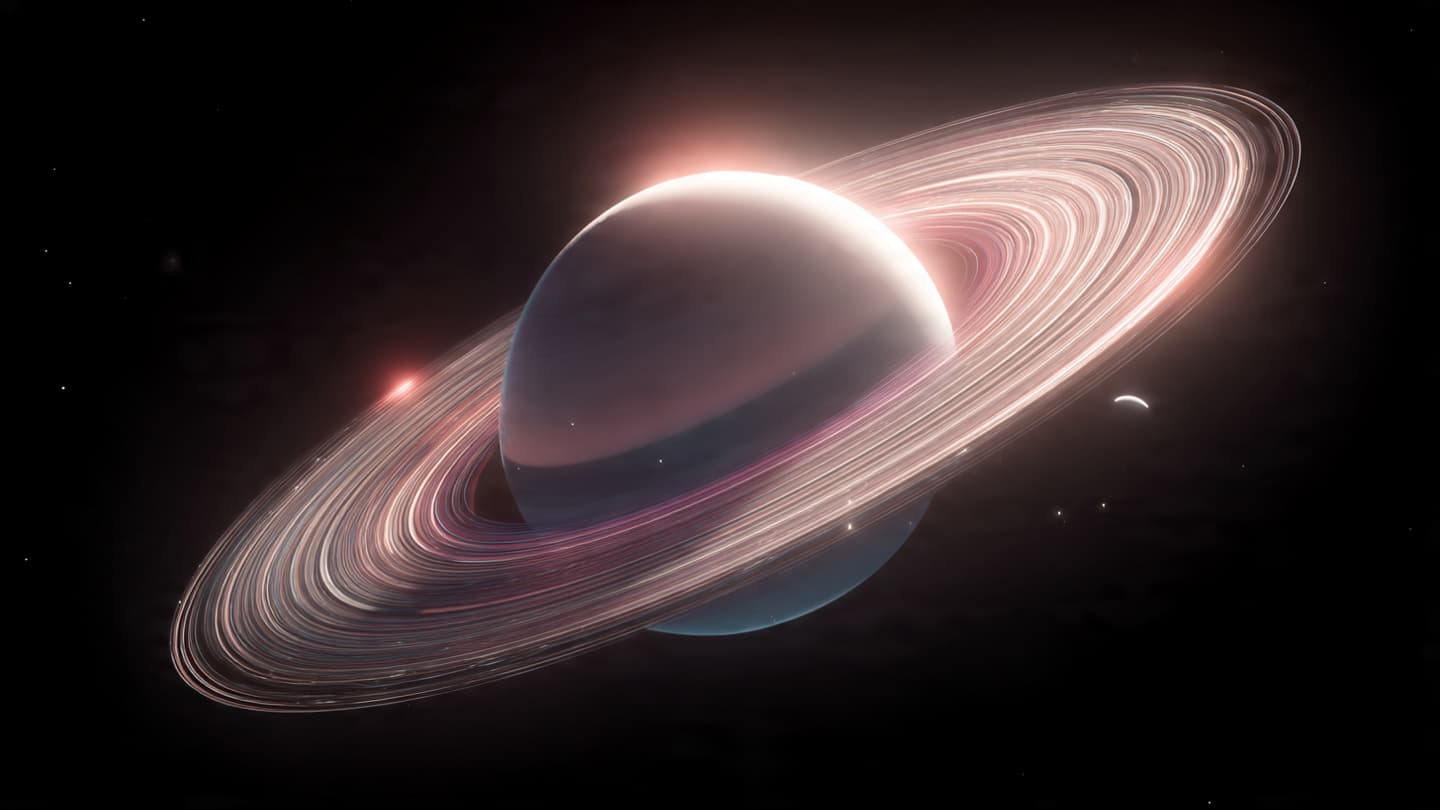
Some features of the universe feel so permanent that humanity rarely pauses to imagine their absence. For generations, has appeared in textbooks, telescopes, and human imagination as the planet crowned with brilliant rings. Yet according to estimates from , those iconic rings are slowly fading and may disappear entirely within roughly 100 million years.
Scientists explain that Saturn’s rings are composed largely of ice particles, rock fragments, and cosmic debris orbiting the planet under the influence of gravity. Over time, however, some of this material is gradually being pulled toward Saturn itself through a process researchers often describe as “ring rain.”
Observations from missions including the provided important evidence supporting this theory. Instruments detected particles from the rings falling into Saturn’s upper atmosphere under the influence of the planet’s magnetic field and gravity.
Although 100 million years may sound immense from a human perspective, astronomers note that it represents a relatively brief moment in planetary history. Saturn itself is estimated to be more than 4 billion years old, meaning the rings may exist only during a comparatively short phase of the planet’s lifespan.
Researchers continue debating exactly when and how Saturn’s rings originally formed. Some theories suggest they emerged from shattered moons or comets broken apart by gravitational forces. Others propose more gradual processes involving accumulated debris over long periods of time.
The fading rings also remind scientists that planetary systems remain dynamic rather than static. Even familiar celestial objects evolve continuously through collisions, gravitational interactions, atmospheric change, and orbital shifts unfolding across millions or billions of years.
For many observers, Saturn’s rings carry significance beyond scientific measurement. They have inspired art, literature, education, and curiosity for centuries, becoming one of the most recognizable images in astronomy. The realization that humanity exists during the limited era in which the rings are visible adds a reflective dimension to their beauty.
NASA scientists emphasize that Saturn’s rings will not vanish suddenly within any human lifetime. Their disappearance remains an extremely gradual process unfolding across geological timescales. Still, the research offers a quiet reminder that even the universe’s most iconic sights are temporary within the broader passage of cosmic time.
AI Image Disclaimer: Some space illustrations associated with this article may be AI-generated renderings inspired by astronomical research and planetary imagery.
Sources: NASA, Jet Propulsion Laboratory, Space.com, Scientific American, National Geographic
Published by Banx Network. This article is part of the Banx decentralized media programme, powered by the BXE token on the XRP Ledger.