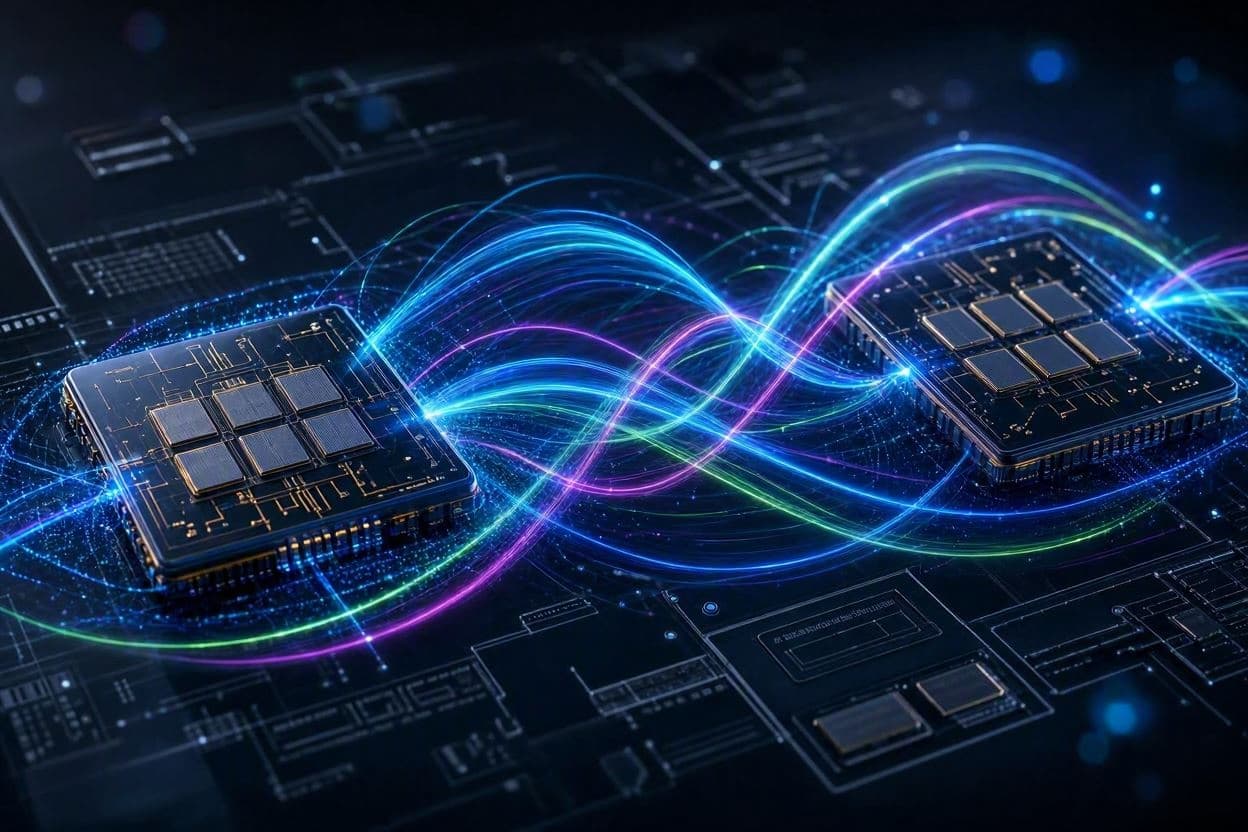
In the quest to build powerful quantum computers, one of the greatest challenges has been enabling different quantum systems to communicate effectively. Qubits, the fundamental units of quantum information, are notoriously fragile and difficult to link across distances. However, a new breakthrough suggests that magnets, specifically the tiny magnetic waves known as magnons, could serve as the missing bridge. Researchers have demonstrated that these magnetic excitations can act as robust carriers of quantum information, potentially allowing disparate quantum devices to "talk" to one another.
Magnons are collective excitations of electron spins in magnetic materials, behaving like particles that can carry energy and information. Historically, their short lifespan—often just nanoseconds—made them impractical for quantum applications. But recent advances have extended this lifetime significantly, up to 18 microseconds in some experiments. This hundredfold increase transforms magnons from fleeting curiosities into viable candidates for quantum memory and communication links, opening new avenues for hybrid quantum systems.
The significance of this development lies in its potential to connect different types of quantum hardware. Just as the internet relies on standard protocols to link diverse computers, a future quantum network will need interfaces that can translate between superconducting qubits, trapped ions, and other platforms. Magnons, with their ability to interact with both microwave and optical fields, offer a versatile medium for such translations, acting as a universal translator in the quantum realm.
Researchers at institutions like the University of Vienna and Argonne National Laboratory have been at the forefront of this work. By engineering specific magnetic materials and controlling their environment, they have created conditions where magnons can maintain coherence long enough to perform useful tasks. This control allows for the selective coupling of qubits, enabling them to exchange information without losing their quantum state.
The use of magnets also offers practical advantages. Magnetic components are well-understood and can be manufactured using existing technologies, potentially lowering the barrier to entry for building scalable quantum networks. Unlike some exotic materials required for other quantum approaches, magnetic films can be integrated into compact, chip-scale devices, paving the way for miniaturized quantum processors.
This breakthrough addresses a critical bottleneck in quantum computing: scalability. As systems grow larger, the difficulty of maintaining connections between all qubits increases exponentially. By using magnons as intermediaries, researchers can create modular systems where smaller quantum units are linked together, simplifying the architecture and improving reliability. It is a step toward building quantum computers that are not just powerful but also practical.
While challenges remain, such as minimizing noise and improving efficiency, the progress is encouraging. The ability to harness magnetic waves for quantum communication represents a convergence of condensed matter physics and quantum information science. It highlights the power of interdisciplinary research in solving complex technological problems.
As the field moves forward, the role of magnets in quantum technology is likely to expand. From enhancing sensor sensitivity to enabling secure communication networks, magnons offer a toolkit for innovation. In the silent language of spinning electrons, we may have found the key to unlocking the full potential of the quantum age.
AI Image Disclaimer: The visual representations associated with this article are AI-generated conceptualizations of quantum systems and magnetic waves, not actual laboratory images.
Sources: ScienceDaily Argonne National Laboratory Newswise
Published by Banx Network. This article is part of the Banx decentralized media programme, powered by the BXE token on the XRP Ledger.

.jpg&w=3840&q=75 "New Wild Cat Species Identified for First Time in 100 Years, Researchers Say")