The universe often reveals itself not in sudden flashes, but in quiet signals that travel patiently across unimaginable distances. Light, once released, moves forward with unwavering dedication, carrying with it a fragment of the moment in which it was born. For astronomers watching the sky, every distant signal is a messenger—sometimes arriving after billions of years of travel.
Recently, one such message has drawn particular attention.
Astronomers have confirmed the presence of an extraordinarily powerful cosmic beam originating roughly eight billion light-years away. The signal is not a laser in the familiar human sense, yet it behaves in a strikingly similar way. Known as a mega-maser, it is an intense natural emission of microwave radiation amplified by vast cosmic conditions.
What makes the discovery especially intriguing is its endurance. The beam appears to have remained remarkably strong despite the immense distance it has traveled across the universe.
To understand this phenomenon, scientists turn to a concept first identified decades ago: the maser, short for “microwave amplification by stimulated emission of radiation.” In laboratories on Earth, masers function similarly to lasers but operate at microwave wavelengths rather than visible light.
Nature, it seems, learned this principle long before humanity did.
Under certain cosmic conditions—particularly within dense regions of gas surrounding galaxies or black holes—molecules can align in such a way that radiation passing through them becomes amplified. Instead of scattering randomly, the energy grows stronger, forming a focused beam of microwave radiation that can travel across vast regions of space.
Most cosmic masers detected by astronomers occur relatively nearby in galactic terms. But this recently confirmed signal belongs to a far rarer category: a mega-maser, a phenomenon millions of times brighter than typical maser emissions.
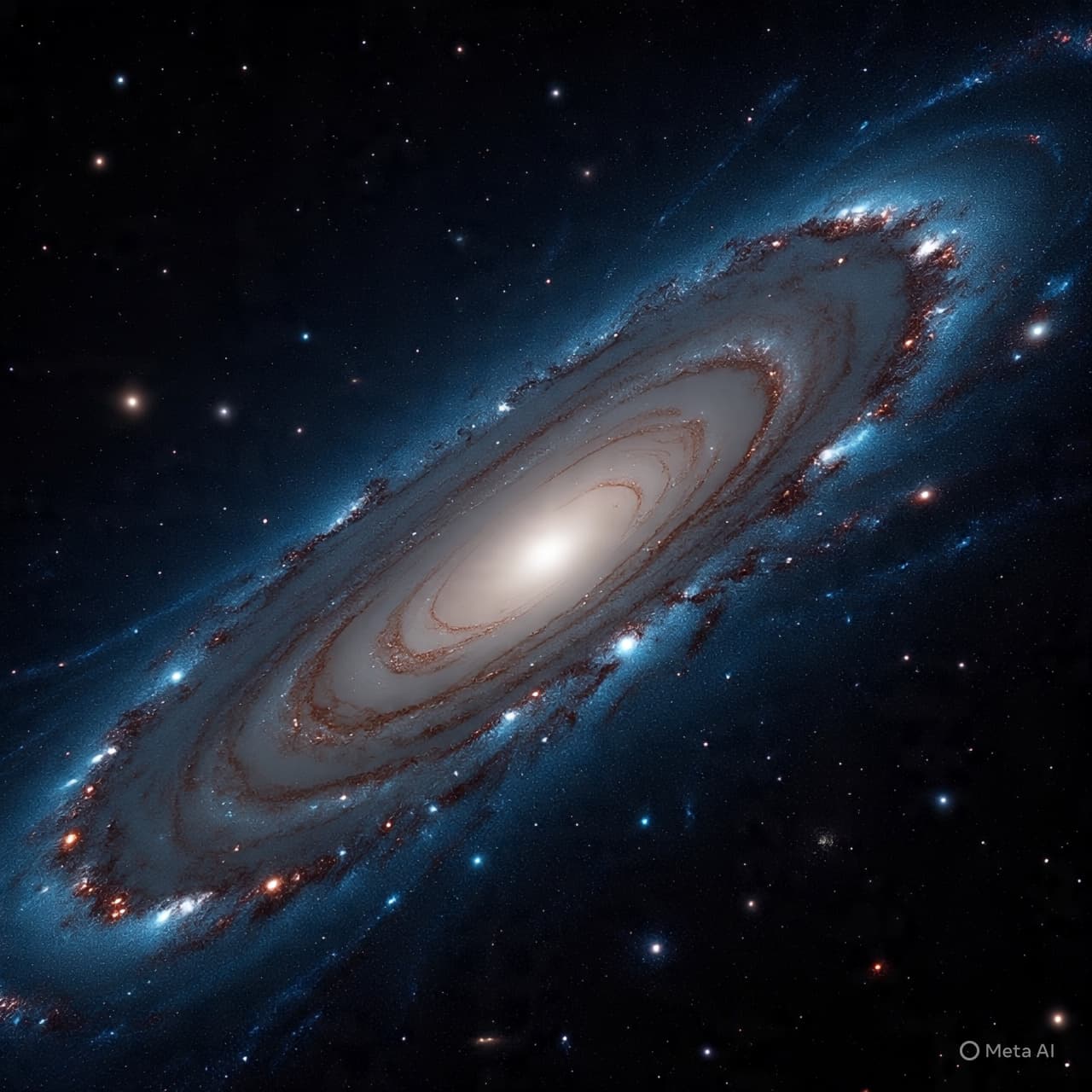
The newly studied beam originates from a distant galaxy where powerful astrophysical processes appear to be compressing enormous clouds of gas. Within these dense environments, molecules such as hydroxyl or water can act as amplifiers, strengthening radiation until it forms a detectable signal strong enough to reach telescopes billions of light-years away.
In effect, the galaxy itself becomes a natural cosmic amplifier.
The fact that this signal has traveled such a staggering distance without fading beyond detection provides astronomers with valuable information about both the source galaxy and the conditions of the early universe. Because the light began its journey roughly eight billion years ago, observing it today offers a glimpse into a time when galaxies were evolving rapidly and cosmic structures were still taking shape.
Each photon that reaches Earth is therefore not only evidence of a distant maser, but also a record of the universe at a much younger stage.
Detecting such signals requires sensitive radio telescopes capable of capturing extremely faint microwaves arriving from deep space. By studying the frequency and structure of the emission, astronomers can infer details about the gas clouds that generated it, including their density, motion, and interaction with surrounding galactic forces.
These observations help researchers understand how galaxies grow, how matter behaves near energetic cosmic environments, and how radiation moves through the intergalactic medium.
For now, the confirmed mega-maser remains a reminder that the universe is capable of producing natural phenomena that echo technologies humans only later learned to create. What appears extraordinary from Earth may simply be another expression of physics unfolding on a grand cosmic scale.
Astronomers continue monitoring the distant signal with advanced radio observatories, hoping to learn more about the environment that created it and whether similar beams may be waiting to be discovered elsewhere in the sky.
The light that began its journey billions of years ago is still arriving today, whispering across the vast quiet of space.
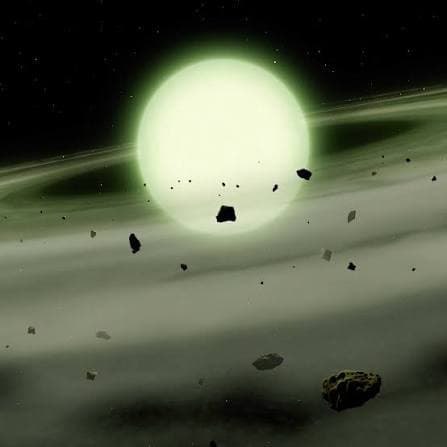
AI Image Disclaimer Visuals are created with AI tools and are not real photographs.
Sources Nature Science New Scientist Space.com Live Science
Published by Banx Network. This article is part of the Banx decentralized media programme, powered by the BXE token on the XRP Ledger.