Some cosmic events arrive with a quiet signature, invisible to the naked eye, yet carrying the weight of unimaginable energy. In 2023, detectors on Earth recorded one such messenger: a particle striking with roughly 100,000 times the energy of the Large Hadron Collider, defying conventional expectations. For physicists, it was a puzzle that danced on the edge of what seemed possible, hinting at violent processes far beyond ordinary cosmic phenomena.
Now, a team of researchers at the University of Massachusetts Amherst has proposed a daring explanation. They suggest the particle may have originated from an exploding black hole, a theoretical object so extreme that its collapse and subsequent explosion could hurl subatomic particles across vast stretches of space at energies beyond anything achievable on Earth. In this view, the event is less a singular anomaly and more a glimpse into the extraordinary physics of the early universe — or into rare corners of the cosmos still largely invisible to us.
The particle belongs to a class known as ultra‑high‑energy cosmic rays, rare and enigmatic visitors that strike the atmosphere with a force far exceeding ordinary solar or galactic emissions. Detecting these cosmic rays requires patience and precision; each arrival is like a whispered secret from the universe, carrying with it clues about the processes that forge the most extreme energy in existence. Researchers have long suspected that supernovae, pulsars, or supermassive black holes might act as cosmic accelerators. This new hypothesis extends that list to quasi‑extremal primordial black holes, tiny yet potent remnants from the dawn of time.
If correct, the implications are profound. Such black holes, if they exist, would serve as natural particle accelerators far surpassing anything humanity has built, allowing the universe to generate energies that challenge both imagination and instrumentation. They could also illuminate mysteries about the early universe, about the birth and death of primordial matter, and about the limits of physics itself. Each particle they send our way becomes a tiny ambassador, carrying encoded information about realms we cannot visit.
Yet as with all cutting‑edge science, caution tempers enthusiasm. Direct evidence tying any single ultra‑high‑energy particle to an exploding black hole remains elusive. Competing theories continue to explain the origin of cosmic rays, and observational limitations make it difficult to track these particles back to their source. Still, the hypothesis is a bold reminder of how the universe often exceeds our expectations, and how even a single particle crashing into our atmosphere can shift our understanding of the cosmos.
In the end, the event is a quiet marvel: a fleeting collision, a brief spark, and yet a messenger of the universe’s most extreme energies. Whether it came from a black hole, a distant collision, or some yet-undiscovered astrophysical engine, it reminds us that the universe still holds secrets that stretch the imagination, challenging us to refine our instruments, our theories, and our sense of possibility.
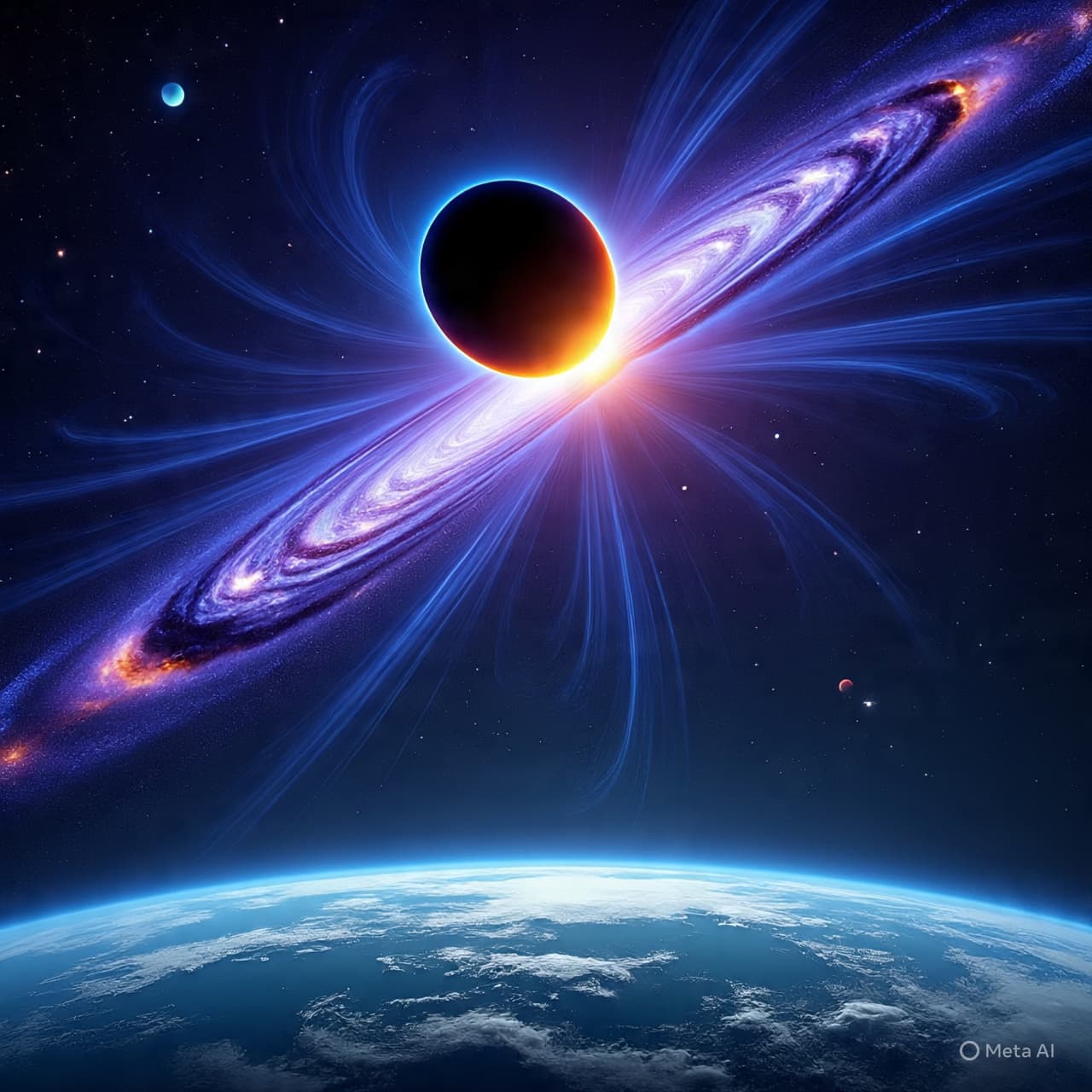
AI Image Disclaimer (rotated wording) “Illustrations were produced with AI and serve as conceptual depictions.”
Sources (Media Names Only) EurekAlert!, ZME Science, ScienceDaily, AZoQuantum, Phys.org
Published by Banx Network. This article is part of the Banx decentralized media programme, powered by the BXE token on the XRP Ledger.