There is a particular delight in a scientific solution that arrives from an unexpected direction—a solution that borrows from the world of music, that finds in a Britpop anthem the key to a problem that has frustrated engineers for years. In the case of one scientist, that solution came from the British band Blur. Their 1994 hit "Girls & Boys" became the unlikely inspiration for a navigation technique that could help future missions to Mars land with greater precision, using the music's rhythmic structure as a model for how a spacecraft might use natural signals to determine its position.
The scientist, who works on spacecraft navigation, was grappling with the challenge of landing on Mars accurately. The planet's atmosphere is thin, the terrain is unpredictable, and the distance from Earth means that signals take minutes to arrive—too long for real-time control. The solution lies in autonomous navigation: the spacecraft must be able to determine its own position and adjust its trajectory without input from Earth. The problem is that the tools available for autonomous navigation are limited. Cameras can be confused by dust and shadows. Radar is heavy and power-hungry. Inertial navigation drifts over time.
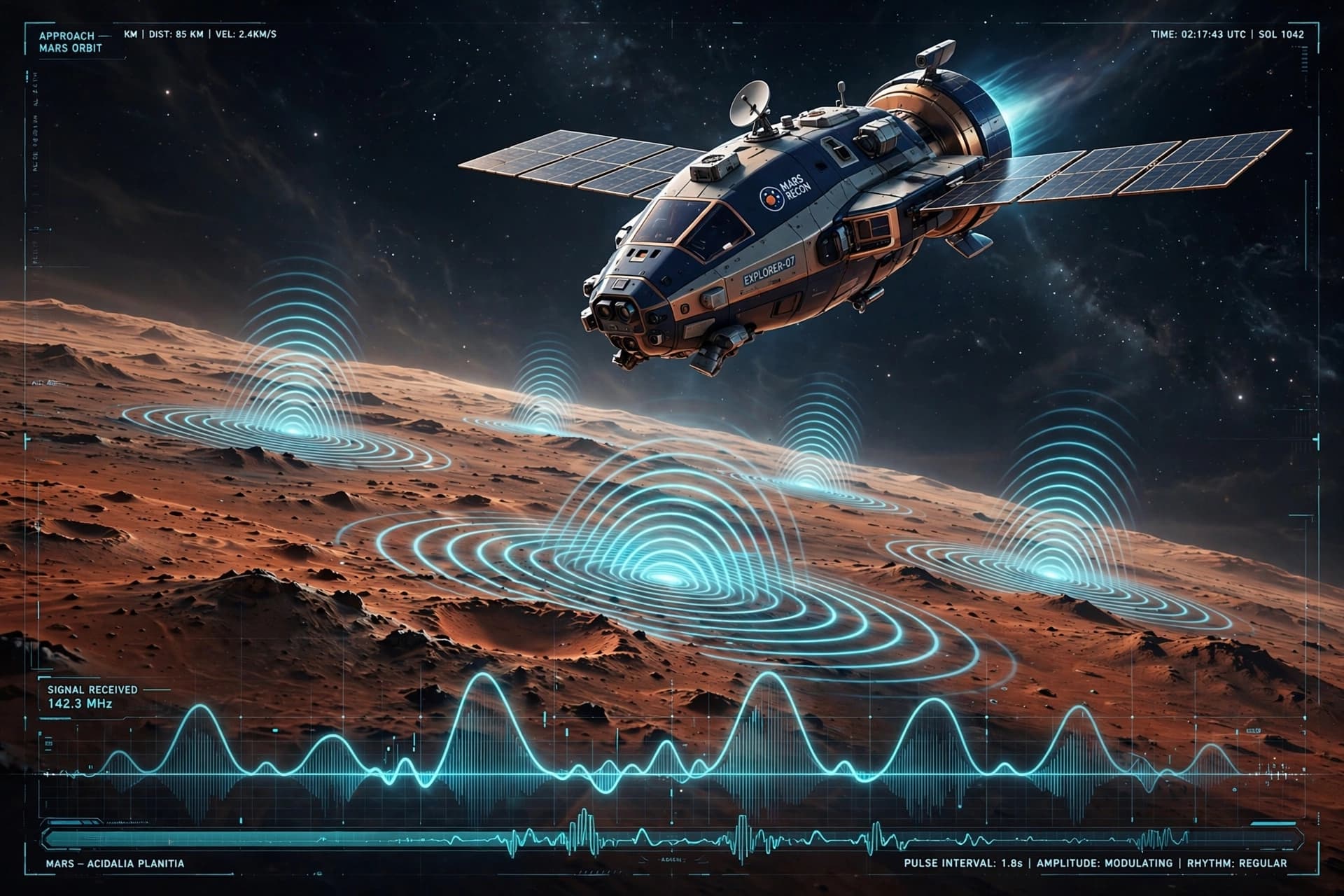
The Britpop insight came from the structure of the music itself. The scientist noticed that the song's repetitive rhythm—the steady beat, the recurring chorus—was a form of signal that could be used to track position. If a spacecraft could detect and lock onto similar rhythmic patterns in the environment—the regular pulse of a beacon, the steady emissions of a known source—it could use those patterns to determine its location. The technique is a form of "signal of opportunity" navigation, in which the spacecraft uses existing signals rather than generating its own.
The approach has been tested in simulations and has shown promise. By locking onto a rhythmic signal and tracking its phase, a spacecraft can determine its velocity and position with high accuracy. The technique is robust to noise and does not require the spacecraft to carry heavy equipment. It is also flexible: the signal can come from a beacon placed on the surface, from a satellite in orbit, or from a natural source such as a pulsar. The key is that the signal must be rhythmic and predictable—much like the beat of a Britpop song.
For the scientist, the Britpop connection is a reminder that inspiration can come from anywhere. The problem of Mars navigation is technical and complex, but the solution came from listening to music and noticing a pattern. The method is now being refined for potential use in future missions. It may not be the only solution, and it may not be the primary one. But it is a reminder that science, at its best, is not confined to laboratories and equations. Sometimes, the answer is already in the air—waiting for someone to hear it.
AI Image Disclaimer: The images accompanying this article were generated by artificial intelligence and are intended for illustrative purposes only.
Sources: Scientific reports, ESA, NASA
Published by Banx Network. This article is part of the Banx decentralized media programme, powered by the BXE token on the XRP Ledger.

.jpg&w=3840&q=75 "September 2026 Was the Second-Warmest on Record, With Global Temperatures Above 1.5°C for a Second Month")