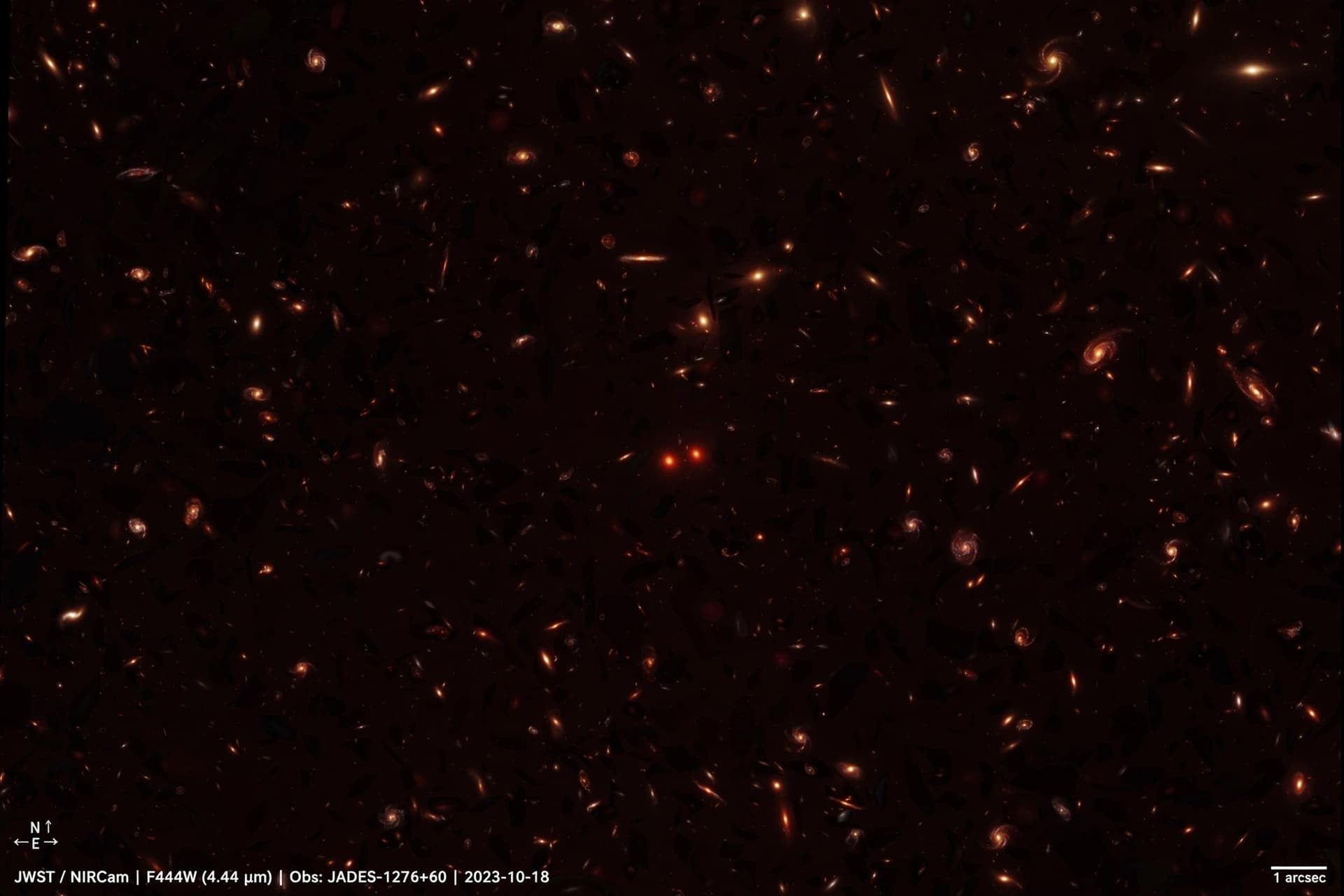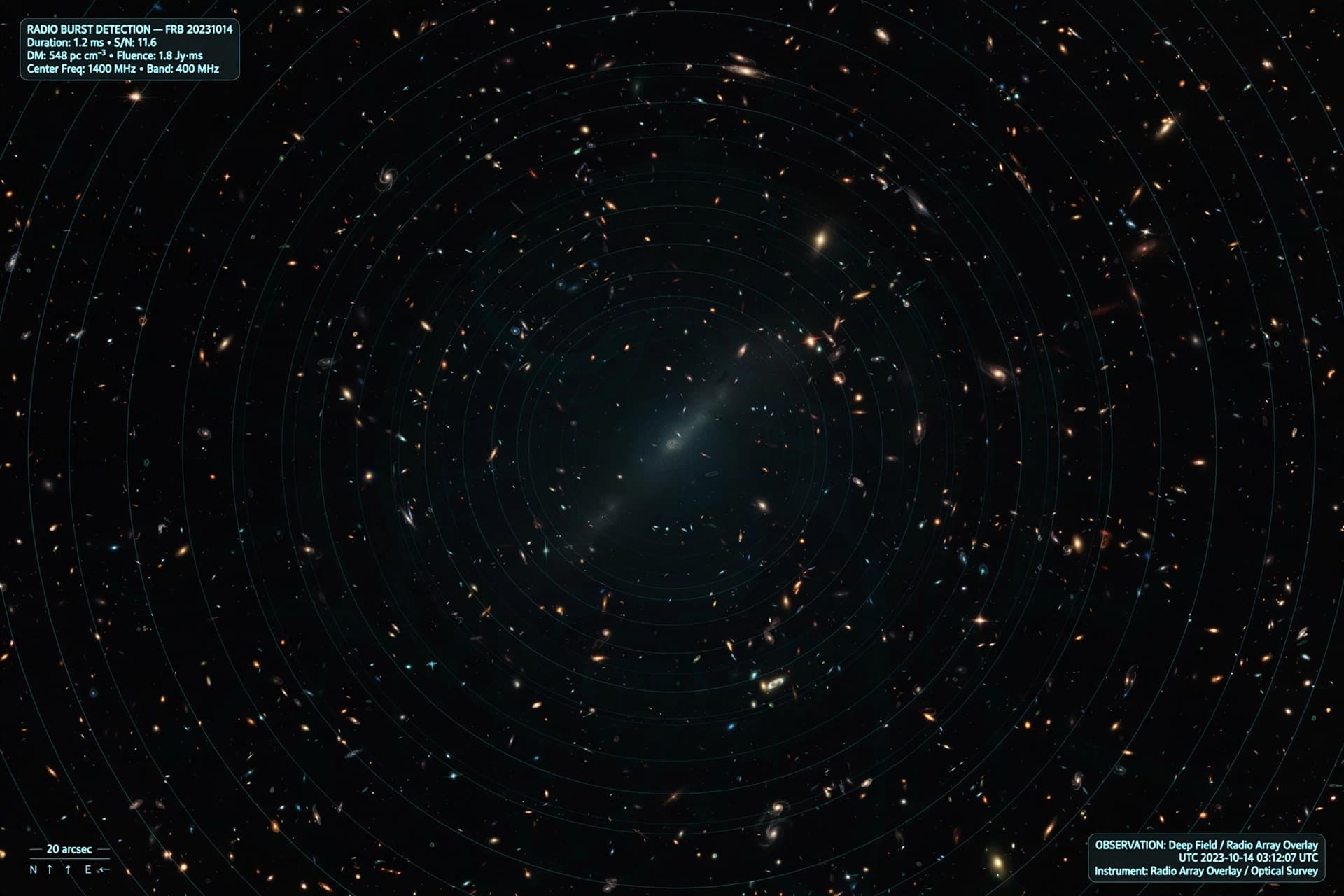
There is a particular satisfaction in solving a mystery that has resisted explanation for nearly two decades—a satisfaction tempered, perhaps, by the knowledge that the answer raises new questions. For astronomers studying fast radio bursts, those millisecond-long flashes of radio energy that appear randomly across the sky and vanish before most telescopes can catch them, the mystery has been not only what causes them but where they come from. Now, a team has identified the host galaxy of the most distant fast radio burst ever localized, pushing the reach of these enigmatic signals to a new cosmological frontier.
Fast radio bursts, or FRBs, were first discovered serendipitously in 2007 by a graduate student examining archival data from the Parkes Observatory in Australia . Since then, hundreds have been detected, but localizing them precisely enough to identify their host galaxies has been extraordinarily difficult. The bursts last only milliseconds, and most radio telescopes have narrow fields of view, making it a matter of luck to catch one in the act .
The breakthrough came through a technique that combines a wide-field survey telescope with an “outrigger” station—a second detector located some distance away. When the main telescope detects a sufficiently bright burst, it signals the outrigger to save its raw data, and subsequent interferometric analysis allows the FRB to be localized with precision . This method was used to pinpoint the non-repeating FRB 180924 to the outskirts of an elliptical galaxy, a result that helped establish that at least some FRBs originate from distant, massive galaxies .
The host galaxy of the newly identified most distant FRB appears to be a relatively modest system. Spectral energy distribution fitting yields a stellar mass of approximately 2.7 billion solar masses—far smaller than the Milky Way—with a star formation rate of about 0.13 solar masses per year . The specific star formation rate, a measure of how actively a galaxy is forming new stars relative to its mass, is consistent with other host galaxies of repeating FRBs, as well as with supernovae and short-duration gamma-ray bursts . This suggests that the conditions giving rise to FRBs may be shared with other energetic cosmic phenomena.
The FRB’s location within its host also offers clues. The burst was found in a region that contains only a small fraction of the galaxy’s total light, with a cumulative light fraction of approximately 0.13 . This offset from the galaxy’s center is consistent with the environments of core-collapse supernovae and binary mergers, suggesting that the progenitor of this FRB may be a young, massive star or a compact object formed through stellar collapse .
The ability to localize FRBs at increasing distances transforms them from curiosities into tools. Because the dispersion of their radio waves depends on the amount of ionized material they pass through, FRBs can be used to measure the distribution of matter in the cosmic web—including the “missing baryons” that ordinary observations cannot easily detect . Each new host galaxy identified adds a data point to that cosmic map.
The question of what exactly produces an FRB remains open. Competing theories include magnetar outflows, supernova remnants, and binary systems involving neutron stars or black holes . The identification of host galaxies and the characterization of their environments provides the context needed to distinguish between these possibilities. The most distant FRB yet localized is not just a record; it is a step toward understanding a phenomenon that, two decades after its discovery, still holds most of its secrets.
AI Image Disclaimer: The visuals in this article were generated using artificial intelligence and are intended for illustrative purposes only, not as astronomical data or documentary records.
Sources: Science (AAAS), Nature, Astrophysical Journal Letters, Science Advances
Published by Banx Network. This article is part of the Banx decentralized media programme, powered by the BXE token on the XRP Ledger.