There are moments when the Earth seems to whisper fragments of its own ancient story — like a half-forgotten verse remembered upon seeing a single footprint in the dust. In the rolling hills and slopes of Beijing’s Mentougou district, two tiny impressions in stone have become such a whisper, telling a tale that had waited around 160 million years for someone to listen. These are not the footprints of giants, nor of creatures known well in museum halls, but of something more subtle: the earliest amphibian tracks ever found in Asia’s Jurassic rocks.
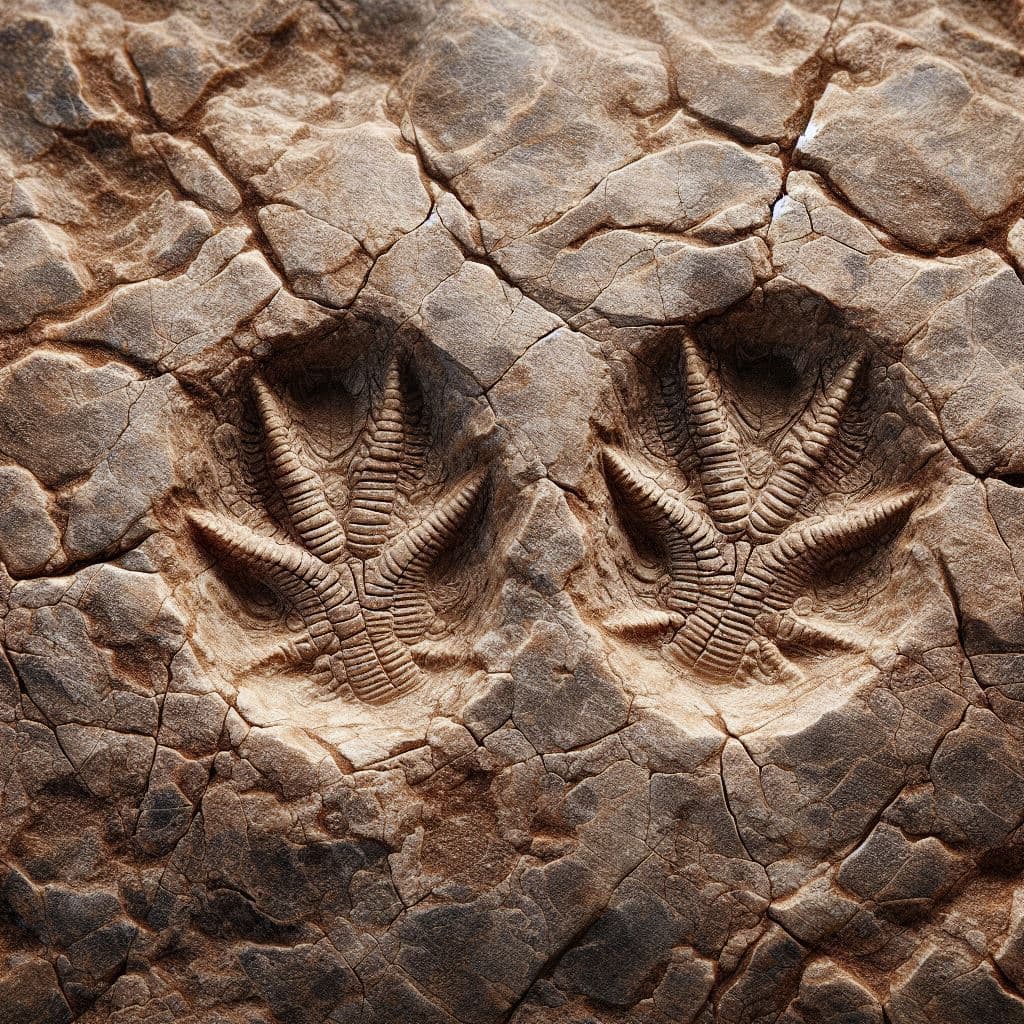
In the quiet layers of the Middle Jurassic Yaopo Formation, a pair of linked footprints was discovered on a roadside slope near Longquan town — each impression small, each toe slender, each a delicate fossilized trace of a life that once moved through lake-swamp terrain. One of the prints, barely 1.5 centimeters long and 1.3 centimeters wide, shows a fan-shaped paw with four pointed toes, identified through careful measurements and comparisons as likely belonging to a primitive salamander-like amphibian.
The discovery is remarkable not for its size but for its rarity. In the Beijing area’s Jurassic sediments, fossil footprints have previously been dominated by the shadows of dinosaurs and turtles. Amphibians — those small, soft-bodied creatures that bridge the worlds of water and land — left behind little direct evidence. These two prints break that silence, adding a new chapter to our understanding of ancient ecosystems in northern China.
Scientists studying the track used photogrammetric 3D modeling to create detailed digital images of the impressions, allowing subtle surface features to emerge with clarity. Such precision helps paleontologists determine how the animal walked, how it placed its feet, and ultimately what kind of creature might have made these marks. Through comparison with known skeletal structures and footprint patterns, the research team concluded the trackmaker most likely belonged to a salamander-like amphibian.
This find does more than fill a gap in the fossil record. It also paints a richer picture of the Middle Jurassic world in this region — a place where small terrestrial amphibians shared their habitats with ferns, ginkgos, cycads, dinosaurs, and turtles. Life at that time formed a complex web, with each organism leaving traces that, to us millions of years later, become clues in the puzzle of Earth’s deep past.
Perhaps most touching of all is how this discovery came to light. The fossil slab was first spotted by Ni Jingchen, a young fossil enthusiast still in school, whose curiosity led him to notice the subtle impressions on a rock slope during an outing. The discovery serves as a gentle reminder that some of the Earth’s oldest stories still lie quietly waiting — and that passionate observers, regardless of age, can help bring them to understanding.
In its final revealing of this ancient print, science affirms what many have long felt in gazing at the natural world: that even the smallest marks can tell profound tales of life long gone, bridging the vastness of time through a simple trace in stone.
In recent scientific reports published in the ichnology journal Ichnos, researchers detailed the footprints’ measurements, morphological features, and paleoecological significance. They underscore that this is the first scientifically described Jurassic amphibian footprint from both China and all of Asia, filling a notable void in paleontological records and helping researchers better understand the distribution and diversity of early amphibians.
AI Image Disclaimer “Graphics are AI-generated and intended for representation, not reality.”
Sources Xinhua / People’s Daily Online CGTN Global Times Anadolu Agency (via A News) BelTA
Published by Banx Network. This article is part of the Banx decentralized media programme, powered by the BXE token on the XRP Ledger.