There is a particular vulnerability in walking. The pedestrian trusts the crosswalk, the signal, the painted lines, the collective agreement that says this space is shared and safe. On Wednesday afternoon in Guelph, that trust was broken three times in less than two hours, a sequence of collisions that left three people in hospital and a city asking familiar questions about the fragile compact between drivers and those on foot .
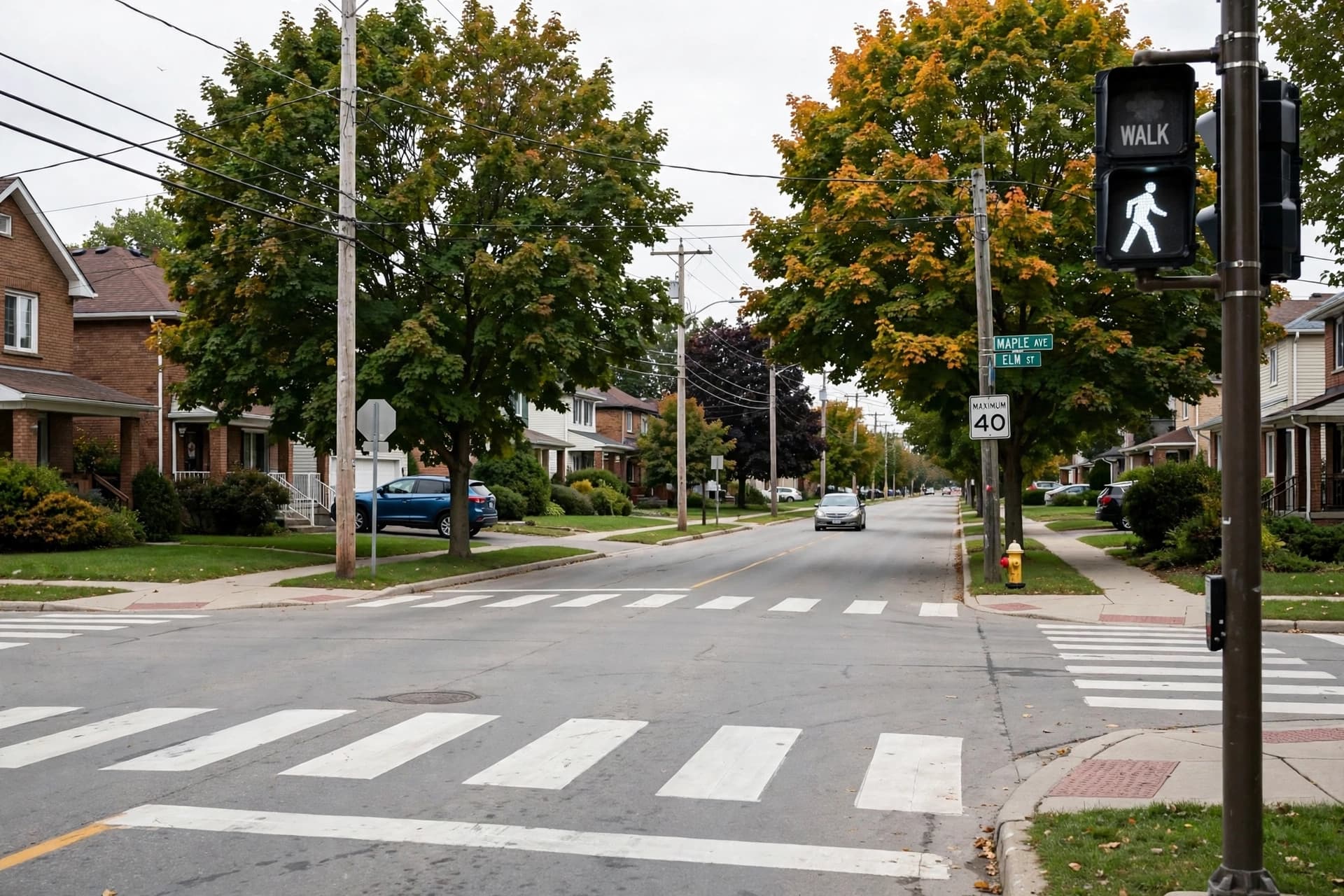
The first collision came just after 1:30 p.m. at the intersection of Cassino Avenue and William Street. A man in his twenties was crossing within the crosswalk when he was struck and taken to hospital with minor injuries . The second occurred at 3:15 p.m. at Gordon Street and Arkell Road, but the details arrived in an unusual way: a woman called police from Guelph General Hospital to report that she had hit a pedestrian and had decided to drive the injured person to the hospital herself. The victim had facial injuries . Minutes later, emergency crews were called to Eramosa Road and Stevenson Street North, where a woman in her seventies was crossing within a crosswalk and was struck by a driver making a left turn. She was transported to hospital with what was believed to be a broken arm .
Three drivers were charged under the Highway Traffic Act . None of the injuries were life-threatening, a detail that offers relief but does not erase the seriousness of what occurred. The fact that two of the three pedestrians were struck while using crosswalks is a detail that lingers, a quiet contradiction of the assumption that following the rules is enough.
Guelph Police used the incidents as an occasion for a reminder that is both ordinary and necessary. Road users were urged to slow down, stay alert, and make eye contact to clarify intentions . The language is standard, the kind of advisory that appears after every cluster of collisions. But the repetition itself is the point. The advice has not changed because the problem has not changed. People continue to be struck in crosswalks, and drivers continue to make turns without seeing what is in front of them.
There is something about the clustering of these events that deserves attention. Three collisions in under two hours is not a statistical inevitability; it is a pattern that suggests conditions, whether human or environmental, that made the afternoon unusually dangerous. The time of day, the light, the traffic volume, the particular intersections involved: all of these will be examined, and all of them matter. But the deeper question is one that no single investigation can answer. How does a city build streets where the most vulnerable users are not an afterthought?
For the three people in hospital, the answer is not abstract. One has a broken arm. One has facial injuries. One has minor injuries that may heal quickly or may not. The drivers face charges and whatever consequences follow. The city faces the quieter, harder work of asking whether its crosswalks are as safe as they appear, and whether the reminders it issues after collisions are enough to prevent the next one.
---
Image Disclaimer: All images in this article are AI-generated and are not actual photographs of the collisions or the individuals involved.
Sources: CTV News Kitchener, Guelph Today, Caught in Guelph
Published by Banx Network. This article is part of the Banx decentralized media programme, powered by the BXE token on the XRP Ledger.