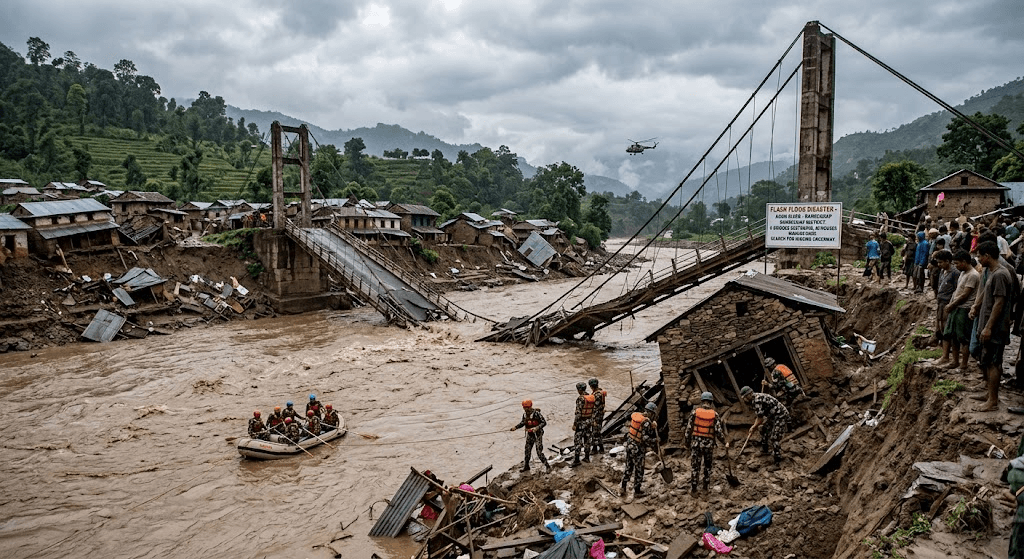
KATHMANDU — Torrential monsoon downpours triggered severe flash floods and landslides across eastern and central Nepal on Monday, October 12, 2026 sweeping away at least 40 homes, collapsing six vital bridges, and leaving up to 10 people missing in one of the region's worst weather-related disasters this season.
Swollen rivers overflowed their banks following hours of relentless rainfall, sending fast-moving currents of mud and debris roaring through riverbed settlements and hill towns.
The surge of floodwaters caused severe infrastructure damage by sweeping away six key bridges—including footbridges and motorable suspension spans—effectively cutting off remote mountainous communities from emergency access. In addition to the structural destruction, at least 40 houses were destroyed or washed away as foundation soils gave way to riverbank erosion and mudslides. Meanwhile, search and rescue teams are actively scouring downstream riverbanks and landslide zones for up to 10 individuals reported missing by local authorities.
Personnel from the Nepal Army, Armed Police Force, and local volunteer groups deployed across the hardest-hit districts to conduct emergency rescue and evacuation operations.
In several locations, responders were forced to use ropes and inflatable rafts to pull stranded residents to safety from rooftop structures surrounded by fast-moving floodwaters. Disaster management officials have set up temporary relief shelters in nearby school buildings and community halls to accommodate displaced families.
The destruction of crucial bridges and key highway sections has severed transport links between rural districts and regional centers, complicating relief distribution efforts.
Met Division meteorologists have issued warnings that continuous rains are expected to persist over the next 24 to 48 hours, raising water levels in major river systems. Authorities have urged communities residing in low-lying riparian areas and steep terrain to remain on high alert and evacuate to safer ground immediately.
International aid agencies and non-governmental organizations have begun coordinating with the Nepalese government to mobilize emergency supplies, including clean drinking water, medical kits, and temporary tarpaulins for shelter. As access routes remain blocked by debris and collapsed bridges, humanitarian teams are evaluating air-drop options for the most isolated mountain villages to prevent secondary crises like disease outbreaks and food scarcity.
Published by Banx Network. This article is part of the Banx decentralized media programme, powered by the BXE token on the XRP Ledger.