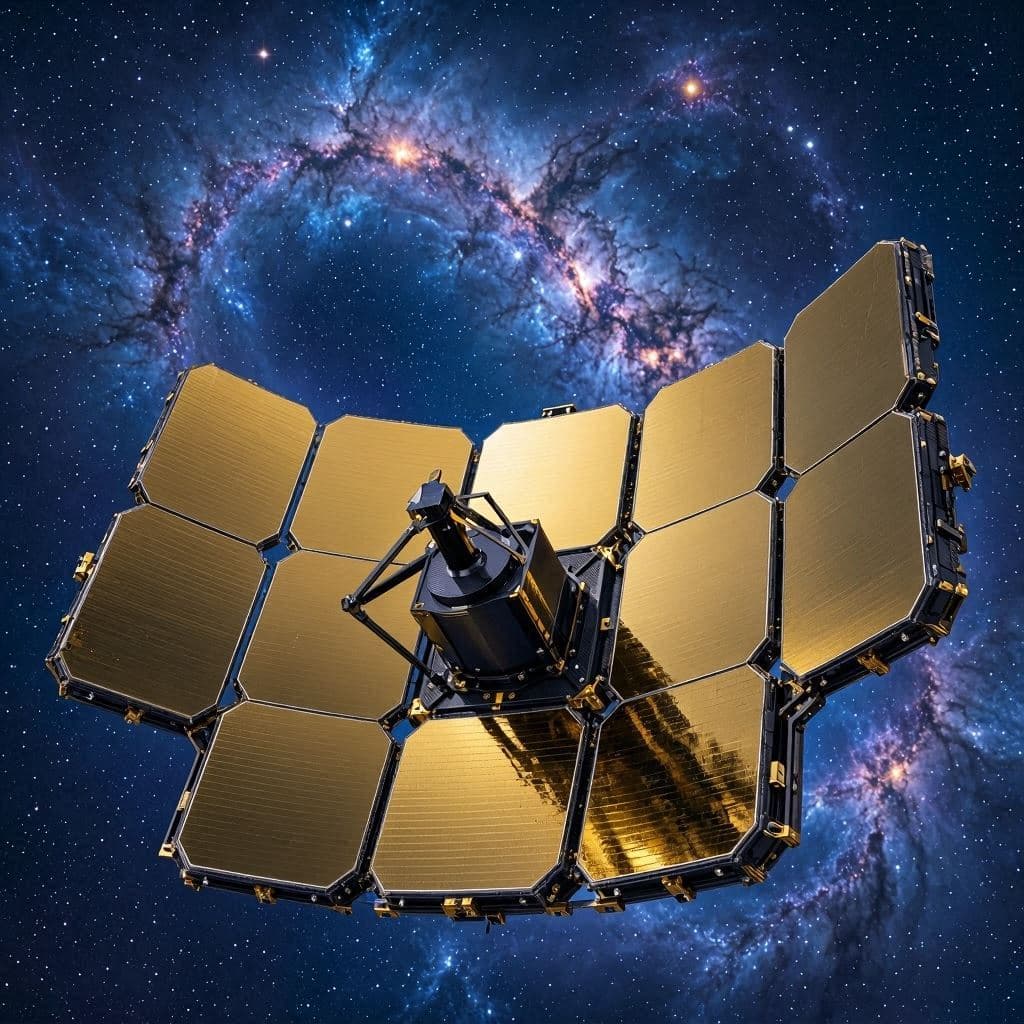
Human curiosity has always been directed upward, toward the silent expanse of the night sky. For centuries, we have peered through lenses and mirrors, seeking answers to questions about our origins and our place in the cosmos. Now, NASA is preparing to launch a new space telescope, designed to probe the deepest mysteries of the universe. This instrument represents not just a technological leap, but a continuation of our enduring quest for knowledge. It invites us to imagine what secrets lie hidden in the darkness, waiting to be revealed by light.
Body: The new telescope is equipped with advanced sensors capable of detecting faint signals from the early universe. Its primary mission includes studying dark energy and dark matter, the invisible forces that shape the structure and expansion of the cosmos. By observing distant galaxies and supernovae, scientists hope to understand why the universe is accelerating in its expansion. This research could fundamentally alter our understanding of physics and gravity.
Another key objective is the characterization of exoplanets. The telescope will analyze the atmospheres of planets orbiting other stars, searching for signs of water, methane, and other biomarkers. These observations bring us closer to answering the age-old question: Are we alone? Each spectrum analyzed is a step toward identifying potentially habitable worlds, expanding the horizon of possible life beyond Earth.
The engineering behind the telescope is a marvel of precision. Lightweight materials and deployable structures allow it to fit within a rocket fairing while unfolding to a size comparable to a tennis court in space. Active optics adjust the mirror segments in real-time to maintain perfect focus, compensating for thermal changes and mechanical stresses. This level of accuracy is essential for capturing the faint light of distant objects.
Collaboration plays a crucial role in the mission’s success. Scientists from around the world contribute to the design, data analysis, and interpretation of findings. This global effort reflects the universal nature of scientific inquiry, transcending borders and political differences. The telescope serves as a symbol of unity, reminding us that we share a common wonder about the universe.
Public engagement is also a priority. NASA plans to release stunning images and data sets that inspire awe and curiosity. Educational programs will help students and enthusiasts understand the science behind the discoveries. By sharing the journey, the agency hopes to ignite a new generation of astronomers and engineers.
Challenges remain, including the complexity of deployment and the harsh conditions of space. Every stage of the mission carries risk, from launch to operation. However, the potential rewards—new insights into the fabric of reality—are worth the effort. The telescope stands as a testament to human ingenuity and perseverance.
Closing: As the new telescope prepares for its journey, anticipation builds within the scientific community and the public alike. It promises to illuminate the unknown, turning mystery into understanding. In doing so, it reaffirms our commitment to exploring the final frontier.
AI Image Disclaimer: Visuals in this article are AI-generated representations of space telescopes and cosmic phenomena, intended to illustrate the themes of astronomical discovery and exploration.
Sources: NASA Official Website Space.com Scientific American The New York Times
Published by Banx Network. This article is part of the Banx decentralized media programme, powered by the BXE token on the XRP Ledger.