From the red, dusty plains of Mars, the sky offers a view that is both familiar and alien. The Sun appears smaller than it does from Earth, and the moons that circle the planet are mere specks compared to our own lunar companion. Yet, these small moons, Phobos and Deimos, play a significant role in the Martian sky. Recently, NASA’s Perseverance rover captured a striking image of Phobos passing directly in front of the Sun, a phenomenon known as a transit or eclipse. This event provides not only a visual spectacle but also valuable scientific data about the moon’s orbit and interior.
Phobos, the larger and closer of Mars’ two moons, orbits the planet so quickly that it rises in the west and sets in the east, completing a circuit in just about seven and a half hours. Its proximity to Mars means that it appears large enough to partially block the Sun, creating a mini-eclipse that lasts only a few seconds. Unlike total solar eclipses on Earth, where the Moon completely covers the Sun, Phobos is too small and irregularly shaped to block the entire solar disk.
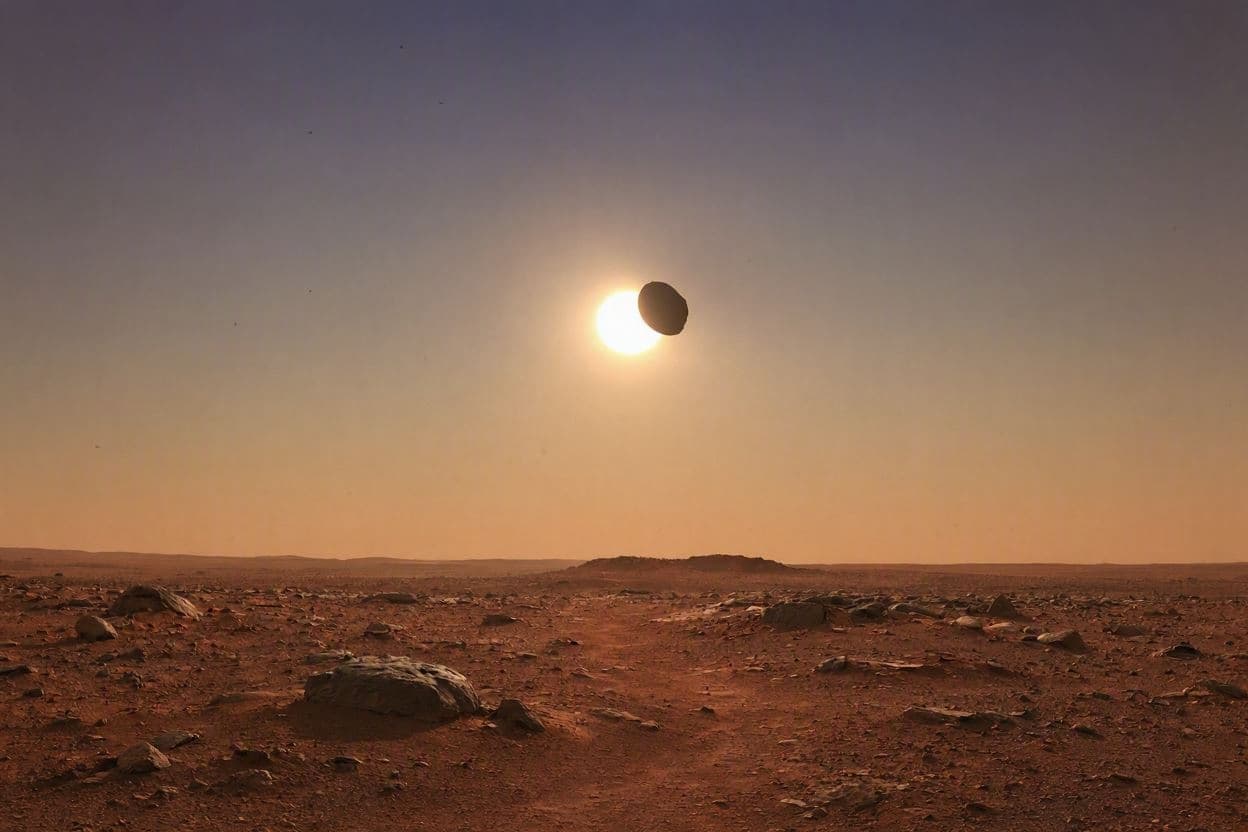
The image captured by Perseverance shows Phobos as a dark, potato-shaped silhouette against the bright face of the Sun. The jagged edges of the moon are clearly visible, highlighting its cratered and uneven surface. This visual detail helps scientists refine their models of Phobos’ shape and orientation, which are crucial for understanding its gravitational influence on Mars.
These transits are not just photographic opportunities; they are precise timing experiments. By measuring the exact moment Phobos blocks the Sun, scientists can track subtle changes in the moon’s orbit. Phobos is slowly spiraling inward toward Mars, driven by tidal forces, and is expected to either crash into the planet or break apart into a ring system in tens of millions of years. Monitoring its position helps predict this eventual fate.
Furthermore, observing the way sunlight passes around Phobos can provide clues about its internal structure. If the moon is a solid rock or a rubble pile held together by gravity, it may flex slightly under Mars’ gravitational pull. These tiny deformations can affect the timing of the transit, offering indirect evidence of the moon’s composition and density.
For the engineers operating Perseverance, capturing these events requires careful planning. The rover must be positioned correctly, and its cameras must be protected from the intense sunlight. The success of this observation demonstrates the versatility of the rover’s instruments and the skill of the team managing its operations from millions of miles away.
The public appeal of such images is also significant. They connect people on Earth to the daily experience of a robot on another world. Seeing the Sun through the eyes of Perseverance fosters a sense of presence and exploration, making the distant planet feel more accessible and real. It reminds us that we are not just sending machines to Mars, but extending our senses to another world.
As Perseverance continues its mission, it will likely capture more transits of both Phobos and Deimos. Each event adds to the growing dataset that helps us understand the Martian system. These small moons, though insignificant in size, hold key information about the history and future of the Red Planet.
The observation of a Phobos eclipse by the Perseverance rover highlights the scientific value of Martian astronomy. By tracking these transits, scientists gain insights into the moon’s orbit and structure, while also sharing the wonder of the Martian sky with the world. It is a small event with big implications for our understanding of Mars.
AI Image Disclaimer: The visuals accompanying this article are AI-generated representations designed to illustrate the perspective of a solar transit by Phobos as seen from the Martian surface.
Sources: NASA Jet Propulsion Laboratory The Planetary Society SpaceNews
Published by Banx Network. This article is part of the Banx decentralized media programme, powered by the BXE token on the XRP Ledger.