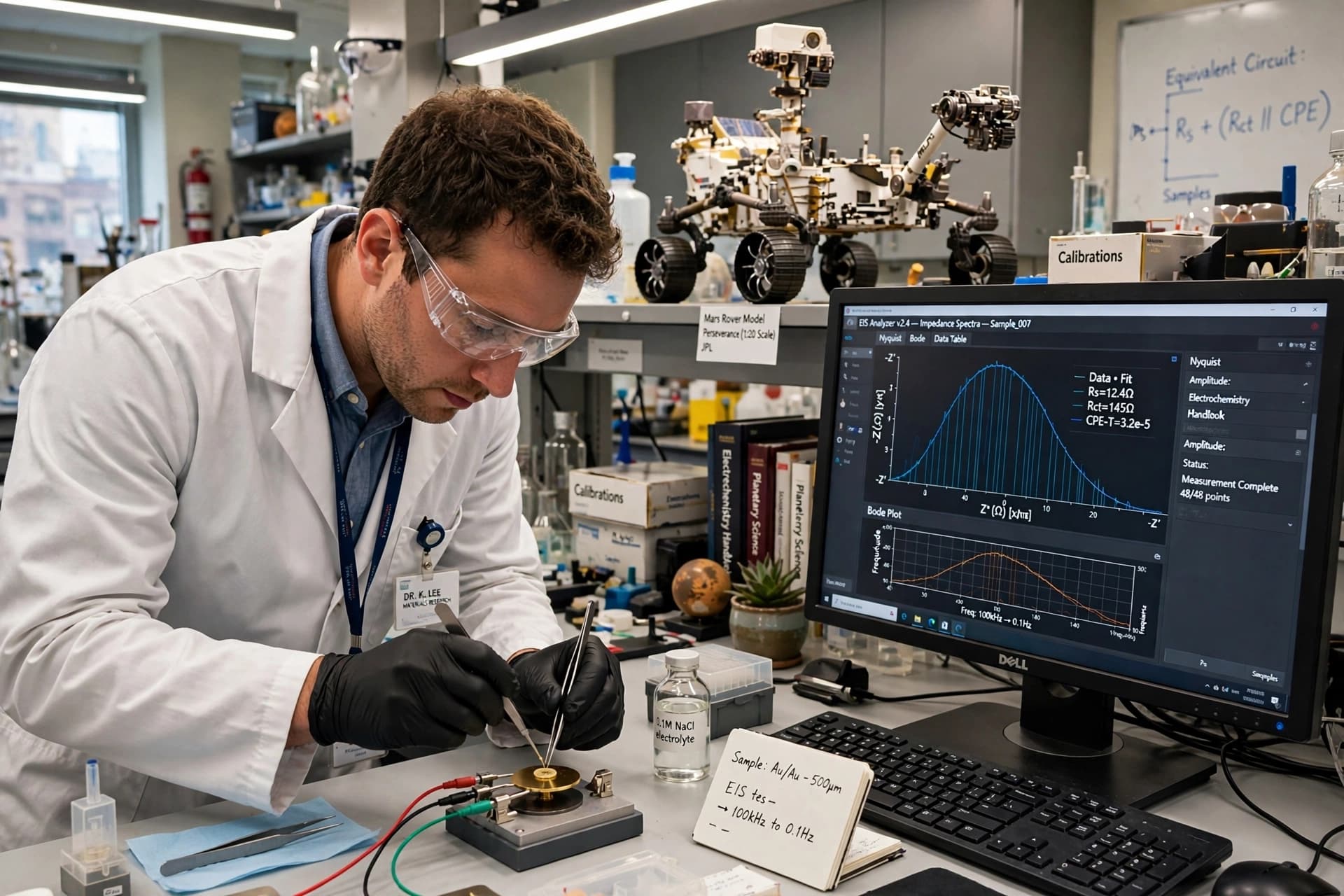
There is a particular elegance in a scientific method that uses what is already present—the electrical properties of living cells—to answer one of the oldest questions: is there life elsewhere? A new technique developed by researchers at the University of Maryland is using electrical signals to detect the presence of living organisms, a method that could one day be deployed on spacecraft to search for life on other planets. The approach, described in a paper published in the journal Nature Communications, relies on the fact that all living cells maintain an electrical potential across their membranes—a voltage that is a fundamental signature of life.
The technique, known as electrical impedance spectroscopy, works by applying a small electrical current to a sample and measuring how it responds. Living cells have a different electrical signature than non-living material, because their membranes act as capacitors, storing and releasing charge in a way that dead cells or minerals do not. By measuring the impedance of a sample across a range of frequencies, the researchers can distinguish between living and non-living material with high sensitivity .
The team tested the technique on a variety of samples, including bacterial cultures, fungal spores, and human cells. In each case, the living samples produced a distinctive electrical signature that was absent in sterilized or non-living controls. The method was also able to detect life in samples that were too dilute to be detected by conventional methods, suggesting it could be used to search for sparse microbial life in environments like Martian soil or the subsurface oceans of icy moons .
What makes the technique particularly promising for space exploration is its simplicity. Electrical impedance spectroscopy requires only a small sample, minimal power, and no reagents—making it well-suited for the constraints of a spacecraft instrument. It could be integrated into a rover or lander to analyze soil samples in situ, providing a quick and reliable test for the presence of life. The researchers are now working on miniaturizing the technology and testing it under conditions that simulate the extreme environments of space.
The search for life beyond Earth has traditionally focused on chemical signatures—organic molecules, isotopic ratios, or atmospheric gases. But electrical impedance offers a different approach: it detects the active, dynamic properties of living systems rather than the static chemical traces they leave behind. A living cell is not just a collection of molecules; it is a system that maintains a voltage across its membrane, that pumps ions, that responds to its environment. That activity is a more direct sign of life than any chemical remnant. The technique is not yet ready for a mission, but it represents a new way of thinking about how we might recognize life when we find it—or confirm that it is not there.
AI Image Disclaimer: All images in this article are AI-generated and are intended for illustrative purposes only.
Sources: Nature Communications, University of Maryland, Phys.org
Published by Banx Network. This article is part of the Banx decentralized media programme, powered by the BXE token on the XRP Ledger.