The Dream of Stopping Time
Imagine being diagnosed with a terminal illness in 2035.
Your doctors cannot save you with the technology available at the time.
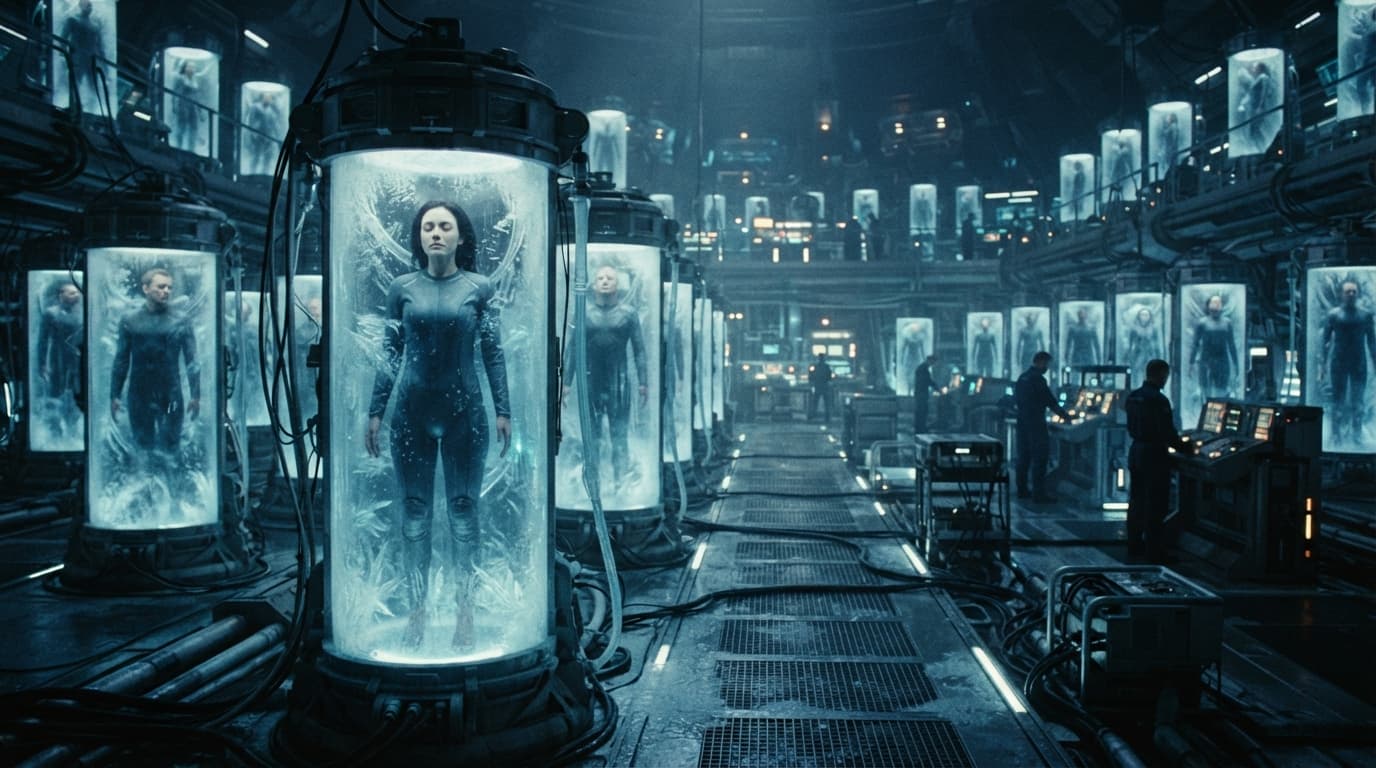
Instead of accepting death, you are placed inside a specialised preservation system.
Your body is cooled.
Biological activity slows almost completely.
You remain preserved for decades.
Then, in the year 2135, doctors have developed treatments capable of repairing your condition.
You are warmed.
Your cells begin functioning again.
You open your eyes.
To you, almost no time has passed.
To the rest of the world, a century has disappeared.
This is the basic idea behind cryostasis.
It is one of the most fascinating concepts at the intersection of medicine, biology and science fiction.
But there is an important distinction.
Human cryostasis capable of freezing and later reviving a living person does not currently exist.
What does exist is a growing field of research into preserving biological material at extremely low temperatures.
Understanding that science is the first step toward understanding whether the science-fiction version could ever become reality.
What Is Cryostasis?
The term cryostasis is often used broadly to describe a state in which biological processes are reduced or effectively halted through extreme cooling.
The concept is related to cryobiology, the study of how living organisms, cells and biological materials respond to very low temperatures.
At sufficiently low temperatures, chemical reactions slow dramatically.
This is why biological materials can sometimes be preserved for extended periods.
But there is a major problem.
Freezing water creates ice crystals.
And ice crystals can destroy cells.
When water inside or around a cell freezes, expanding ice can physically damage membranes and other structures.
Simply putting a human body into a freezer would therefore not preserve it.
It would cause catastrophic cellular damage.
This is one of the fundamental problems cryobiologists have spent decades trying to solve.
The Ice Problem
The human body contains a large amount of water.
That makes conventional freezing particularly dangerous.
When water turns into ice, its molecular structure changes.
Ice crystals can grow within biological tissues and physically disrupt cellular structures.
The damage becomes especially concerning in organs such as the brain.
Neurons are incredibly complex.
Their connections are responsible for memory, personality, perception and other aspects of human identity.
If those structures were extensively destroyed, simply warming the body would not restore the person.
The challenge therefore isn't merely:
How do we freeze a human?
It is:
How do we stop ice from destroying the biological information that makes the human body function?
Vitrification: Freezing Without Traditional Ice
One of the most important concepts in modern cryobiology is vitrification.
Instead of allowing water to form ordinary ice crystals, researchers use specially formulated cryoprotective solutions and carefully controlled cooling conditions to transform biological material into a glass-like state.
This process can dramatically reduce the formation of damaging ice crystals.
Vitrification has already become an important technique for preserving certain biological materials, including reproductive cells and embryos. [1]
The technique demonstrates something important:
Biological material does not necessarily have to be destroyed by extreme cold.
With the right conditions, some structures can remain remarkably well preserved.
But preserving a human being remains an entirely different challenge.
We Can Already Preserve Parts of Life
Cryopreservation is not theoretical.
Scientists and medical professionals routinely preserve certain biological materials at very low temperatures.
Sperm, eggs and embryos can be cryopreserved for medical and reproductive purposes.
Blood cells and other biological samples can also be stored using cryogenic techniques.
These successes demonstrate that cells can survive extremely low temperatures when the preservation process is carefully controlled.
But a human is not simply a collection of individual cells.
The body contains organs, blood vessels, connective tissues, nerves and enormous networks of biological interactions.
Preserving one type of cell is therefore vastly easier than preserving an entire organism.
The Organ Problem
One of the biggest areas of research is organ preservation.
If scientists could reliably preserve organs for extended periods, medicine could be transformed.
Imagine a world where donor organs could be stored for months or years rather than being limited by short transplantation windows.
A liver could be preserved until the right patient becomes available.
A heart could potentially be transported across continents without the same time pressure.
A kidney could be stored in a biological bank.
This would dramatically change transplantation.
Researchers are therefore investigating cryopreservation, vitrification and other techniques for preserving increasingly complex tissues and organs. [2]
The lessons learned could eventually contribute to much more ambitious forms of biological preservation.
The Brain Is the Biggest Challenge
If human cryostasis is ever possible, the brain may be the most important organ to preserve.
The brain contains approximately 86 billion neurons.
Those neurons communicate through enormous networks of connections.
These networks encode the information responsible for everything from learned skills to memories and aspects of personality.
Preserving the brain therefore requires more than keeping neurons physically intact.
Researchers would need to preserve the fine structures and molecular information associated with neural function.
This raises one of the deepest questions in cryonics:
What exactly needs to be preserved for a person to remain the same person?
Is it the neurons?
The synaptic connections?
The molecular structures?
The information encoded in the brain?
Or some combination of all of them?
Science does not currently have a complete answer.
Cryonics Is Not the Same as Cryostasis
The terms are often used interchangeably, but there is an important distinction.
Cryostasis, in the science-fiction sense, generally implies that a living person can be placed into a reversible state of suspended biological activity and later revived.
Cryonics refers to the preservation of legally deceased people with the hope that future technology might eventually be able to restore them.
That distinction matters.
No cryonics organisation has demonstrated the successful revival of a cryopreserved human being.
Cryonics is therefore based on the possibility that future science may eventually overcome today's limitations.
It is not currently a proven medical treatment.
The Problem of Rewarming
Even if scientists solved the freezing problem, another major obstacle would remain:
How do you safely warm a large biological structure?
Warming tissues unevenly can create additional damage.
Some areas may heat faster than others.
That can cause mechanical stress and potentially damage preserved structures.
Researchers therefore investigate sophisticated warming techniques designed to heat biological material rapidly and uniformly.
This becomes particularly difficult as the size and complexity of the preserved object increase.
Preserving a microscopic sample is one challenge.
Preserving an entire human body is another.
Could Nanotechnology Solve the Problem?
This is where cryostasis moves toward speculation.
One theoretical solution would involve extremely advanced nanotechnology.
Imagine microscopic machines capable of operating inside the body.
They could potentially repair damaged cell membranes, restore molecular structures, remove cryoprotectant chemicals and repair microscopic damage caused during preservation.
Such technology does not currently exist at the level required for human revival.
But nanomedicine is an active area of research, and scientists continue to investigate increasingly precise methods of manipulating biological systems.
If molecular-scale repair technologies become dramatically more advanced in the future, they could theoretically change what is possible with cryopreservation.
For now, however, this remains speculative.
Could Artificial Intelligence Help?
AI could also become an important part of future cryobiology.
Modern biological research generates enormous quantities of data.
Machine-learning systems can analyse molecular structures, predict interactions and help researchers identify promising compounds.
AI could potentially help scientists design better cryoprotectants or predict how different tissues respond to cooling and warming.
It could also model the enormous number of variables involved in organ preservation.
The future of cryostasis may therefore involve a combination of:
AI + cryobiology + nanotechnology + regenerative medicine.
None of these technologies alone is sufficient.
Together, however, they could eventually produce capabilities that are difficult to imagine today.
Could Regenerative Medicine Complete the Picture?
Suppose future researchers could preserve a human brain successfully but discovered that other tissues had suffered damage.
Advanced regenerative medicine could potentially provide another part of the solution.
Stem-cell technologies, tissue engineering and regenerative medicine are already being investigated for repairing damaged tissues and organs.
Future medicine could potentially combine biological preservation with regeneration.
A damaged organ might be repaired or replaced.
A damaged blood vessel could be regenerated.
A section of tissue could potentially be rebuilt.
This would change cryostasis from a preservation problem into a preservation-and-repair problem.
That may be a more realistic long-term pathway.
Suspended Animation Is a Different Possibility
There is another concept that is sometimes confused with cryonics.
Rather than freezing someone for decades, doctors could potentially place a patient into a temporary state of dramatically reduced metabolism.
This idea is sometimes described as suspended animation.
Researchers have investigated ways of slowing metabolism in medical emergencies.
One example is therapeutic hypothermia, which can reduce metabolic demand and is used in certain clinical situations.
Researchers have also investigated emergency preservation techniques designed to temporarily slow biological processes following severe trauma.
These approaches are not equivalent to putting someone in a cryogenic chamber for 100 years.
But they demonstrate that medicine can manipulate metabolism in ways that would once have seemed impossible.
The Spaceflight Connection
Cryostasis becomes even more interesting when space exploration enters the picture.
Humanity's first interstellar missions could potentially take centuries with conventional propulsion.
A crew travelling to another star would therefore face enormous challenges.
Food.
Radiation.
Psychological stress.
Life support.
Generational changes.
One theoretical solution would be to reduce the crew's biological activity during long journeys.
If humans could safely enter a reversible low-metabolism state, spacecraft could potentially carry people across enormous distances without requiring normal human life support for the entire journey.
This remains speculative.
But the concept has been explored extensively in scientific discussions about long-duration human spaceflight.
Could Humans Sleep Through a Journey to Mars?
Mars is far closer than another star.
Yet even a trip to Mars involves months of travel.
A future spacecraft might theoretically use some form of metabolic suppression to reduce resource requirements.
Less food would be required.
Less psychological stimulation might be necessary.
Crew members could spend significant periods inactive.
However, genuine human suspended animation has not been demonstrated.
Current spacecraft missions rely on astronauts remaining awake and functioning normally.
Cryostasis for space travel therefore remains a future concept rather than an existing technology.
The 2035–2050 Outlook
What could realistically happen over the next few decades?
By 2035
Cryobiology could make further progress in preserving increasingly complex tissues.
Organ preservation could become more sophisticated.
Researchers may improve vitrification and rewarming techniques.
AI could become increasingly important in designing cryoprotective chemicals and modelling biological damage.
But human cryostasis is unlikely to be routine medicine.
By 2040
Scientists could potentially preserve larger and more complex organs with greater reliability.
Advanced tissue engineering could begin combining preservation with regeneration.
Longer-duration organ storage could have major implications for transplantation.
Research into suspended animation may also progress.
By 2050
The most optimistic scenario could see major breakthroughs in whole-organ preservation and increasingly sophisticated methods for preserving complex neural structures.
However, the successful revival of a fully cryopreserved human would still represent a monumental scientific achievement.
There is no guarantee it will be possible by 2050.
It may take much longer.
It may even prove impossible.
What Would Successful Cryostasis Mean?
If humans could genuinely be preserved and revived, the consequences would be extraordinary.
Medicine could change completely.
A terminal diagnosis might no longer necessarily mean immediate death.
Patients could potentially be preserved until treatments become available.
People facing incurable diseases could theoretically wait for future therapies.
Space travellers could spend long periods in suspended states.
Scientists could potentially preserve biological specimens for extremely long periods.
Cryostasis could even change how humanity thinks about time.
A person born in 2000 could theoretically wake up in a world centuries removed from their own.
The Social Consequences
But successful cryostasis would create difficult questions.
Who pays for preservation?
Who owns a person's assets while they are preserved?
What happens to marriages and families?
Would a person who wakes up 100 years later still have legal rights to their property?
What happens to their identity?
Would they be considered the same legal person?
And what happens if someone wakes up in a society where their language, culture and technology have radically changed?
Cryostasis would not simply be a medical technology.
It could become a legal, economic and philosophical revolution.
The Inequality Problem
Another concern would be access.
If cryostasis initially cost hundreds of thousands or millions of pounds, only wealthy individuals might be able to afford it.
That could create a strange new form of inequality.
The wealthy could potentially preserve themselves for future medical advances.
Those without access would not have the same option.
If the technology eventually became reliable, governments could face difficult questions about whether long-term biological preservation should be treated as a healthcare service.
The economics of extending human life could become as important as the science.
Would the Person Who Wakes Up Still Be You?
This may be the most profound question of all.
Imagine that your brain is preserved.
A century later, scientists repair every visible structure.
Your memories appear intact.
Your personality appears unchanged.
You wake up.
Are you the same person?
From one perspective, the answer might seem obvious.
Your brain contains the information that made you who you were.
But philosophers have debated personal identity for centuries.
If the biological processes responsible for consciousness stopped for 100 years, would your subjective experience simply continue after the interruption?
Or would there be some deeper discontinuity?
Science cannot currently answer this.
Cryostasis therefore raises questions about identity that extend far beyond biology.
Could Cryostasis Defeat Death?
This is where the distinction between science and speculation becomes essential.
Cryostasis has not defeated death.
No adult human has been cryopreserved and subsequently revived.
No current technology can freeze a person, store them for decades and safely restore them to normal biological function.
What scientists have demonstrated is much more limited:
Cells can be preserved.
Embryos can be preserved.
Certain tissues can be preserved.
Some organs can be cooled and stored for extended periods.
These achievements are real.
The leap from those achievements to a revived human being is enormous.
The Information Problem
There may be another way to think about the challenge.
Perhaps the most important thing to preserve is not simply the body.
It is information.
The information contained in the brain determines who we are.
If the fine structure of the brain could be preserved with extraordinary accuracy, future technology might theoretically be able to repair physical damage while retaining that information.
This concept is still highly speculative.
Scientists do not yet know exactly how all human memories and aspects of identity are physically encoded.
But it suggests an important principle:
The future of cryostasis may depend as much on information preservation as temperature.
The Future Could Be Stranger Than Science Fiction
The idea of waking up in the future once seemed impossible.
Today, scientists can preserve embryos, cells and biological samples for long periods.
Researchers are improving organ preservation.
Advanced imaging can reveal structures inside the brain at remarkable levels of detail.
AI is transforming biological research.
Regenerative medicine is attempting to repair damaged tissues.
And nanotechnology continues to push toward increasingly precise control over biological systems.
None of these developments proves that human cryostasis will work.
But together they demonstrate that the boundary between biological preservation and science fiction is not necessarily fixed.
Three Possible Futures 1. Cryostasis Remains Impossible
The complexity of the human brain may prove too great.
Preservation could cause irreversible molecular damage that future technology cannot repair.
In this scenario, cryonics remains an interesting experiment but never becomes a genuine method of life extension.
2. Organ Preservation Comes First
Scientists may never develop whole-body cryostasis, but could become extremely successful at preserving organs.
This alone would transform medicine.
A future global organ bank could make transplantation faster, safer and more widely available.
3. Human Cryostasis Becomes Possible
The most extraordinary scenario would involve reliable preservation and revival of humans.
Such technology could potentially transform medicine, space exploration and our understanding of death.
But reaching that point would require breakthroughs across multiple scientific fields.
The Ultimate Question
Cryostasis sits at an unusual boundary.
Part of it is established science.
Part of it is experimental research.
And part of it remains firmly in the realm of speculation.
We know that extreme cold can slow biological processes.
We know that cells and embryos can be cryopreserved.
We know that vitrification can reduce destructive ice formation.
We know that researchers are making progress in organ preservation.
But we do not yet know whether an entire human can be preserved and successfully revived.
That may remain one of the greatest unanswered questions in future medicine.
Perhaps one day, a patient will enter a preservation chamber, knowing that the medicine of their era cannot save them.
Perhaps a century later, another generation of doctors will have the technology to repair what the first could not.
Or perhaps humanity will discover that some biological boundaries cannot be crossed.
For now, cryostasis remains a possibility rather than a proven technology.
But the research raises a remarkable question:
What if the future of medicine isn't simply about extending life—but about giving life the ability to wait?
References
[1] U.S. National Library of Medicine / National Center for Biotechnology Information — Research literature on cryopreservation and vitrification. Vitrification is widely investigated as a method of reducing ice-crystal formation during biological preservation.
[2] National Institutes of Health — Research on organ preservation and transplantation. NIH-supported research continues to investigate methods for extending the preservation window of organs intended for transplantation.
[3] Society for Cryobiology — Cryobiology and Cryopreservation Research. The Society for Cryobiology provides scientific information and research resources concerning the effects of low temperatures on biological systems.
[4] National Institutes of Health — Cryopreservation and Tissue Engineering Research. Research into cryopreservation, regenerative medicine and tissue engineering provides potential pathways toward improved preservation of complex biological materials.
[5] NASA — Human Research Program. NASA research examines the physiological challenges associated with long-duration human spaceflight, including approaches to reducing risks associated with extended missions.
[6] National Aeronautics and Space Administration — Research into long-duration spaceflight and human health. NASA investigates technologies and biological strategies that could support future exploration missions beyond low Earth orbit.
[7] National Institute of General Medical Sciences — Cell Biology and Cellular Preservation. Research into cellular structure and biological processes provides the scientific foundation for understanding how extreme temperatures affect living systems.
[8] National Institutes of Health — Regenerative Medicine Research. Stem-cell and regenerative medicine research investigates methods of repairing or replacing damaged tissues and organs.
[9] U.S. Food and Drug Administration — Regenerative Medicine and Advanced Medical Technologies. Provides information concerning the development and regulation of emerging regenerative medicine technologies.
[10] Society for Cryobiology — Cryonics and Cryopreservation. Scientific discussions distinguish established cryobiological preservation techniques from speculative claims concerning the future revival of cryopreserved humans.
Published by Banx Network. This article is part of the Banx decentralized media programme, powered by the BXE token on the XRP Ledger.