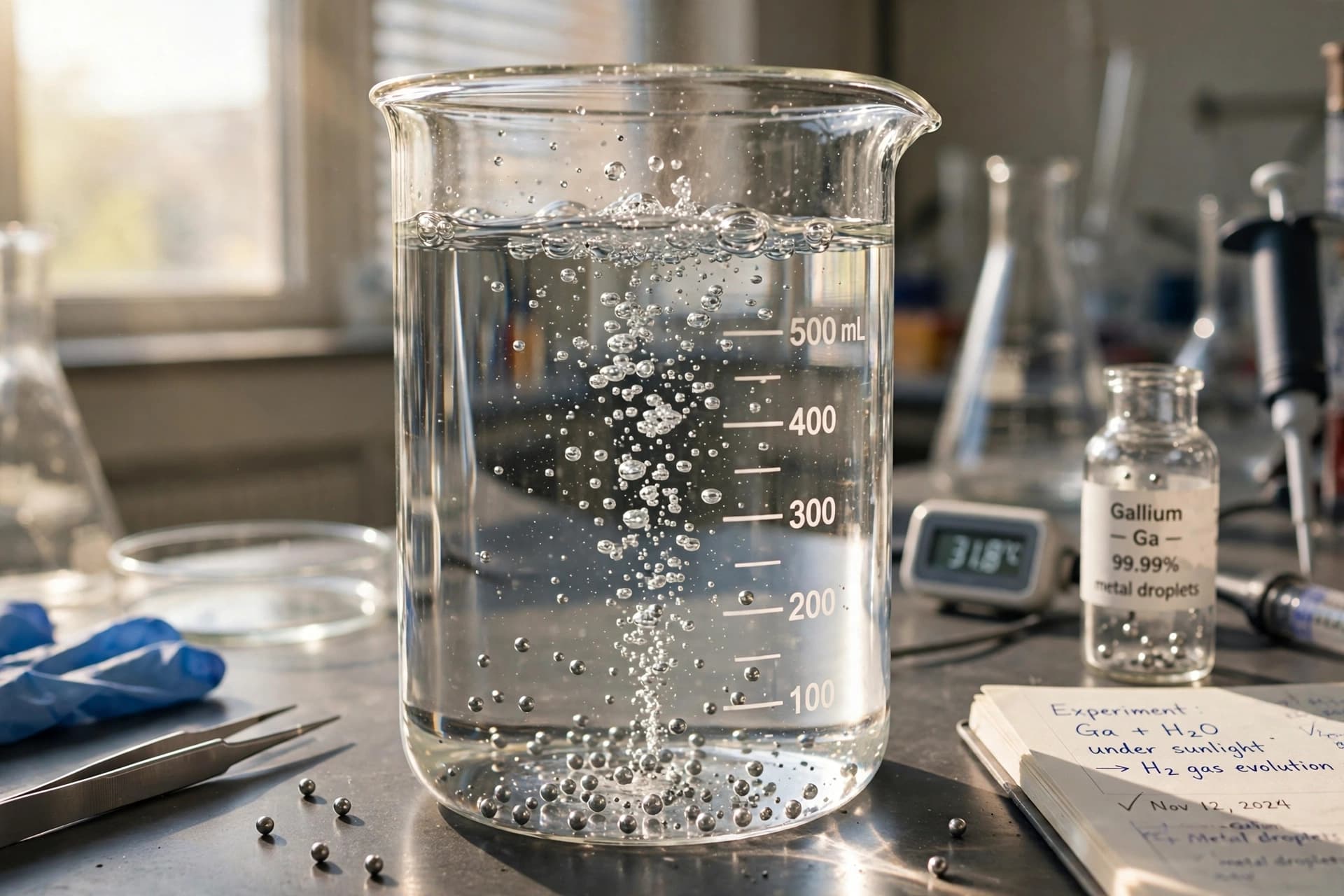
There is a particular elegance in a discovery that uses what is abundant to create what is needed—a process that takes sunlight, water, and a metal that melts in your hand, and produces a fuel that burns clean. In laboratories on opposite sides of the world, researchers have independently developed new methods for extracting hydrogen from water using light, each offering a different path toward the same goal: green hydrogen that does not require fossil fuels, scarce metals, or purified water to produce.
The first breakthrough comes from the University of Sydney, where researchers used liquid gallium—a metal that melts at just above room temperature—to split water molecules and release hydrogen. The process works by suspending gallium particles in either freshwater or seawater and activating them under sunlight. The gallium reacts with the water to become gallium oxyhydroxide and releases hydrogen. Crucially, the gallium oxyhydroxide can then be reduced back into gallium and reused, creating a circular process .
The team achieved a maximum efficiency of 12.9 percent. While that number may sound modest, lead researcher Professor Kourosh Kalantar-Zadeh placed it in context: "For instance, silicon-based solar cells started with six percent in the 1950s and did not pass 10 percent till the 1990s" . The method's advantage lies in its simplicity and its ability to use seawater, which is abundant, rather than requiring purified freshwater—a significant obstacle for conventional electrolysis. "We now have a way of extracting sustainable hydrogen, using seawater, which is easily accessible while relying solely on light for green hydrogen production," said lead author Luis Campos .
A second advance comes from Chalmers University of Technology in Sweden, where researchers have produced hydrogen using sunlight and tiny particles of electrically conductive plastic—without the scarce and expensive metal platinum that is typically required as a co-catalyst. Platinum reserves are limited and concentrated in a few countries, making it a bottleneck for widespread hydrogen production . The Chalmers team developed nanoparticles of conjugated polymers that are both light-absorbing and water-compatible. "With as little as one gram of the polymer material, we can produce 30 litres of hydrogen in one hour," said researcher Alexandre Holmes . The research leader, Professor Ergang Wang, described the achievement: "Developing efficient photocatalysts without platinum has been a long-standing dream in this field" .
The two approaches reflect a broader surge of innovation in solar hydrogen. A separate team, including researchers from Jagiellonian University, has developed a photocatalyst using single-atom nickel that can produce hydrogen from water without chemical additives—and works in seawater as well as freshwater. Their system achieved a production rate of 144 micromoles of hydrogen per gram per hour in North Sea water samples . And in August, Nature published research on polymer catalysts that achieve high efficiency for solar-driven hydrogen production .
Hydrogen is attractive as a fuel because its use produces only water as a by-product, yet most hydrogen today is made from fossil fuels. Green hydrogen—produced using renewable energy—has long been pursued as a solution, but the challenges of cost, efficiency, and the need for pure water have slowed progress. The new methods address each of these obstacles in different ways: gallium avoids the need for purified water, conductive polymers avoid platinum, and single-atom catalysts avoid chemical additives. None of these technologies is yet ready for commercial deployment at scale. The Sydney team is working toward a mid-scale reactor; the Chalmers group is exploring ways to eliminate the vitamin C that currently acts as a sacrificial additive. But together, they represent a quiet, incremental advance toward a fuel that could one day power a world without carbon emissions—produced from nothing more than sunlight and the water that covers most of the planet.
AI Image Disclaimer: The visual elements in this article were created using AI generation tools and are intended for illustrative purposes only.
Sources: EurekAlert!, Fapesp, National Science and Technology Council, Nature
Published by Banx Network. This article is part of the Banx decentralized media programme, powered by the BXE token on the XRP Ledger.