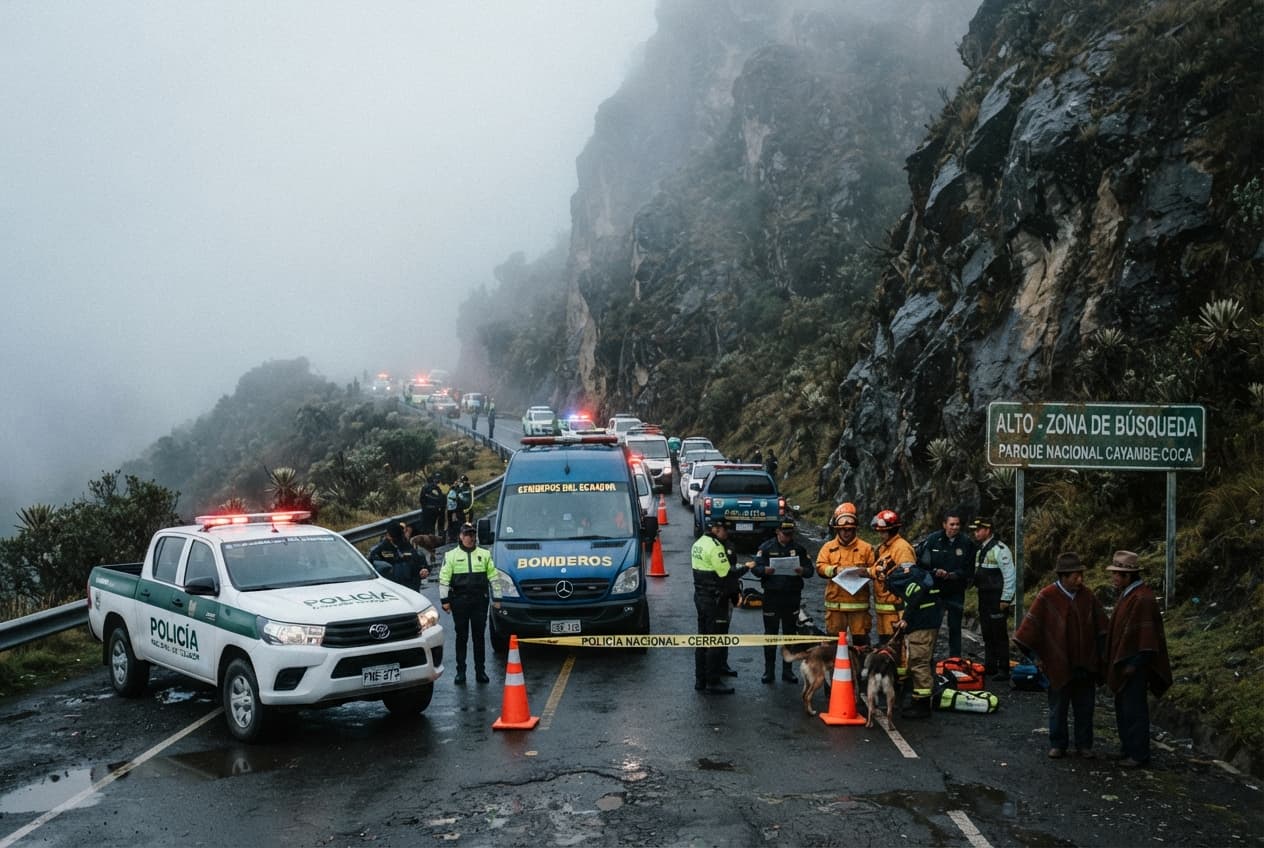
Quito, Ecuador—A long-distance passenger coach derailed from a winding mountain highway early Monday morning, tumbling hundreds of feet down a steep Andean embankment. The vehicle was making an overnight run between regional provinces when it careened off the edge of an unlit mountain pass. Local indigenous villagers living near the canyon floor were the first to reach the wreckage, using makeshift stretchers to carry survivors up the slope. Professional civil defense teams arrived shortly after, deploying rappelling ropes and rescue dogs to comb through the dense brush.
Paramedics established a triage post on the highway shoulder, treating travelers for severe polytrauma, hypothermia, and broken bones. Emergency helicopter units airlifted the most critically injured patients to specialized trauma facilities in the capital city. Transport officials confirmed that multiple passengers lost their lives during the violent descent, though official headcounts remained preliminary as extraction continued. Surviving passengers reported that the coach had experienced mechanical sluggishness on the uphill grades prior to the derailment.
Police restricted all traffic along the mountain corridor, stranding hundreds of commercial freight trucks and private cars on either side of the accident zone. Technical inspectors examined the gravel shoulder where the bus left the road, noting the complete absence of concrete barriers or warning reflectors. Representatives from the interprovincial transport cooperative declined to answer reporters' questions regarding driver shift logs and brake checks. Engineering experts warned that unstable soil conditions along the ravine could trigger secondary landslides during the recovery phase.
Families of the passengers gathered at the municipal terminal in the departure city, demanding passenger manifests and updates from company representatives. Rescue crews worked under floodlights through the evening hours to hoist deceased victims and heavy vehicle components from the canyon floor. Regional authorities announced an emergency review of safety standards for all high-altitude routes crossing the central mountain range. Prosecutors seized the vehicle's mechanical logbooks and black box data recorder to determine the exact cause of the catastrophic departure.
The accident highlights the persistent dangers associated with aging transport fleets operating on precarious Andean infrastructure during adverse weather. Health ministry coordinators declared red alerts across regional hospitals to ensure adequate bed capacity for incoming emergency victims. Police investigators urged eyewitnesses driving behind the coach to submit dashcam recordings to assist with the formal inquiry. Recovery operations remain active as crews attempt to clear the remaining structural debris from the mountainside.
Published by Banx Network. This article is part of the Banx decentralized media programme, powered by the BXE token on the XRP Ledger.