In the vast, sun-drenched plains of what we now call western North America, some 68 million years ago, a quiet presence moved through the ferns and cycads like a living fortress adrift in time. Triceratops, whose very name evokes "three-horned face," carried its crown of bone and horn with an almost serene dignity. It was not a creature of thunderous charge or ceaseless fury, but one that seemed to embody a certain steadfast patience, grazing amid the last golden days of the dinosaurs before the world turned.
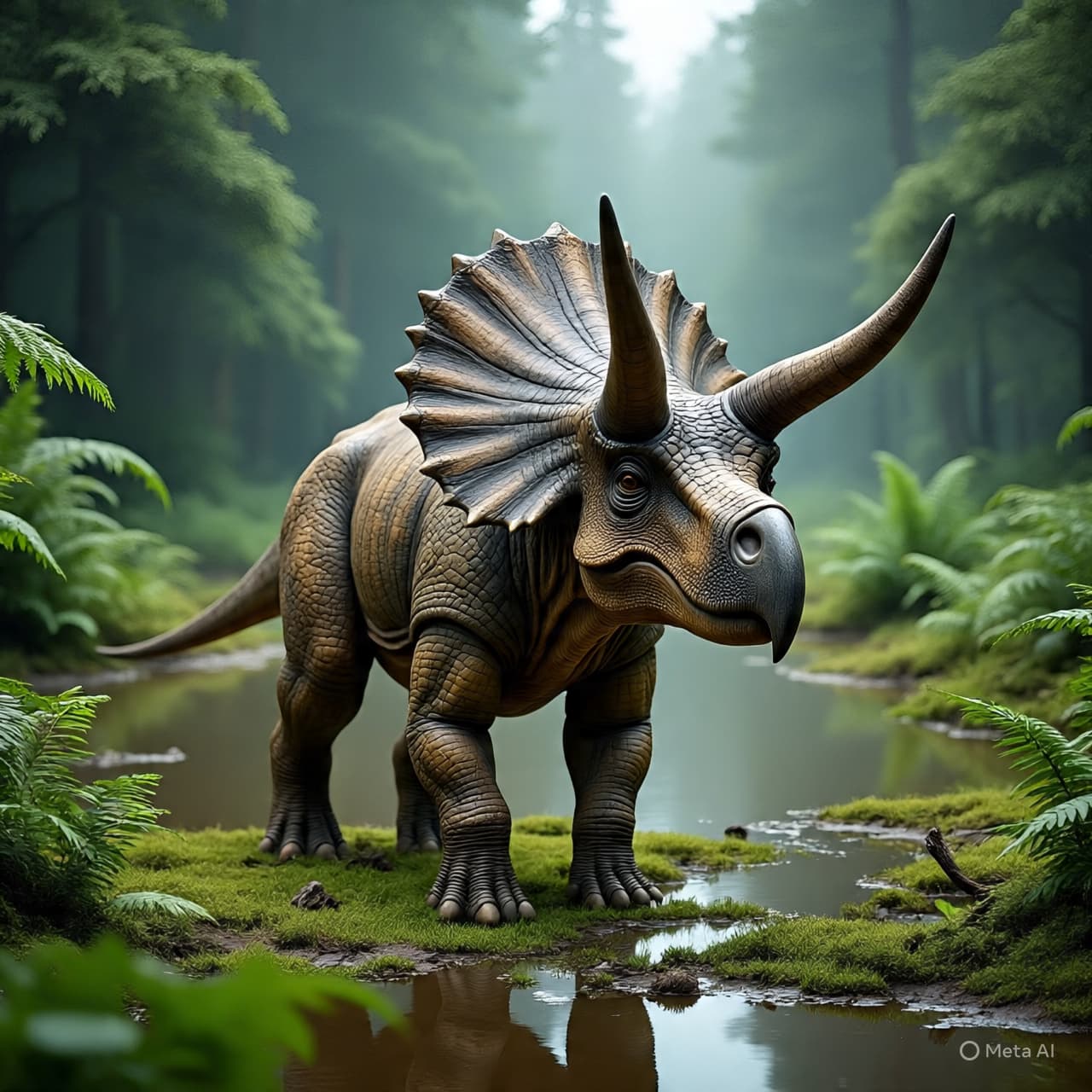
The body Picture this sturdy wanderer, stretching perhaps nine meters from beak to tail and weighing several tons, its massive body supported by pillar-like limbs that spoke of quiet strength rather than haste. At the forefront was its most striking feature: a broad, bony frill sweeping back like a shield from another era, flanked by two long brow horns curving upward in gentle menace, and a smaller nasal horn adding balance to the ensemble. This elaborate headgear, one of the largest among land animals, has long invited wonder. Was it armor against the formidable Tyrannosaurus that shared its landscape, leaving healed bite marks as quiet testimony to survival? Or perhaps a canvas for display, much like the antlers of modern deer, where size and form spoke volumes in the subtle language of kinship and choice?
Recent reflections from the fossil record suggest Triceratops may not have roamed entirely alone; discoveries of grouped juveniles hint at social threads, small gatherings that evoke a sense of community in an otherwise solitary-seeming life. Its beak, sharp and parrot-like, cropped tough vegetation with efficient grace, while batteries of shearing teeth worked tirelessly behind it. Living in the late Maastrichtian age of the Cretaceous, on the island continent of Laramidia, Triceratops thrived in a world of lush floodplains and towering conifers, a time when the earth still pulsed with reptilian majesty. Fossils abound in places like the Hell Creek Formation, where paleontologists continue to uncover layers of its story from hatchlings to weathered adults—reminding us how much remains to be gently revealed.
Yet even in its abundance, Triceratops carries an air of mystery. Debates linger over whether certain related forms represent growth stages or distinct kin, and healed wounds suggest encounters that were perhaps more ritual than relentless war. In these quiet details, we glimpse not just a dinosaur, but a reflection of life's enduring patterns: protection, display, survival, and the slow turn of generations.
Closing As the Cretaceous drew to its close around 66 million years ago, Triceratops stood among the final non-avian dinosaurs, its world forever altered by events beyond its horizon. Today, its fossils continue to surface, offering fresh glimpses into that ancient realm. Through careful study, scientists piece together the contours of its existence, inviting us to ponder the quiet grandeur of creatures that once walked where we now stand.
AI Image Disclaimer Visuals in this article are AI-generated illustrations created with AI tools and serve solely as conceptual depictions, not actual photographs.
Sources
• National Geographic
• Britannica
• Smithsonian Institution / National Museum of Natural History
• American Museum of Natural History
• Live Science
Published by Banx Network. This article is part of the Banx decentralized media programme, powered by the BXE token on the XRP Ledger.