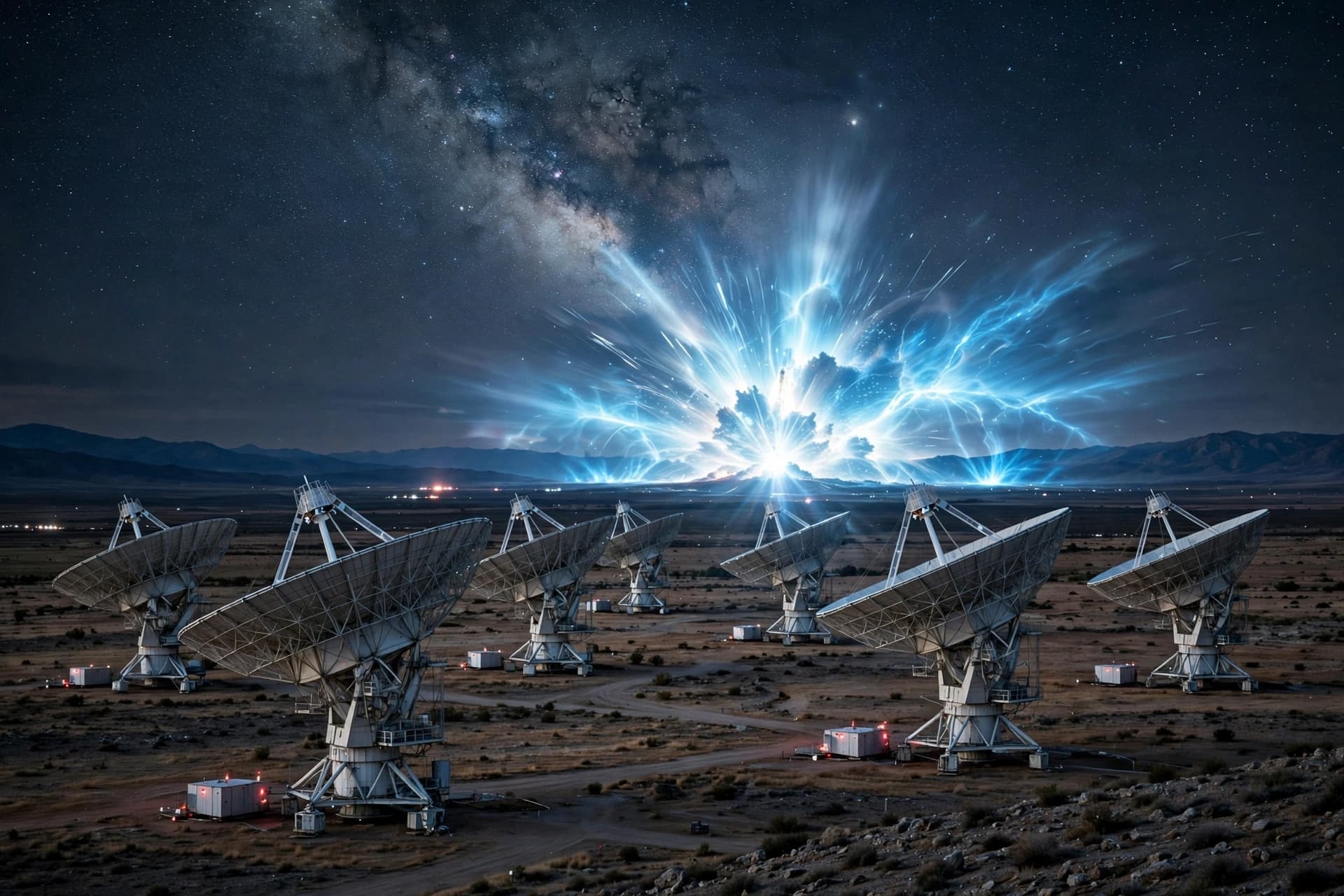
There is a particular wonder that accompanies the detection of something unexpected—a signal from the cosmos that does not fit the patterns we know, that arrives without warning, and that reminds us how much remains unknown about the universe we inhabit. Astronomers have detected a mysterious burst of energy from a distant galaxy, a phenomenon that has puzzled researchers and prompted a flurry of speculation about its origin.
The burst, classified as a fast radio burst (FRB), was detected by radio telescopes and lasted only milliseconds. But in that brief instant, it released more energy than the Sun emits in a day. What makes this particular burst unusual is its location. Most known FRBs originate from magnetars—highly magnetized neutron stars—in relatively nearby galaxies. This one came from a galaxy billions of light-years away, and its properties do not match the expected signature of a magnetar.
The discovery, published in The Astrophysical Journal, has led astronomers to consider a range of possible explanations. One possibility is that the burst came from a type of neutron star with extreme magnetic fields, but one that has not yet been observed directly. Another is that it originated from a more exotic object, such as a cosmic string—a theoretical structure left over from the early universe—or a black hole with unusual properties. None of these explanations is fully satisfactory, and the researchers are careful to note that more data is needed to determine what caused the burst.
Fast radio bursts have been detected since 2007, and their study is a relatively new field. The first FRB was discovered by accident, in archival data from the Parkes radio telescope in Australia. Since then, hundreds have been detected, and astronomers have learned that they are common throughout the universe. But the mechanisms that produce them remain uncertain, and each new detection adds to the puzzle.
What makes this particular burst significant is the challenge it poses to existing theories. If it was produced by a magnetar, it requires a magnetar with properties that have not been observed before. If it was produced by something else, it requires a new class of object or a new physical mechanism. The researchers are not claiming to have solved the mystery. They are presenting a detection, a set of data, and a question. The answer will require more observations, more analysis, and perhaps a new understanding of the universe's most energetic phenomena. For now, the burst remains what it was when it arrived: a signal from the darkness, a message without a sender we can identify.
AI Image Disclaimer: All images in this article are AI-generated and are intended for illustrative purposes only.
Sources: The Astrophysical Journal, Nature Astronomy, Space.com
Published by Banx Network. This article is part of the Banx decentralized media programme, powered by the BXE token on the XRP Ledger.