There is a particular distinction in a university laboratory that leads NASA missions—a distinction that speaks not just to the quality of the science but to the ability to manage complexity, to integrate instruments, to coordinate with international partners, and to deliver results that meet the exacting standards of spaceflight. At the University of California, Berkeley, the Space Sciences Laboratory has been doing exactly that for decades. Its latest mission, ESCAPADE, is a twin-spacecraft mission to study the Martian magnetosphere, and it exemplifies how a university lab can play a leading role in NASA's science program.
ESCAPADE, which stands for Escape and Plasma Acceleration and Dynamics Explorers, is a Small Innovative Missions for Planetary Exploration, or SIMPLEx, mission. It consists of two small spacecraft that will orbit Mars and study how the solar wind interacts with the planet's magnetic field and atmosphere. The mission is designed to understand the processes that drive the escape of atmospheric particles to space—a process that scientists believe transformed Mars from a wetter, warmer world to the cold, dry planet it is today. The mission is scheduled to launch in 2025 and will arrive at Mars in 2026.
The Space Sciences Laboratory's role in ESCAPADE is comprehensive. It is responsible for the overall mission management, the science operations, and the integration of the instruments. The lab has a long history of leading NASA missions, including MAVEN, which studied the Martian atmosphere, and THEMIS, which studied Earth's magnetosphere. The lab's expertise in space plasma physics and its ability to manage complex missions have made it a key partner for NASA, and its scientists have been involved in dozens of missions over the past five decades.
What makes the lab's role particularly notable is its location within a university. Unlike NASA centers, which are dedicated to spaceflight, the Space Sciences Laboratory is part of a university, and its scientists are also professors and mentors to students. The lab provides opportunities for graduate and undergraduate students to participate in mission design, instrument development, and data analysis—experiences that are difficult to replicate elsewhere. The lab's culture of innovation and its willingness to take on risky, high-reward missions have made it a model for how universities can contribute to space exploration.
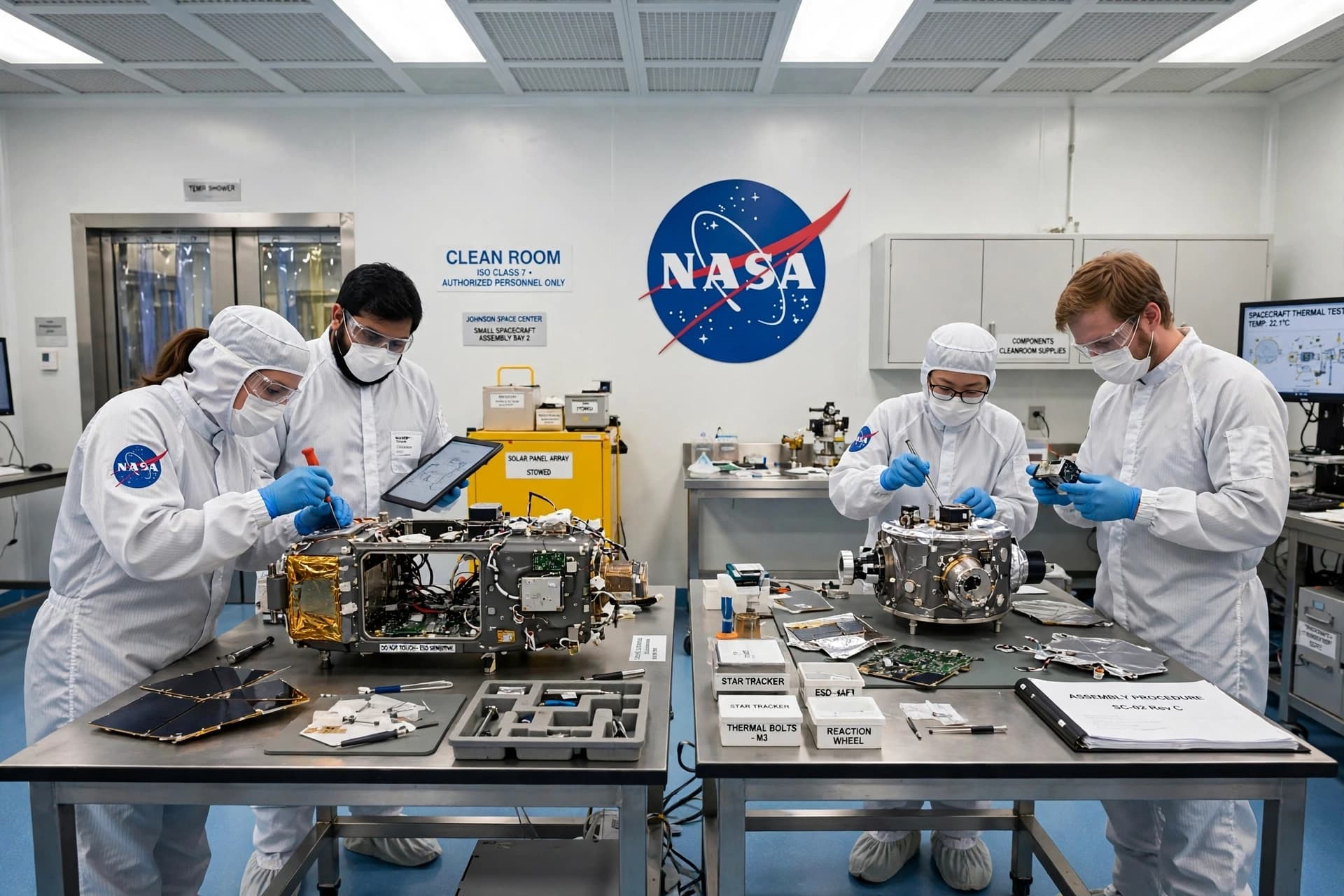
The ESCAPADE mission is a continuation of that tradition. It is a small mission, but its science goals are significant, and its success will depend on the lab's ability to manage the mission and deliver the data. The twin spacecraft are being built and tested, the instruments are being calibrated, and the team is preparing for launch. The lab's director, Stuart Bale, has said the mission represents the lab's commitment to exploring the unknown and to training the next generation of space scientists. The mission is underway. The launch is coming. And the lab, as it has for decades, is leading the way.
AI Image Disclaimer: The visual elements in this article were created using AI generation tools and are intended for illustrative purposes only.
Sources: University of California, Berkeley, NASA, Space Sciences Laboratory
Published by Banx Network. This article is part of the Banx decentralized media programme, powered by the BXE token on the XRP Ledger.