There is a particular complexity in the way living things respond to the temperature of their environment—a complexity that becomes more urgent as the planet warms, and as species are forced to adapt or move or perish. A new study of threespine stickleback, published in the Journal of Experimental Biology, has examined how developmental temperature affects the range of temperatures a fish can tolerate. The findings suggest that the ability to acclimate is not uniform across the thermal spectrum: lower limits show consistent plasticity, while upper limits do not.
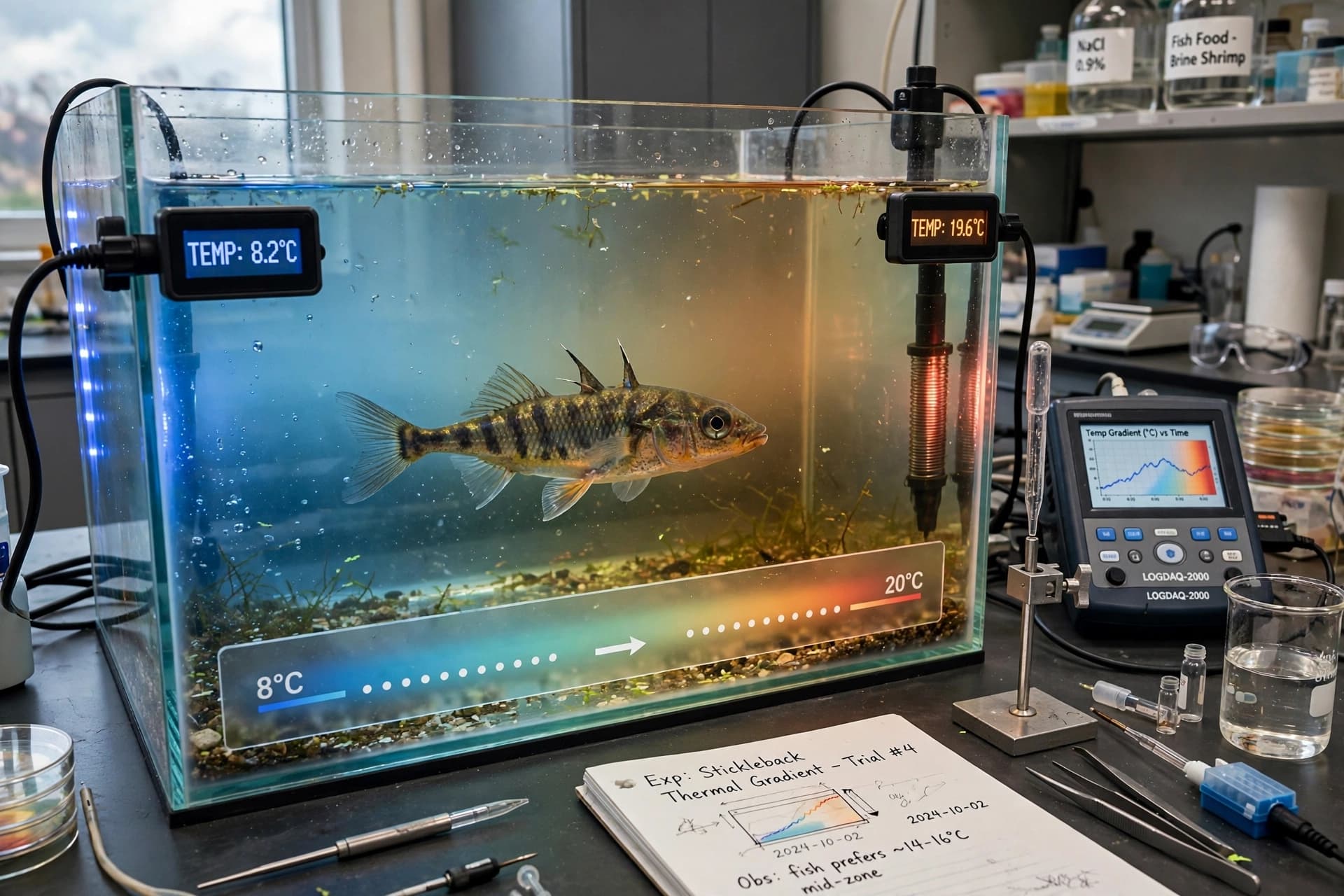
The study, led by researchers at the University of British Columbia, raised threespine stickleback at three different temperatures—14, 18, and 22 degrees Celsius—and then measured their critical thermal limits. The critical thermal minimum (CTmin) is the temperature at which a fish loses its ability to maintain equilibrium; the critical thermal maximum (CTmax) is the point at which it loses muscular control. Both are measures of how much heat or cold an organism can tolerate before its functions begin to fail. The researchers found that fish raised at warmer temperatures had higher CTmin—that is, they were less tolerant of cold—while fish raised at cooler temperatures had lower CTmin. This pattern was consistent across populations, suggesting that developmental plasticity in lower thermal limits is a general feature of the species. But CTmax showed no such pattern: fish raised at different temperatures had the same upper limits, regardless of their developmental environment. The upper thermal limit, in other words, appears to be fixed—a hard ceiling that does not respond to early-life conditions.
The findings have implications for how species may respond to climate change. If upper thermal limits are inflexible, then fish that are already living near their maximum temperature may be unable to acclimate to further warming. They will have to move, adapt genetically, or die. Lower thermal limits, by contrast, may be more plastic, allowing fish to adjust to cooler conditions if they can find them. The study adds to a growing body of research on the limits of acclimation, and on the factors that determine whether a species can survive in a changing world.
Threespine stickleback are a model organism in evolutionary biology, studied for their rapid adaptation to different environments. They are found in both marine and freshwater habitats across the Northern Hemisphere, and their populations have diverged in response to local conditions. The new study adds to that understanding, showing that the temperature at which a fish develops can shape its tolerance for cold, but not for heat. The distinction may seem small, but it carries large consequences—for the fish, for the ecosystems they inhabit, and for the scientists trying to predict what a warmer world will look like.
AI Image Disclaimer: All images in this article are AI-generated and are intended for illustrative purposes only.
Sources: Journal of Experimental Biology, University of British Columbia, Phys.org
Published by Banx Network. This article is part of the Banx decentralized media programme, powered by the BXE token on the XRP Ledger.